Super Smash Bros. for Nintendo 3DS and Wii U
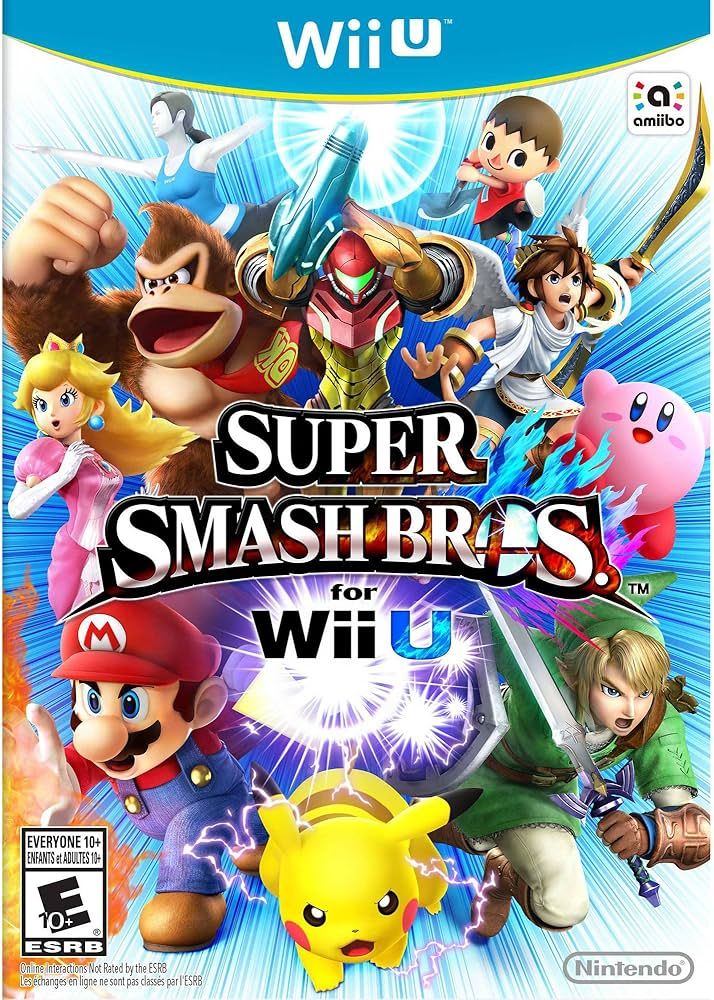
Super Smash Bros. for Nintendo 3DS and Wii U, often called Super Smash Bros. 4, is the fourth main entry in Nintendo's crossover fighting series. Released in 2014, it refined the platform fighter formula and became a major title in the competitive esports scene. Its roster of 58 characters and deep mechanics fostered a dedicated community that thrived until the release of its successor.
| Developer | Bandai Namco Studios and Sora Ltd. |
|---|---|
| Publisher | Nintendo |
| Release Date (3DS) | September 13, 2014 (Japan), October 3, 2014 (NA/EU) |
| Release Date (Wii U) | November 21, 2014 (NA), December 6, 2014 (Japan) |
| Platforms | Nintendo 3DS, Wii U |
| Genre | Crossover platform fighter |
| Base Roster | 51 characters |
| DLC Characters | 7 characters |
| Online Services Ended | April 8, 2024 |
Gameplay and Core Mechanics
As a platform fighter, the core objective is to knock opponents out of an arena. Attacks increase a character's damage percentage, making them fly farther when hit until they are launched off-screen for a knockout. The battlefield is filled with items from various video game franchises, including powerful Final Smash attacks triggered by Smash Balls and Assist Trophies that summon helper characters. The games are crossover titles featuring characters, items, music, and stages from numerous Nintendo and third-party franchises.
A significant competitive feature is the Omega form for stages. This transforms any stage into a flat, hazard-free layout with ledges on both sides, similar to the classic Final Destination stage, creating a standardized environment for serious matches. The game introduced extensive character customization, allowing players to modify special moves and equip stat-altering power-ups for existing fighters and custom Mii Fighters. These custom builds could be transferred between the 3DS and Wii U versions, as could certain items earned in specific modes. Players could also use Amiibo figures to train computer-controlled fighters.
The game's online multiplayer was structured around two main modes for playing with strangers. For Fun mode featured random stages and items with timed matches only, and omitted Omega stages. For Glory mode was designed for competition, featuring stock matches with no items exclusively on Omega stages. For Glory included both standard Smash battles and 1-on-1 duels, with player wins and losses recorded. Customized characters, Mii Fighters, and Amiibo could not be used in online matches against strangers. Online also included a Spectator Mode where viewers could bet on matches to win gold, and a Conquest mode where players supported selected characters by playing as them online to earn rewards.
Solo and Local Play Modes
Solo play featured the returning Classic mode, which included an intensity setting influenced by director Masahiro Sakurai's previous project, Kid Icarus: Uprising. Players could spend in-game currency to increase the difficulty for greater rewards. The Home-Run Contest from Melee returned with a new competitive variation for up to four players. Both versions shared two new modes. Target Blast tasked players with hitting a bomb into targets to cause chain reactions for points. Trophy Rush had players break falling crates to build a Fever meter and quickly earn trophies and customization items.
The game featured a Global Smash Power ranking system for solo mode scores, which showed how many other players a person had outscored rather than a leaderboard position. Although online matches lacked a formal ranking system, matchmaking attempted to pair players of similar skill levels. For local and online play with friends, all rules were fully customizable.
Version Differences and Exclusive Features
The Nintendo 3DS and Wii U versions were distinct experiences with their own content and technical specs. The 3DS version featured stereoscopic 3D graphics with optional cel-shaded outlines to improve character visibility. Its flagship exclusive mode was Smash Run, based on City Trial from Kirby Air Ride. In it, players explored an open environment to defeat enemies and collect power-ups before facing off in a randomly selected final match. The 3DS also had StreetSmash, a simple top-down fighting game activated via the system's StreetPass feature. It supported the New Nintendo 3DS's C-Stick for Smash Attacks but was incompatible with the Circle Pad Pro peripheral.
The Wii U version offered high-definition 1080p graphics and its flagship exclusive, 8-Player Smash, allowing for chaotic battles on select large stages, though this mode was not available online. It featured three exclusive new modes. Smash Tour was a board game-style mode where up to four players assembled a team of fighters. Special Orders presented a series of escalating challenges set by Master Hand and Crazy Hand where players risked losing accumulated prizes upon defeat. Event Mode offered themed challenges for one or two players. The Wii U version had vast controller support, including the Wii U GamePad, Wii Remote, Classic Controller, Wii U Pro Controller, and the GameCube controller via a special adapter. It also included creative tools like a Stage Builder and a Photo mode for creating dioramas with an SD card, and a Masterpieces gallery with demos of classic games.
The Evolving Roster and DLC
The game launched with 51 characters, introducing 17 newcomers. These included the Wii Fit Trainer, Villager from Animal Crossing, Rosalina & Luma and Bowser Jr. from Mario, Little Mac, Greninja, Palutena and Dark Pit from Kid Icarus, Lucina and Robin from Fire Emblem, Shulk, the Duck Hunt duo, Mega Man, Pac-Man, and the customizable Mii Fighter with Brawler, Swordfighter, and Gunner styles. Some characters like Wii Fit Trainer had gender variations. Returning fighters who were previously transformations, like Zelda and Sheik or Samus and Zero Suit Samus, became separate characters. Charizard returned as a solo fighter, while the Ice Climbers were cut due to 3DS technical limitations. Wolf and Solid Snake from Brawl were also absent.
Seven additional characters were released as downloadable content between 2015 and 2016. This included returning veterans Mewtwo, Roy, and Lucas. The DLC also introduced major third-party fighters: Ryu from Street Fighter, Cloud Strife from Final Fantasy VII, and Bayonetta. Corrin from Fire Emblem Fates was also added. Bayonetta was selected as the overall winner of a worldwide character ballot held between April and October 2015, ranking first in Europe and top five in North America. The ballot results for the most requested characters, including Sora and Banjo & Kazooie, were not revealed at the time to avoid complicating negotiations. The DLC is no longer available for purchase following the closure of the Nintendo 3DS and Wii U eShops in March 2023.
Development and Post-Launch Support
Development began in March 2012 after series director Masahiro Sakurai completed Kid Icarus: Uprising. The project was a collaboration between Sakurai's Sora Ltd. and Bandai Namco Studios, with staff from franchises like Tekken and Soulcalibur contributing. The game was first announced by former Nintendo CEO Satoru Iwata at E3 2011 and fully revealed at E3 2013.
Sakurai aimed to tune the gameplay to sit between the fast-paced, competition-oriented Super Smash Bros. Melee and the slower, more casual-friendly Super Smash Bros. Brawl. The game was one of the first to support Nintendo's Amiibo figures. Some features from previous games were removed, such as the story mode from Brawl.
Post-launch support included several updates. An April 15, 2015 update added online content-sharing features. A free Miiverse stage was added on June 14, 2015. An online tournament mode was introduced in a July 31, 2015 update. Online services for the game, including multiplayer, were discontinued on April 8, 2024. A subsequent issue preventing reinstallation of purchased 3DS DLC was fixed by April 17, 2024.
Legacy and Impact on Competition
Super Smash Bros. for Wii U quickly became the centerpiece of the series' competitive scene following its release. Its balanced gameplay, the standardized Omega forms, and the dedicated For Glory online mode provided a structured foundation for tournament play. The diverse roster, further expanded by DLC, ensured a wide variety of matchups and strategic depth. The game's mechanics, positioned between Melee and Brawl, appealed to a broad spectrum of players.
The game's competitive lifespan was sustained by major tournaments where it was a headline event. Its meta-game evolved significantly as players mastered techniques and explored the potential of each character, from early top tiers to later discoveries surrounding DLC fighters like Bayonetta and Cloud. The ability to customize special moves, though restricted in official online play, added another layer of theorycrafting and personalization for the community.
While the release of Super Smash Bros. Ultimate in 2018 largely succeeded it as the primary competitive title, Smash 4 left a lasting mark. It bridged the community between Brawl and Ultimate, introduced third-party characters like Cloud, Ryu, and Bayonetta to the series, and proved the viability of a more balanced, post-Melee Smash game at the highest level of esports. Its dedicated player base continued to host tournaments for years, confirming its place in fighting game history.
FAQ
When was Super Smash Bros. for Wii U released?
The Wii U version was first released in North America on November 21, 2014. It launched in Europe on November 28, 2014, in Australia on November 29, 2014, and in Japan on December 6, 2014.
How many characters are in Smash Bros. for Wii U and 3DS?
The game features a total of 58 playable characters. The base game included 51 characters on-disc, and an additional 7 characters were released as downloadable content between 2015 and 2016.
What is the difference between For Fun and For Glory mode?
For Fun mode features random stages and items, with only timed matches and Omega stages omitted. For Glory mode is for competitive play, featuring stock matches with no items exclusively on Omega stages, and it records a player's wins and losses from both standard and 1-on-1 battles.
Can you still play Smash 4 online?
No, online multiplayer and other online services for Super Smash Bros. for Nintendo 3DS and Wii U were officially discontinued on April 8, 2024.
Who was the last DLC character added to the game?
The final downloadable characters were Corrin from Fire Emblem Fates and Bayonetta, released on February 3, 2016, in North America. Bayonetta was chosen as the winner of a worldwide character ballot held by Nintendo.
Source: English Wikipedia (CC BY-SA), rewritten by the Redington Cybersport desk.