Super Smash Bros. Brawl
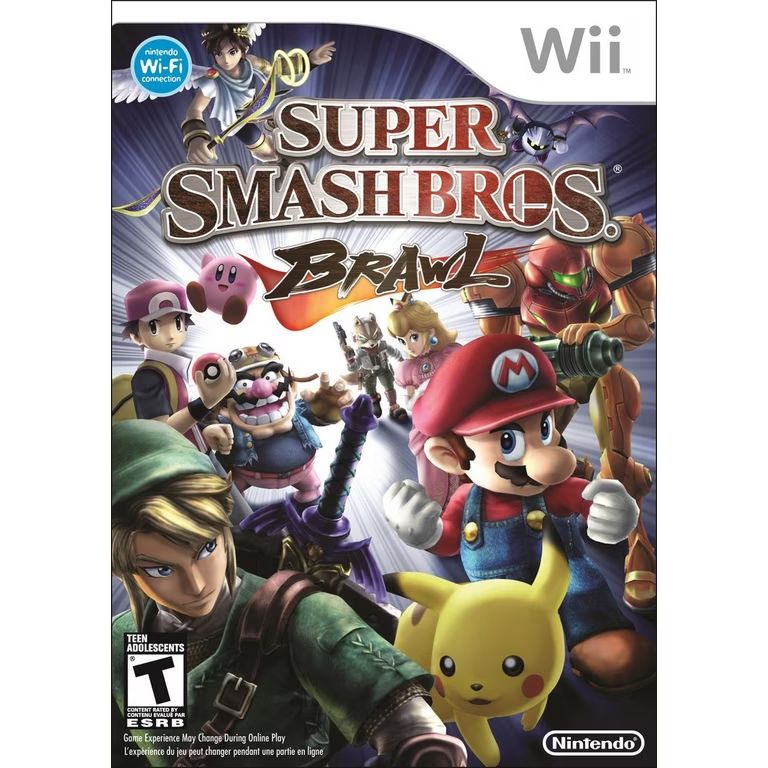
Super Smash Bros. Brawl is the third installment in Nintendo's popular platform fighting series, released for the Wii in 2008. It expanded the franchise with a large roster, a story-driven single-player campaign, and the series' first online multiplayer. The game was a critical and commercial success, selling over thirteen million copies worldwide.
| Developer | Sora Ltd. |
|---|---|
| Publisher | Nintendo |
| Director | Masahiro Sakurai |
| Platform | Wii |
| Release | January 31, 2008 (JP), March 9, 2008 (NA), June 26-27, 2008 (AU/EU) |
| Genre | Platform fighter |
| Modes | Single-player, multiplayer, online multiplayer |
| Predecessor | Super Smash Bros. Melee |
| Successor | Super Smash Bros. for Nintendo 3DS and Wii U |
Development and Release
Super Smash Bros. Brawl was announced at a pre-E3 2005 press conference by Nintendo president Satoru Iwata. It marked a shift for the series, being the first title not primarily developed by HAL Laboratory. Instead, a creative team under Sora Ltd., led by series director Masahiro Sakurai, was assembled with members from various Nintendo and third-party studios. Development began in October 2005 and faced several delays before its worldwide release in 2008, starting in Japan on January 31 and concluding in Europe on June 27.
The game was a major production, featuring a musical score composed by a collaboration of 38 video game composers. Its development allowed Sakurai to realize a more extensive single-player experience, a goal he had held for the series. The game's scope and polish were recognized upon release, with Brawl winning Fighting Game of the Year from the Academy of Interactive Arts & Sciences and later being included in the book 1001 Video Games You Must Play Before You Die.
Core Gameplay Mechanics
Brawl follows the series' signature platform fighting formula, where the objective is to knock opponents off the screen rather than deplete a health bar. Characters start with 0% damage, and as they take hits, their damage percentage increases. A higher percentage makes a character fly farther when struck, making them easier to launch out of the arena. Matches can be played with up to four combatants using various controllers, including the Wii Remote, GameCube controller, and Classic Controller.
The game introduced several new mechanics. The most notable is the Final Smash, a character-specific super attack activated by breaking a floating Smash Ball. These powerful moves can turn the tide of a battle. Brawl also expanded the item system with new additions and changes to returning ones. Assist Trophies and Poké Balls summon guest characters and Pokémon to aid the player, adding another layer of chaos to the fights.
Roster and Stages
The playable roster in Brawl grew from its predecessor, Super Smash Bros. Melee, though some Melee characters were cut. It is historically significant for introducing the series' first third-party characters. The selection includes classic Nintendo icons like Mario and Pikachu, alongside newcomers and guest fighters. Each character has its own set of standard attacks, special moves, and a Final Smash.
Brawl features 41 selectable stages, with 29 available from the start. Stages are dynamic, often changing layouts or featuring interactive elements like destructible terrain. For the first time, stages were based on third-party franchises, such as Metal Gear Solid's Shadow Moses Island. The game also includes a Stage Builder mode, allowing players to create and share their own battle arenas, which could be submitted online via the now-discontinued Nintendo Wi-Fi Connection.
The Subspace Emissary
A major addition to Brawl is its expansive single-player Adventure mode, titled The Subspace Emissary. This is a side-scrolling beat 'em up with a full narrative, explained through computer-generated cutscenes. The plot follows Nintendo characters banding together to fight the Subspace Army, led by the Ancient Minister. The mode features original enemies like the Primid, as well as bosses from Nintendo's history.
The Subspace Emissary can be played cooperatively with a second player. It incorporates a progression system using collectible stickers, which players can apply to character trophies to power up abilities within the mode. Scenario writer Kazushige Nojima, known for the Final Fantasy series, collaborated with director Masahiro Sakurai to construct the mode's storyline, making it a more fleshed-out narrative experience than previous Smash Bros. single-player offerings.
Multiplayer and Online Features
Brawl offers extensive local multiplayer options, including Special Brawl for matches with custom rules, and Tourney mode for elimination tournaments supporting up to 32 participants. A Rotation feature allows up to sixteen players to cycle in and out of matches. The game was also the first in the series to include online multiplayer via the Nintendo Wi-Fi Connection.
Players could battle with registered friends or random opponents online, communicating with preset phrases. A Spectator mode let players watch matches and bet on the outcome. The online service also allowed for sharing custom stages, snapshots, and replay videos through a Smash Service, which featured daily user-submitted content. These online functions, however, were discontinued on May 20, 2014.
Vault and Collectibles
The Vault serves as Brawl's collection hub, housing trophies and stickers. Trophies are collectible statues with descriptions of characters and items from gaming history. They are primarily earned through the Coin Launcher minigame, where players shoot coins to unlock them. Additional trophies can be captured in The Subspace Emissary using a Trophy Stand item, some of which provide backstory for the adventure mode.
Stickers are another collectible, consisting of video game artwork. Beyond being collected for completion, stickers have a functional use in The Subspace Emissary, where they can be applied to characters to enhance their stats. Players could also arrange trophies and stickers on virtual backgrounds to create snapshots, which were shareable online during the service's active period.
Legacy and Impact
Super Smash Bros. Brawl was a massive commercial success, becoming the eighth best-selling Wii game with over thirteen million copies sold. It received widespread critical acclaim for its content and entertainment value, despite some criticism for loading times. Its ambitious single-player campaign and introduction of online play set new benchmarks for the series.
The game's influence is lasting, having been followed by Super Smash Bros. for Nintendo 3DS and Wii U in 2014. Its role in popularizing the platform fighter genre and its status as a definitive multiplayer experience on the Wii confirm its place as a landmark title in both the Super Smash Bros. series and competitive gaming history.
FAQ
When was Super Smash Bros. Brawl released?
Super Smash Bros. Brawl was released in Japan on January 31, 2008, in North America on March 9, 2008, in Australia on June 26, 2008, and in Europe on June 27, 2008.
What is The Subspace Emissary?
The Subspace Emissary is Brawl's story-driven single-player Adventure mode. It is a side-scrolling beat 'em up with cutscenes, where players fight the Subspace Army. It can be played cooperatively and features a sticker system to power up characters.
Did Brawl have online multiplayer?
Yes, Brawl was the first game in the series to feature online battles via the Nintendo Wi-Fi Connection. This service allowed for matches with friends or random players, spectator mode, and sharing of custom content, but it was discontinued on May 20, 2014.
What is a Final Smash?
A Final Smash is a character-specific super attack introduced in Brawl. It is significantly more powerful than regular moves and is activated by destroying a floating item called a Smash Ball during a match.
How many characters and stages are in Brawl?
Brawl features an expanded roster from its predecessor, including the series' first third-party characters. It contains 41 selectable stages, 29 of which are available initially, with some based on third-party games like Metal Gear Solid.
Source: English Wikipedia (CC BY-SA), rewritten by the Redington Cybersport desk.