Super Smash Bros. Ultimate
Super Smash Bros. Ultimate is the definitive crossover fighting game for the Nintendo Switch, released in 2018. It is the best-selling fighting game of all time and a major competitive title in esports.
| Developer | Bandai Namco Studios and Sora Ltd. |
|---|---|
| Publisher | Nintendo |
| Release Date | December 7, 2018 |
| Platform | Nintendo Switch |
| Game Director | Masahiro Sakurai |
| Base Roster | 74 playable fighters |
| Total Roster (with DLC) | 89 playable fighters |
| Copies Sold (as of Dec. 2025) | Over 37 million |
| Main Theme | "Lifelight" by Hideki Sakamoto |
The Ultimate Platform Fighter
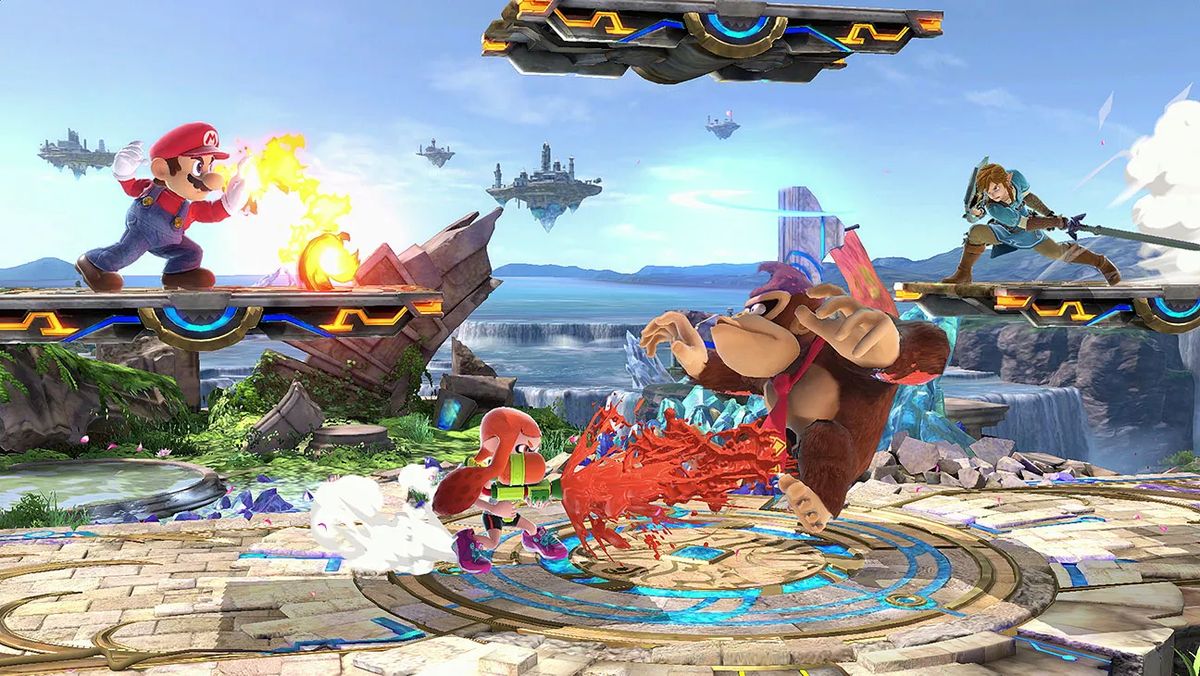
Super Smash Bros. Ultimate is a platform fighter where players control characters from across video game history to knock opponents out of an arena. The core mechanic is a percentage meter that increases as a character takes damage, making them easier to launch. Matches can be played with up to eight players under various rulesets, including Timed matches for the most KOs, Stock matches with limited lives, and Stamina battles with hit points. Players have extensive control, able to toggle items, stage hazards, and special attacks like Final Smashes on or off to create their ideal competitive or casual environment.
The game features an enormous selection of 103 base stages, plus one added in a free update. Each stage has dynamic elements, but for competition, any stage can be set to a standardized Battlefield or Omega form. The Stage Morph function allows two selected stages to alternate during a match. Ultimate also refines character-specific mechanics with clear on-screen gauges, such as for Cloud Strife's Limit Break. These systems provide the depth and consistency that form the foundation of its competitive scene.
In addition to standard battles, Ultimate includes several specific multiplayer modes. Smashdown restricts each character to a single use per session. Squad Strike allows battles with teams of three or five characters. The Tourney mode supports playoff brackets for up to 32 players. The game also supports the use of items like Poké Balls and Assist Trophies, which summon helper characters, though these are typically disabled in organized competition.
A Historic Roster of Fighters
The game's defining achievement is its massive roster, which includes every fighter from the series' history. The base game offers 74 characters, comprising all 63 veterans from past games and 11 newcomers. These newcomers include the Inklings from Splatoon, Princess Daisy and King K. Rool from the Mario and Donkey Kong series, Ridley and Dark Samus from Metroid, Simon and Richter Belmont from Castlevania, Chrom from Fire Emblem, Isabelle from Animal Crossing, Ken Masters from Street Fighter, and Incineroar from Pokémon.
Characters with very similar movesets are classified as Echo Fighters, such as Princess Daisy and Dark Samus, offering subtle variations. Some characters, like Bowser Jr., have alternative skins that represent different characters, such as the other Koopalings, but use identical moves. Unlocking the full roster is a core part of the initial experience, achieved through playing Classic mode, the World of Light adventure, or a set number of battles, starting with only the original eight fighters from the first Super Smash Bros. game.
This already vast selection was expanded significantly through downloadable content. A free fighter, Piranha Plant from the Mario series, was offered in January 2019 to early purchasers. This was followed by two Fighters Pass bundles. The first added five fighters: Joker from Persona 5, the Hero from Dragon Quest, Banjo & Kazooie, Terry Bogard from Fatal Fury, and Byleth from Fire Emblem. The second and final pass added six more: Min Min from ARMS, Steve from Minecraft, Sephiroth from Final Fantasy VII, Pyra and Mythra from Xenoblade Chronicles 2, Kazuya Mishima from Tekken, and Sora from Kingdom Hearts in October 2021. In total, the game features 89 playable fighters.
Modes and the Spirit System
Beyond standard versus battles, Ultimate includes a wealth of game modes. It brings back classics like Classic mode, Special Smash, and the Home-Run Contest, which was added in a post-launch update. The single-player and collection experience is anchored by the Spirits system, which replaces the trophies from earlier games.
Spirits are collectible representations of characters from various franchises. They are primarily earned by winning special Spirit Battles, which are themed challenges where conditions mimic the Spirit's character. For example, the Rayquaza Spirit battle involves fighting a giant, similarly colored Ridley with wind effects. Spirits can be equipped to power up a fighter with specific abilities, strategically chosen to counter a battle's conditions. They can be leveled up, enhanced into a stronger form, or converted into Cores to summon new ones. A rotating Spirit Board offers more battles to collect them.
This system is central to the World of Light adventure mode, a lengthy campaign where players explore a map to rescue captured fighters and Spirits. The narrative involves the entity Galeem destroying the world, with only Kirby escaping. Players use regained allies and Spirits to overcome challenges, eventually confronting Galeem and a second entity, Dharkon. The final outcome depends on which spirits are freed, leading to different endings.
Development and Creative Vision
Development began in earnest after work on the previous game's DLC concluded in 2015, with the project plan in place by December of that year. Series creator Masahiro Sakurai returned as director, leading the same core teams from Bandai Namco Studios and Sora Ltd. This continuity sped up the preparation process. The development period was shorter than for previous series entries, with additional assistance from companies Hatena and tri-Crescendo.
Sakurai has stated that creating a Smash Bros. game for the Switch was a final request from the late Nintendo president Satoru Iwata, a motivation that drove the project. The central, ambitious goal was to include every past fighter, a complex task involving both development hurdles and licensing negotiations that increased costs. The return of the established development teams made this ambitious roster possible. The game was first teased in a Nintendo Direct in March 2018 and was a primary focus of Nintendo's E3 presentation that June before its December release.
The game's extensive soundtrack features over 900 music tracks, with the main theme "Lifelight" composed by Hideki Sakamoto. Several other well-known video game musicians contributed. The game was met with critical acclaim for its polished gameplay and large amount of content, though its online mode faced criticism for technical issues. Ultimate is the best-selling fighting game ever and is also a major title in competitive esports.
Competitive and Technical Features
Ultimate supports a wide array of play options crucial for both casual and competitive scenes. It features local multiplayer, local wireless play, and online play via Nintendo Switch Online using Wi-Fi or LAN connections. The online mode allows players to earn in-game currency for victories, which can be spent on Spirits, music, and Mii Fighter costumes. For competitors, the game supports LAN play and is compatible with Joy-Con, the Nintendo Switch Pro Controller, and GameCube controllers via a USB adapter.
Post-launch updates continually added features for players to engage with. Version 3.0 introduced a Stage Builder for creating and sharing custom arenas through the Switch Online service, as well as a replay editor for analyzing and sharing matches. These edited replays are also available in the Smash World smartphone app, which lets players check stats and share images and videos. Other updates added limited VR support via the Nintendo Labo VR Kit for viewing matches and a special 1-on-1 mode.
The game also supports amiibo figurines to create trainable AI-controlled Figure Players. With its refined mechanics, vast character selection, and dedicated community support tools, the game maintains a strong competitive presence. Its status as one of the best-selling games on the Nintendo Switch, with over 37 million copies sold, reflects its broad appeal and lasting impact on the fighting game community.
FAQ
How many characters are in Super Smash Bros. Ultimate?
The base game includes 74 playable fighters. With all downloadable content added through October 2021, the total roster expands to 89 characters, including every fighter from the series' history.
What is the World of Light?
World of Light is the single-player adventure mode in Ultimate. It integrates the Spirits system into a story where players explore a map, complete Spirit Battles to rescue captured fighters, and confront the entities Galeem and Dharkon.
What are Echo Fighters?
Echo Fighters are characters with movesets and proportions very similar to another fighter, but with their own animations and slight gameplay differences. Examples include Princess Daisy (based on Peach) and Dark Samus (based on Samus).
When did Super Smash Bros. Ultimate come out?
Super Smash Bros. Ultimate was released worldwide for the Nintendo Switch on December 7, 2018.
Who was the last DLC character added to the game?
Sora from the Kingdom Hearts series was the final downloadable fighter added to Super Smash Bros. Ultimate, released in October 2021 as part of the second Fighters Pass.
Source: English Wikipedia (CC BY-SA), rewritten by the Redington Cybersport desk.