2010 FIFA World Cup South Africa
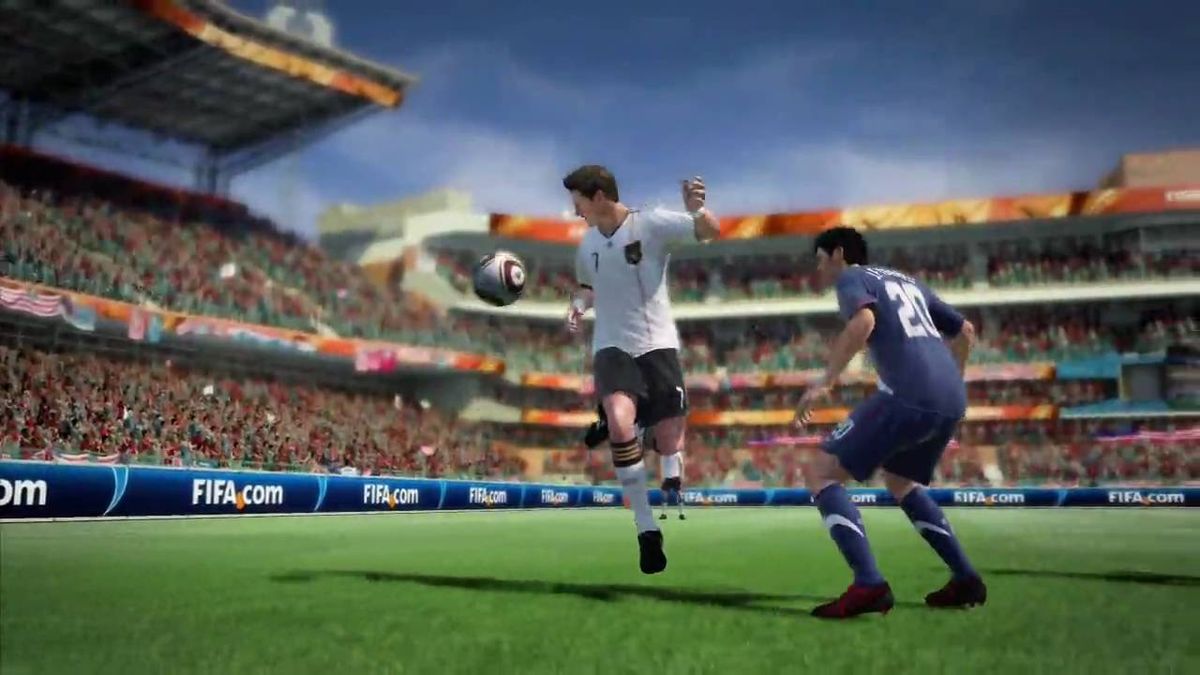
2010 FIFA World Cup South Africa is the official video game for the 2010 FIFA World Cup, published by EA Sports. Released in 2010, it is widely regarded as one of the greatest football video games ever made, celebrated for its deep authenticity and comprehensive tournament experience.
| Developer | EA Sports |
|---|---|
| Publisher | EA Sports |
| Release Date | 27 April 2010 (North America) |
| Platforms | PlayStation 3, Xbox 360, Wii, PSP, iOS |
| Game Modes | Single-player, Multiplayer |
| Commentary | Clive Tyldesley and Andy Townsend |
| Teams | 199 national teams |
| Stadiums | All 10 official World Cup venues |
| Soundtrack | 28 tracks from 21 countries |
Development and Authentic Vision
EA Sports developed 2010 FIFA World Cup South Africa over a 12-month period with the explicit goal of matching the quality of FIFA 10 while focusing on a single, major event. The project was led by two separate teams: a gameplay team under creative director Gary Patterson, and a core team responsible for game modes and audio-visual presentation. The decision to release it as a full standalone game, rather than downloadable content, was driven by the size, scope, and specific nature of the World Cup tournament.
To achieve complete authenticity, EA Sports collaborated closely with FIFA and the host nation. Several team members traveled to South Africa to record ambient sounds, most notably the distinctive vuvuzela noise from actual football matches, to capture the atmosphere of the event. This dedication extended to visuals, with each of the 199 national teams receiving its own individually rendered crowd. African themes heavily influenced the game's aesthetic, from its menu designs to the specially curated global soundtrack.
Comprehensive Teams and Stadiums
The game's roster is one of its most defining features, containing 199 of the 204 national teams that participated in the real-world 2010 FIFA World Cup qualification process. EA confirmed the list in February 2010, stating they included every team FIFA permitted them to use. The five excluded teams were the Central African Republic, Eritrea, São Tomé and Príncipe from Africa, and Bhutan and Guam from Asia, all of which withdrew from qualification before it began. Additionally, Brunei, Laos, Papua New Guinea, and the Philippines are not featured as they did not enter qualification at all.
For venues, the game includes all 10 official stadiums used in South Africa for the World Cup finals. Beyond these, it also features a selection of stadiums from each of the six qualifying confederations, as well as a range of generic stadiums, allowing the full qualification journey to feel geographically diverse and authentic.
Core Gameplay Innovations and Modes
The gameplay was built upon the FIFA 10 engine but introduced several World Cup-specific enhancements. A new environmental dynamic factored in altitude, causing player fatigue to accumulate at a higher rate in matches played at elevation, simulating a real advantage for teams accustomed to such conditions. The penalty kick system was overhauled to tie the outcome more directly to the player's timing and composure rather than pure statistics.
The headline mode allows players to take any of the 199 teams from the initial qualification rounds all the way to a virtual reproduction of the World Cup Final. The Captain Your Country mode returned, functioning similarly to the Be a Pro mode, where players could import their Virtual Pro from FIFA 10 and guide him through international matches to earn accomplishments and attribute boosts. Another significant feature was the Scenario Mode, which offered 55 playable moments from past World Cup tournaments, with updates later adding scenarios from the 2010 event itself. Online play was supported via PlayStation Network and Xbox Live, though limited to unranked head-to-head matches.
Unique Wii and Multiplatform Experience
The Wii version of the game was designed as a distinctly different product. It featured more stylized, cartoon-like graphics and utilized a nuanced physics system tailored for casual, arcade-style gameplay. This version supported multiple control schemes, including the Classic Controller. It introduced exclusive mechanics centered on quick-time events, requiring players to press buttons at the right moment to save penalty shots or free kicks, or to win possession from goal kicks and corners.
A social feature on the Wii allowed multiple players to take control of a single team together. The other console versions, for PlayStation 3 and Xbox 360, delivered the core simulation experience with the full suite of modes. The PSP and iOS versions provided portable alternatives, though with scaled-down features and presentation.
Release Timeline and Regional Controversy
The game was formally announced on 26 January 2010 in an interview with line producer Simon Humber. It was released in North America on 27 April 2010, followed by releases in Asia and Europe on 30 April 2010. A playable demo for Xbox 360 and PlayStation 3 arrived on 8 April 2010, featuring Italy and Spain as playable teams and including the ability to upload video replays to the EA Football World website.
The launch was not without incident. The game was pulled from sale in Saudi Arabia due to a translation issue. The Arabic word for the soccer ball in the game was interpreted as Allah, meaning God. For religious and political reasons, Saudi players would not kick an object bearing that name, making the game unplayable and leading to its withdrawal from the market there.
Soundtrack and Cultural Celebration
EA Sports crafted a soundtrack intended to celebrate the cultural vibrancy of the first World Cup held in Africa. The soundtrack comprised 28 tracks from artists representing 21 different countries, creating a global audio backdrop. The headline track was K'naan's Wavin' Flag (Coca-Cola Celebration Mix), which became an anthem for the real-world tournament and is linked to the game. This carefully selected music played a key role in immersing players in the international festival atmosphere of the event.
Reception, Sales, and Lasting Legacy
Critical reception was generally positive, with aggregate scores highest for the primary console versions. The Xbox 360 version scored 83.43% on GameRankings and 83/100 on Metacritic, while the PlayStation 3 version scored 82.82% and 82/100 respectively. The PSP version received scores in the low 70s, the Wii version in the high 60s, and the iOS version was rated at 62.50%.
Commercially, the game was a strong success, selling nearly 2 million units worldwide by May 2010. By 2022, it was generally considered by players and critics to be the best of EA Sports' modern FIFA World Cup video game series. Furthermore, it is frequently cited as one of the greatest football video games of all time, praised for its depth, authenticity, and faithful capture of a specific sporting event.
FAQ
What platforms was 2010 FIFA World Cup South Africa released on?
The game was released on all major seventh-generation consoles except the Nintendo DS. This includes PlayStation 3, Xbox 360, Wii, and PSP. It was also available on iOS.
How many teams are in the game?
The game includes 199 of the 204 national teams that took part in the real 2010 FIFA World Cup qualification. The five excluded teams had withdrawn from qualification before it began.
What is the Captain Your Country mode?
Captain Your Country is a game mode similar to Be a Pro, where you control a single player. Owners of FIFA 10 could import their Virtual Pro into this mode to earn accomplishments and attribute boosts while leading their national team.
Who are the commentators in the game?
The commentary team for the game consists of Clive Tyldesley and Andy Townsend, who provide match analysis and insight during gameplay.
Why was the game pulled from Saudi Arabia?
The game was removed from sale in Saudi Arabia because the Arabic translation for the soccer ball was interpreted as Allah. For religious and political reasons, Saudi players would not kick it, leading to the game's withdrawal.
Source: English Wikipedia (CC BY-SA), rewritten by the Redington Cybersport desk.