Super Smash Bros. Melee
Super Smash Bros. Melee is a 2001 crossover fighting game for the Nintendo GameCube and the second entry in the Super Smash Bros. series. It is known for its fast-paced, accessible gameplay and has maintained an active competitive scene for over two decades, establishing its status as a classic in both gaming and esports.
| Developer | HAL Laboratory |
|---|---|
| Publisher | Nintendo |
| Platform | Nintendo GameCube |
| Release | November 21, 2001 (JP), December 3, 2001 (NA), May 24, 2002 (EU), May 31, 2002 (AU) |
| Genre | Platform fighter |
| Players | 1-4 |
| Best-selling GameCube title | Over 7 million copies sold by 2008 |
| Director | Masahiro Sakurai |
| Preceded by | Super Smash Bros. (N64) |
| Succeeded by | Super Smash Bros. Brawl |
Core Gameplay and Mechanics
Super Smash Bros. Melee is classified as a platform fighter, a subgenre it helped define. The primary objective is to knock opponents off the stage rather than deplete a traditional health bar. Each character has a damage percentage that increases when they are hit. The higher this percentage, the farther they are launched by attacks, making them easier to knock out. Losing a character off the stage costs a stock, or life. Most special moves are executed with a single button press combined with a direction on the joystick, a departure from the complex input combinations of traditional fighters.
The game field is interactive, featuring stages themed after various Nintendo franchises such as Mario, The Legend of Zelda, and Star Fox. While rendered in 3D, movement is restricted to a two-dimensional plane. Stages often include moving platforms and environmental hazards, and not all are available immediately, requiring players to unlock them by meeting specific requirements. Items from across Nintendo's history frequently appear during battles. These can be thrown, used for melee attacks, or provide instant effects, adding an element of chaos. Players can customize matches by adjusting rules, including the number and type of items, and choosing from several victory conditions.
The two most common multiplayer modes are Time mode, where the player or team with the most knockouts wins after a set time, and Stock mode, where the last player or team with lives remaining wins. Other options include Coin mode, where players collect coins by hitting opponents and try not to lose them by falling. Computer-controlled opponents have adjustable artificial intelligence difficulty ranked from one to nine, and players can also set individual handicaps to alter strength.
Characters and Roster
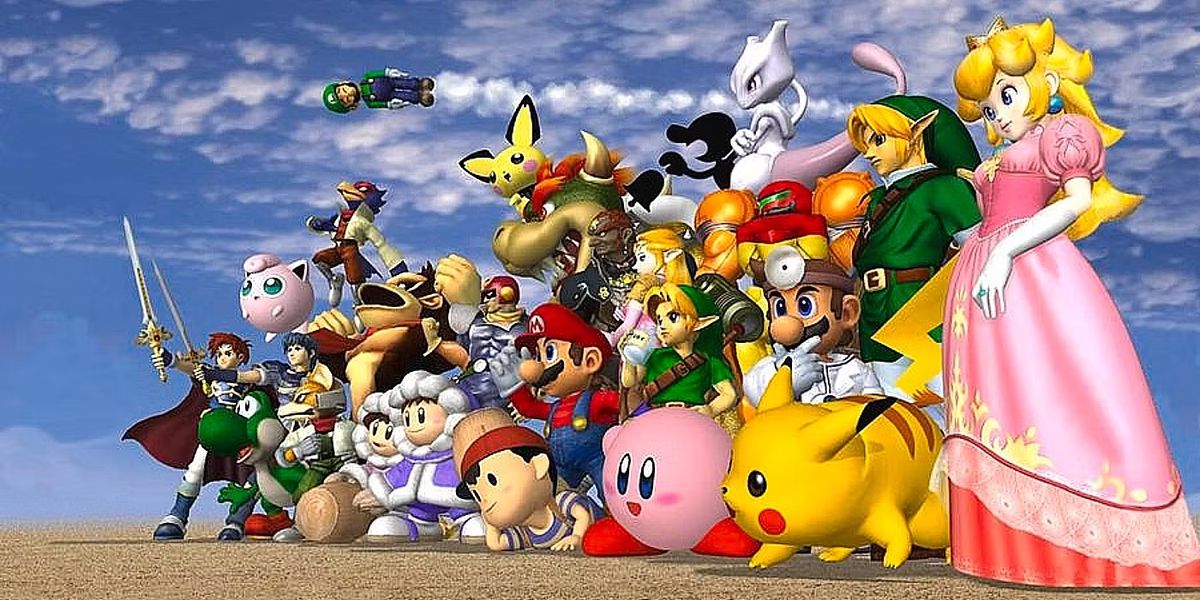
The game features a roster of 25 characters, a significant increase from the 12 in the original Super Smash Bros. Fourteen are available from the start, with the remaining 11 unlocked by completing specific in-game tasks. Every fighter originates from a Nintendo franchise, represented by a series icon next to their damage meter, such as a Triforce for Link or a Poké Ball for Pokémon.
The roster includes famous faces like Mario and Link alongside characters who were obscure to Western audiences at the time. The inclusion of Marth and Roy from the Fire Emblem series, which had not been released outside Japan, notably boosted the franchise's international popularity and led to its release in the West. Each character utilizes a moveset inspired by their home series. The game also makes references to character relationships from their original universes in modes like Event Mode.
During development, the team considered many characters that were ultimately not included. Video game developer Hideo Kojima requested Solid Snake, and Yuji Naka of Sonic Team requested Sonic the Hedgehog, but neither was added as the game was too far in development. These characters later appeared in the sequel, Brawl. The developers also suggested characters from four other games to represent the Famicom era before choosing the Ice Climbers. Ayumi Tachibana from Famicom Detective Club was considered but became only a trophy. Some characters on the final roster have very similar movesets, a design the media often refers to as clones.
Game Modes and Content
Melee offers a wealth of single-player and multiplayer content. For solo play, it introduced the Adventure Mode, a side-scrolling journey through predefined universes based on Nintendo worlds. Classic Mode tasks players with a series of battles against multiple opponents culminating in a boss fight. Specialized minigames include the Target Test, where each character has its own area to destroy ten targets, and the Home Run Contest, a ten-second challenge to launch a sandbag as far as possible.
All-Star Mode is an unlockable feature that requires the player to defeat every character in the game consecutively with limited resources. Multiplayer supports up to four players locally in free-for-all or team battles. The game contains a detailed Trophy collection system, with hundreds of 3D models of Nintendo characters and objects, including many obscure or Japan-only references. One trophy is exclusive to the Japanese version. Collecting these trophies became a major pursuit for players.
Development and Release
Directed by Masahiro Sakurai with Shigeru Miyamoto as co-producer, Melee was developed in an intense 13-month cycle beginning around autumn 2000. Sakurai described his lifestyle during this period as destructive, with no holidays and short weekends, and felt great pressure to deliver a quality sequel, calling it the biggest project he had led up to that point. The game was a launch title for the GameCube, designed to highlight the console's advanced graphics over the Nintendo 64.
The project proposal was completed on July 5, 1999. Special attention was paid to the opening FMV sequence, created with three graphic houses in Tokyo as an homage to the GameCube's debut. The developers posted detailed explanations of the game's physics and changes from its predecessor on their official website. Voice recording began in February 2001, and composer Shogo Sakai took over the opening theme that same month.
The game was presented at the Electronic Entertainment Expo 2001 and later at Space World in August 2001 with updated demos. Nintendo ran playable tournaments with the game and a GameCube as prizes. Before release, the Japanese website offered weekly updates with screenshots and character profiles. Melee was first released in Japan in November 2001, followed by North America in December and Europe and Australia in May 2002. It was re-released under the Player's Choice label in January 2003 after selling a million copies and was bundled with the GameCube for $99.99 in August 2005.
Reception and Lasting Legacy
Super Smash Bros. Melee received widespread critical acclaim upon release. Reviewers praised its expansion of features from the original game, with IGN stating it was in an entirely different league than the N64 version. GameSpot lauded the more advanced classic mode and the quality of the character models and textures. While responses to single-player modes like Adventure Mode were mixed, the multiplayer mode was universally highlighted as a strong component, with GameSpy noting it was hard to find a more enjoyable multiplayer experience on any other console.
The game achieved strong sales, becoming the GameCube's best-selling title with over seven million copies sold by 2008. Its lasting legacy is deeply tied to the competitive community that formed around it. Due to its fast-paced gameplay and continuously developing metagame, it has been featured in many competitive gaming tournaments for over twenty years. This dedicated fan community has kept its competitive scene active well beyond the game's original lifespan, sustaining it as a premier esports title. In a 2010 interview, director Masahiro Sakurai proudly stated that Melee felt like the sharpest game in the series.
Music and Audio
The game's audio presentation was a major step forward. It features a large soundtrack comprising both new compositions and re-arranged music from many of Nintendo's popular gaming franchises. Unlockable tracks reward player progression. A special orchestral soundtrack titled Dairantou Smash Brothers DX Orchestra Concert was released in Japan in 2002, performed by the New Japan Philharmonic. This soundtrack was also released in North America as Smashing... Live! and as a gift with the British Official Nintendo Magazine.
Voice acting was also expanded from the previous game. The first recording sessions in February 2001 involved the Japanese Star Fox cast and Masachika Ichimura, the voice of Mewtwo. The developers posted discussions about the game's music and voice acting between Sakurai and the composers on their official website. The attention to audiovisual detail contributed significantly to the game's polished feel and critical success.
FAQ
How many characters are in Super Smash Bros. Melee?
Super Smash Bros. Melee features a total of 25 playable characters. Fourteen are available from the start, and the remaining 11 must be unlocked by completing specific tasks within the game.
What is the objective in a Super Smash Bros. Melee match?
The primary objective is to knock your opponents off the stage. Characters have a damage percentage that increases when hit. A higher percentage makes them easier to launch far enough to fall off the stage and lose a stock, or life.
Why is Super Smash Bros. Melee still played competitively?
Melee is celebrated for its fast-paced, technical gameplay and a deep, continuously developing metagame. This combination has fostered a dedicated competitive community that has kept the tournament scene active for decades beyond the game's original release.
What new single-player mode did Melee introduce?
Melee introduced the Adventure Mode, a side-scrolling experience that takes players through a series of themed levels and battles based on various Nintendo universes. It joined other modes like Classic Mode and the Home Run Contest.
How did Melee impact the Fire Emblem series internationally?
The inclusion of Fire Emblem characters Marth and Roy in the Western release of Melee, despite the series being previously unavailable outside Japan, generated significant interest. This popularity directly contributed to the decision to release Fire Emblem games internationally.
Source: English Wikipedia (CC BY-SA), rewritten by the Redington Cybersport desk.