FIFA 06
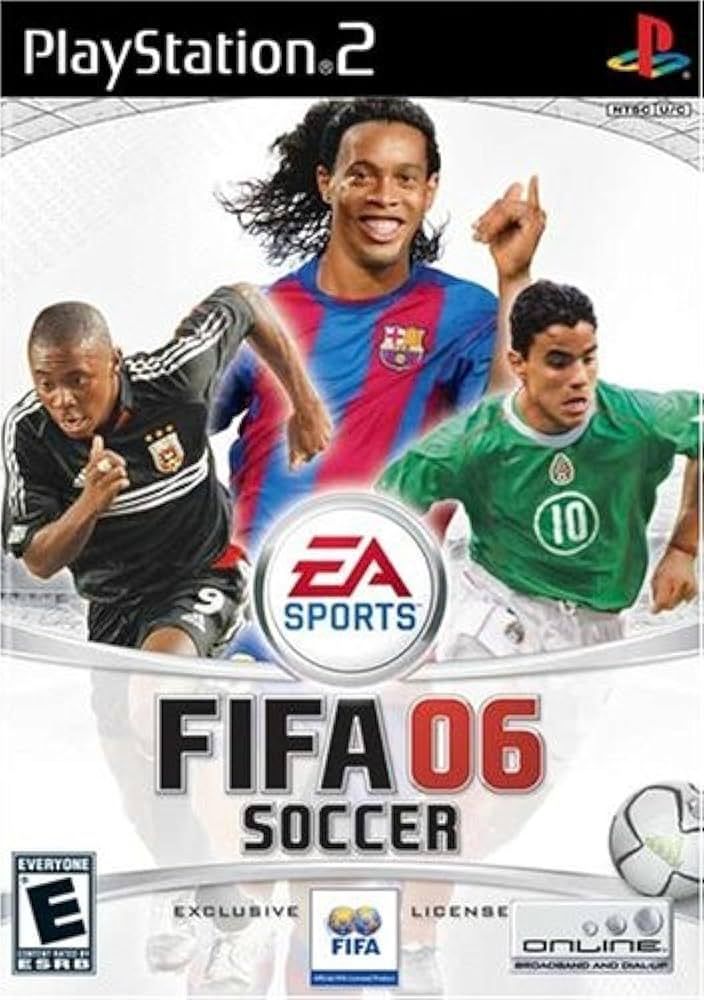
FIFA 06, known as FIFA Soccer 06 in North America, is the thirteenth installment in EA Sports' long-running football simulation series. Released in 2005, it was the final FIFA title exclusive to sixth-generation consoles and introduced major gameplay and career mode innovations. It became the UK's best-selling game of 2005 and a high point for the series at the time.
| Developer | EA Canada |
|---|---|
| Publisher | Electronic Arts (EA Sports) |
| Release Date | 4 October 2005 (US) |
| Platforms | PlayStation 2, Xbox, GameCube, Microsoft Windows, Nintendo DS, PlayStation Portable, Game Boy Advance, mobile phones |
| Cover Athletes | Ronaldinho, Wayne Rooney, Freddy Adu, Omar Bravo, Lukas Podolski, Park Chu-Young |
| Series | FIFA (13th game) |
| Taglines | You play. They obey. / The total soccer experience |
| Commentary | Clive Tyldesley and Andy Gray |
A Comprehensive Technical Overhaul
FIFA 06 was built on a foundation of significant technical change. The developers at EA Canada conducted a complete overhaul of the game engine, discarding the previous ball physics system and rewriting more than half of the game's underlying programming code. This effort was directed at improving player control and creating a more authentic football simulation. A central new mechanic was team chemistry, a dynamic system that determined how effectively a squad played together based on factors like player morale and how often the same lineup was used.
The game's audio presentation also marked a break from recent tradition. The familiar commentary duo of John Motson and Ally McCoist was replaced by ITV's Clive Tyldesley and Sky Sports pundit Andy Gray for the English-language version. Market-specific cover art highlighted global stars, with Ronaldinho and Wayne Rooney featured across Europe, Australia, and Brazil, while North American covers added Freddy Adu and Omar Bravo, and regional editions in Germany and South Korea included Lukas Podolski and Park Chu-Young respectively.
The Expanded Managerial Career
The career mode in FIFA 06 grew into a deep, multi-faceted management simulation spanning 15 in-game seasons. Players began by creating a manager profile and were initially restricted to choosing a club with a four-star rating or lower, unless they purchased the Career Teams bundle from the in-game Fan Shop. A new and constant consideration was a limited budget, which had to be strategically allocated across player transfers, staff upgrades, and other club operations.
Sponsorship deals, a fresh addition, became a crucial financial lifeline. Managers negotiated with sponsors, who provided weekly payments and performance bonuses. Failing to meet a sponsor's expectations, such as winning a specific cup, risked losing that funding at the season's end. The mode required a careful balance of board objectives, player morale, team chemistry, and supporter satisfaction. Success was primarily driven by match results, and consistently failing board goals could lead to contract termination, with multiple dismissals ending the career mode entirely.
Player morale directly impacted contract negotiations and performance, while team chemistry was a product of both morale and squad consistency. The mode also introduced a staff system, where upgrades to roles like the negotiator could improve the club's ability to sign better players for less money. A comprehensive manager history section tracked all seasonal records, league finishes, cup wins, and detailed statistics for every campaign.
Social Competition in the FIFA 06 Lounge
For group play, FIFA 06 introduced the FIFA 06 Lounge, an advanced multiplayer system supporting up to eight human players. Participants selected a persistent identity and a team to compete in a series of matches under customizable rules. The Lounge offered a variety of structured match types designed to maintain competitive balance and interest.
These included standard formats like Winner Stays On and rematches, as well as inventive handicaps such as Catch-Up, where one player began the match with a predefined goal deficit to overcome. Other modes pitted the winner against the highest or lowest ranked player in the session, or matched the best team against the worst by star rating. The Lounge maintained a detailed leaderboard recording points, wins, goals, bookings, clean sheets, offsides, and various winning and undefeated streaks. Crucially, the entire session could be saved and resumed later, allowing for ongoing tournaments among friends.
Unlockables, Challenges, and Nostalgic Content
FIFA 06 included a substantial rewards system driven by in-game challenges. Over 100 challenges were organized into ten geographical regions, each containing ten to twelve specific objectives. Completing these on any of the four main difficulty levels, or a fifth high difficulty, earned players FIFA Points.
These points were currency in the Fan Shop, used to unlock a wide array of content. This included classic player biographies, new camera angles, alternate kits for clubs, additional stadiums, and video compilations. Two notable unlockable teams were the Classic XI, a squad of football legends assembled by EA Sports, and the World XI, a team of contemporary stars selected by FIFPro, both based at the Cardiff Millennium Stadium.
The game also featured a dedicated retro section with nostalgic content. This housed a video compilation of memorable football moments chosen by the developers, and a retrospective video looking back at the history of the FIFA series, set to the song Cobrastyle by Teddybears featuring Mad Cobra. Furthermore, the PlayStation 2 version included the original 16-bit FIFA International Soccer as a playable extra.
Team Management and Extras
Beyond the core modes, FIFA 06 provided extensive tools for customization through its Team Management section. Here, players could create new athletes, edit existing players' attributes and kit numbers, modify squad lists, and set kick-takers. The mode also allowed for manual transfers of players between clubs and the selection of players for their national teams, giving players control over the game's database.
The Extras menu housed additional media content, such as a video interview with Barcelona striker Samuel Eto'o and tutorial videos explaining the game's new features. It also contained video previews for other EA Sports titles like NBA Live 06 and FIFA Street 2. Players could unlock season highlight packages from the 2004–05 campaigns of the German Bundesliga, English Premier League, French Division 1, and Italian Serie A. This content was not present in the GameCube version of the game.
Platform Variations and the Next-Gen Debut
The game was released on a wide spectrum of platforms, with notable differences in content. The GameCube version, for example, was missing the tutorial videos, game previews, and unlockable season highlights found in other console editions. The most distinct version was released for the new Xbox 360, titled FIFA 06: Road to FIFA World Cup.
This was effectively a separate game, featuring only national teams and built from the ground up with a new game engine designed to utilize the graphical capabilities of the seventh-generation console. It holds the distinction of being the very first FIFA title released on a seventh-generation platform, marking the series' initial step into the HD era.
Commercial Performance and Critical Response
FIFA 06 was a tremendous commercial success. It was the best-selling video game in the United Kingdom for 2005, outperforming its main rival, Pro Evolution Soccer 5. Across all platforms, it sold over 1 million copies in the UK. The PlayStation 2 version specifically received a Double Platinum sales award from ELSPA, indicating sales of at least 600,000 copies in that territory alone. Globally, the game sold more than 3.6 million copies, which at the time made it the highest-selling installment in the history of the FIFA series, surpassing its predecessor by over 100,000 units.
Critical reception ranged from positive to mixed, largely dependent on the platform. Aggregate review scores were strongest for the PC, GameCube, and Xbox versions, which received averages around 80 out of 100. The handheld versions saw lower scores, with the PSP version in the 70s, the Nintendo DS version in the mid-60s to 70s, and the Game Boy Advance version receiving scores around 49.50% and 70 out of 100, reflecting the technical limitations of portable hardware at the time.
FAQ
What was new in FIFA 06's career mode?
The career mode was expanded to 15 seasons and introduced detailed budget management, sponsor negotiations, and a team chemistry system. Players had to manage board expectations, player morale, and staff upgrades, with failure risking dismissal.
What is the FIFA 06 Lounge?
The FIFA 06 Lounge was a new multiplayer mode for up to eight players. It featured various match types like Winner Stays On and handicaps, and it kept persistent leaderboards tracking wins, goals, and streaks, with the ability to save sessions.
Which teams like Classic XI were in FIFA 06?
FIFA 06 featured two special unlockable teams: the Classic XI, composed of football legends selected by EA Sports, and the World XI, made of contemporary superstars chosen by FIFPro. Both played their home games at the Cardiff Millennium Stadium.
How did FIFA 06 sell?
FIFA 06 was the UK's best-selling game of 2005, selling over 1 million copies across all platforms there. Globally, it sold more than 3.6 million copies, making it the highest-selling FIFA game at the time of its release.
What was different about the Xbox 360 version?
The Xbox 360 version was titled FIFA 06: Road to FIFA World Cup. It was a separate game featuring only national teams and was built on a new engine to utilize the console's graphics. It was the first FIFA title on a seventh-generation console.
Source: English Wikipedia (CC BY-SA), rewritten by the Redington Cybersport desk.