Pro Evolution Soccer 2008
Pro Evolution Soccer 2008 (PES 2008) is the 2007 installment in Konami's football simulation series, notable for adopting a calendar-year title and debuting on new consoles. It is recognized for its refined gameplay, the Teamvision AI, and a version for the Nintendo Wii with its own control scheme.
| Developer | Konami |
|---|---|
| Release Year | 2007 |
| Announcement Date | 18 June 2007 |
| Platforms | Windows, Wii, Nintendo DS, PlayStation 3, PlayStation 2, PlayStation Portable, Xbox 360 |
| Alternative Titles | World Soccer: Winning Eleven 2008 (Asia), Winning Eleven Play Maker 2008 (Japan Wii) |
| Global Sales (2007) | 6.37 million units |
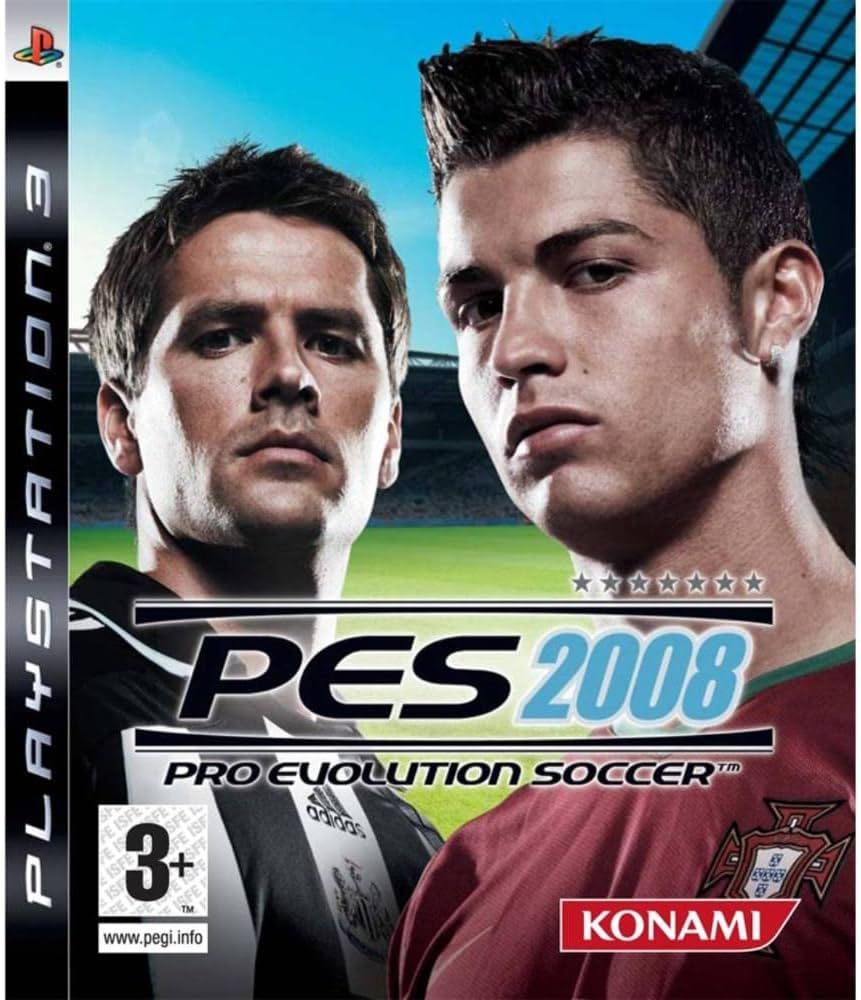
| Cover Athletes | Cristiano Ronaldo (global), Michael Owen (UK), Gianluigi Buffon (Italy), Lucas Neill (Australia), Didier Drogba (France) |
| English Commentators | Jon Champion and Mark Lawrenson |
| Licensed Leagues | La Liga Santander, Ligue 1, Serie A, Eredivisie |
| Unlicensed League | Premier League (partial) |
Strategic Rebranding and Platform Expansion
Konami announced Pro Evolution Soccer 2008 on 18 June 2007, initiating a deliberate shift in the series' identity. The move from sequential version numbers to a calendar-year title was a direct reaction to the naming strategy of the rival FIFA series from EA Sports. Konami sought to avoid the perception among casual observers that the Pro Evolution Soccer franchise was perpetually a year behind. This edition also became the first to use the Pro Evolution Soccer name in the American market, replacing the Japanese Winning Eleven title used there previously.
The game's release marked a major expansion in platform availability. PES 2008 was the first title in the series developed for the PlayStation 3 and Nintendo Wii consoles. It also represented the first international release of the franchise on a Nintendo home console. The game launched across seven platforms in total, including Windows, Nintendo DS, PlayStation 2, PlayStation Portable, and Xbox 360. This wide release contributed to strong global sales of 6.37 million units in 2007, a figure very close to the 6.55 million units sold by FIFA 08 that same year.
Core Gameplay and the Teamvision AI System
Pro Evolution Soccer 2008 was built around delivering authentic football simulation with refined controls and greater tactical depth. The most significant technical innovation was the Teamvision artificial intelligence system. This new intelligence system was designed to adapt and react dynamically to a player's own gameplay style. By learning from and countering repeated attacking patterns and defensive setups, Teamvision aimed to provide a more challenging and less predictable opponent in single-player modes.
The game featured six primary game modes. The centerpiece for many players remained the Master League, a deep management simulation where users control a club's transfers, finances, and matches across multiple seasons. On the PlayStation 2 platform, PES 2008 was often seen as a polished successor to Pro Evolution Soccer 6, with many perceived gameplay exploits from the earlier title removed. Community feedback highlighted the PS2 version for its outstanding gameplay and the enduring appeal of the Master League mode.
A Divergent Vision on the Nintendo Wii
The Nintendo Wii version of PES 2008, titled Winning Eleven Play Maker 2008 in Japan, was a radical departure from the other editions. Its gameplay was entirely constructed around the Wii Remote's pointer functionality. Players controlled their team by pointing a cursor at the screen and physically dragging individual athletes to new positions on the pitch. Passing the ball was executed by pointing at a desired space or teammate and pressing a button.
This control method granted users an unusual level of direct, tactical control, allowing for the manual placement of any player anywhere during play. Konami stated this version offered the best online experience compared to other platforms. It replaced the traditional Master League with a 'Champions Road' mode, where the player would tour a series of different leagues across Europe and could acquire players from teams they defeated. This version omitted the generic team league feature found in other releases.
Licensing Landscape and Community Adaptation
The licensing situation in PES 2008 was a mixture of official partnerships and notable omissions. The game featured fully licensed leagues where all teams were authentic, including Spain's La Liga Santander, France's Ligue 1, Italy's Serie A, and the Netherlands' Eredivisie. However, the English Premier League was only partially licensed, leaving many of its clubs with unlicensed names and kits.
A major absence was the German Bundesliga, for which Konami did not secure the rights. To address this, the developers included a separate league of 18 completely editable generic teams, named Team A through Team R. This feature, which did not appear in the Wii version, became a crucial tool for the player community. Patch makers routinely used these editable teams to recreate the missing Bundesliga or other leagues of their preference. Many players also used the slots to insert custom-created players into immediately playable teams instead of unlocking them through Master League progression.
Presentation, Marketing, and Critical Response
For its presentation, PES 2008 featured a new English commentary pairing of Jon Champion and Mark Lawrenson, replacing the long-time team that had worked on the series from Pro Evolution Soccer 2 through 6. The game's marketing centered on Portuguese star Cristiano Ronaldo, who appeared on all regional cover art. He was joined by local footballers for specific markets, Michael Owen in the United Kingdom, Gianluigi Buffon in Italy, Lucas Neill in Australia, and Didier Drogba in France. The Japanese version featured Cristiano Ronaldo alone on its cover.
Critical reception varied widely depending on the platform. The Wii version received the highest aggregate scores, 83.60% on GameRankings and 83 out of 100 on Metacritic, and won IGN's 2008 award for Best Sports Game on Wii. The PlayStation 2 version also scored well at 82.58% and 82 out of 100. Other versions received lower scores, with the PlayStation 3 at 73.46% and 74 out of 100, the Xbox 360 at 75.53% and 76 out of 100, and the Nintendo DS version at the bottom with 58.57% and 58 out of 100. Commercially, the PS2 and Xbox 360 versions each earned a Platinum sales award in the United Kingdom for sales exceeding 300,000 copies per version.
Sales Performance and Market Position
Pro Evolution Soccer 2008 was a substantial commercial success for Konami. Its worldwide sales of 6.37 million units in 2007 kept it highly competitive with the FIFA series, demonstrating the strength of the rivalry at the time. In Japan, the game sold approximately 104,654 copies following its debut. In the United Kingdom, it entered the sales charts at number five and then climbed to number three in its second week, boosted by a 34 percent increase in sales.
The PlayStation 2 and Xbox 360 editions were particularly strong performers in the UK market, each receiving a Platinum sales award from the Entertainment and Leisure Software Publishers Association for sales of at least 300,000 copies per version. This sales achievement underscored the game's lasting popularity on the previous generation of consoles even as it launched on new hardware like the PlayStation 3 and Wii.
Place in the Pro Evolution Soccer Esports Tradition
While not the subject of a major standalone esports event in 2008, the game existed within a franchise that had a growing competitive culture. The Pro Evolution Soccer series has a history of player-vs-player competition rooted in its simulation-style gameplay. Official organized esports for the franchise began shortly after, with Konami launching an annual tournament series originally named the PES League or PES World Finals in 2010, later rebranded as eFootball.Open.
The mechanics and balance of PES 2008, especially on the primary competitive platforms of PlayStation 2, PlayStation 3, and Xbox 360, provided the environment where skilled players tested their strategies and reflexes. The game's focus on tactical depth and controlled, authentic football formed the foundation for the type of high-skill competition that would later be formalized in Konami's official esports circuits. In this way, PES 2008 served as an important chapter in the ongoing development of the series' competitive community.
FAQ
Why did PES 2008 use a year instead of a version number?
Konami changed the naming convention to a calendar year to align with the EA Sports FIFA series, which used two-digit year titles. This was to prevent the perception that the Pro Evolution Soccer series was a year behind its main competitor.
What was the Teamvision system in PES 2008?
Teamvision was a new artificial intelligence system that adapted to a player's gameplay style. It learned from and reacted to the user's repeated tactics, making AI-controlled opponents more challenging and less predictable.
Which platforms was PES 2008 released on?
The game was released for Windows, Nintendo Wii, Nintendo DS, PlayStation 3, PlayStation 2, PlayStation Portable, and Xbox 360. It was the first series entry on the PS3 and Wii.
Did PES 2008 have the German Bundesliga?
No, PES 2008 did not have the license for the German Bundesliga. Instead, it included a league of 18 fully editable generic teams, which the player community often used to create a Bundesliga patch.
How did the Wii version controls work?
The Wii version used the Wii Remote as a pointer. Players directed their team by pointing at the screen and dragging players with an on-screen cursor. Passing was done by pointing at a target and pressing a button.
Source: English Wikipedia (CC BY-SA), rewritten by the Redington Cybersport desk.