Counter-Strike: Source
Counter-Strike: Source is a landmark tactical first-person shooter that remade the classic Counter-Strike for a new generation. Released in 2004, it modernized the series with advanced graphics and physics while striving to preserve its tense, round-based competitive core. The game became a staple of early esports, though its release sparked a lasting community debate over its competitive merits compared to its predecessor.
| Developer | Valve, Turtle Rock Studios |
|---|---|
| Release | October 7, 2004 |
| Platform | Windows, Mac OS X, Linux |
| Engine | Source |
| Genre | Tactical first-person shooter |
| Modes | Multiplayer |
| Predecessor | Counter-Strike 1.6 |
| Successor | Counter-Strike: Global Offensive |
Gameplay and Core Mechanics
Counter-Strike: Source is a team-based, objective-focused first-person shooter. Two teams, terrorists and counter-terrorists, compete in a series of rounds. A team wins a round by completing a map's objective, such as planting or defusing a bomb, rescuing hostages, or eliminating every member of the opposing team. The ultimate match victory goes to the team that wins the most rounds. This round-based structure, where killed players do not respawn until the next round, is a defining feature that sets it apart from other shooters and creates high-stakes tactical play.
The shooting mechanics are designed to reward precision and control. Shooting while moving dramatically decreases accuracy, and holding down the trigger for automatic fire produces severe recoil. Damage is calculated based on the specific location of the hit, with headshots being the most lethal, while shots to other body areas cause less health loss. Damage is also affected by the distance to the target and whether the target is wearing armor. These systems combine to create a gameplay loop where positioning, aim, and economy management are paramount.
Development and the Source Engine Leap
Development of Counter-Strike: Source began at Valve in January 2004. The main goal was to transfer Counter-Strike to the new Source engine without altering the core gameplay mechanics. To achieve this, designers took the Counter-Strike 1.1 build, stripped it to its essentials, and rebuilt it piece by piece in the new engine. The team included original creators Minh Le and Jess Cliffe, as well as members of the Day of Defeat team. Turtle Rock Studios, which had collaborated with Valve on previous projects, later joined to help finalize and polish the game for release.
The game was announced on May 12, 2004, as the multiplayer component of Half-Life 2. The first public beta was available on August 11, 2004, through the Valve Cyber Café Program, with a wider beta following on August 18 for owners of Counter-Strike: Condition Zero and users with certain ATI Radeon video card vouchers. Counter-Strike: Source launched standalone on Steam for Windows on October 7, 2004, over a month before Half-Life 2 itself, and was later included in Half-Life 2 retail bundles from November 16, 2004.
Technical and Visual Revolution
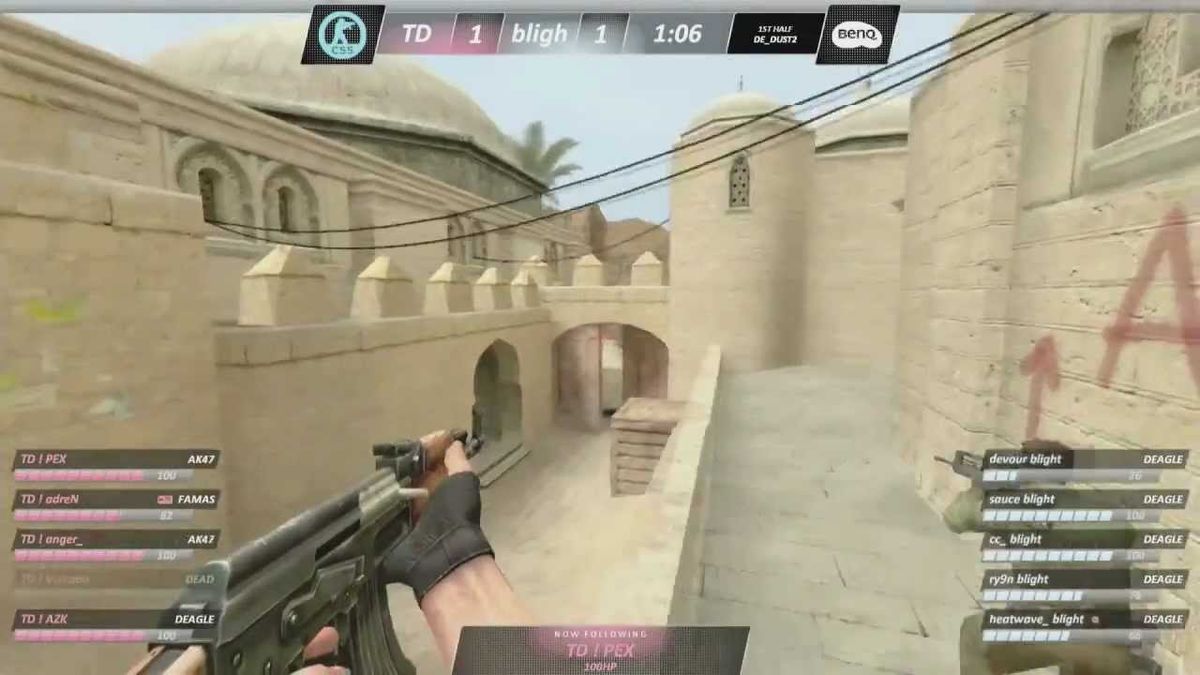
The Source engine transformed the game's presentation and interactivity. The level of texture detail on maps, player models, and weapons increased significantly, with many textures seeing a fourfold resolution increase. 3D models featured substantially higher polygon counts and could cast dynamic shadows. The engine made extensive use of DirectX 9 features like bump mapping, normal mapping, and specularity to give surfaces greater depth and realistic lighting. Cube mapping was used for environmental reflections, such as on weapon scopes, and 3D skyboxes created the illusion of vast environments beyond the playable area.
The new physics system was a major change. It made the game world interactive, with physical objects like barrels and bottles scattered throughout maps that could be moved and affected by explosions and gunfire. Grenade trajectories and explosion effects became more realistic. Perhaps most visibly, the system introduced ragdoll physics for player deaths, replacing the predefined death animations of the original. The audio was also redesigned with a dynamic system for more accurate environmental acoustics and added support for 5.1 and 7.1 surround sound.
Post-Launch Updates and Content
Following release, Turtle Rock Studios led ongoing development. From December 2004 to January 2006, they remade six classic maps missing at launch, added bot support, and fixed bugs. Valve also contributed new content, including three maps and upgraded default player models. In December 2005, Valve introduced HDR lighting, which was gradually added to maps throughout 2006. The in-game radar was redesigned in August 2006 into a mini-map with enemy detection functionality.
A controversial update in November 2006 introduced the Dynamic Weapon Pricing system. It altered weapon prices weekly based on player demand statistics from the previous week, aiming to encourage weapon variety. It was immediately criticized as prices could fluctuate wildly, making popular weapons extremely expensive. Despite rebalancing attempts, the system was eventually removed. That same update also removed the ability to purchase ammunition separately, instead providing ammo automatically with weapon purchases.
A major update arrived in June 2010, porting the game to a newer version of the Source engine in collaboration with Hidden Path Entertainment. This resolved longstanding engine issues and allowed for improved graphics and more accurate hit registration. It also added 144 new achievements, MVP Awards, a domination and revenge system adapted from Team Fortress 2, player statistics, a redesigned scoreboard, and a Mac OS X version. A Linux version followed in February 2013. After years of minimal changes, a final major update in February 2025 upgraded the game to 64-bit binaries with various quality-of-life and graphical improvements.
Competitive Scene and Community Division
Counter-Strike: Source was played in tournaments shortly after its release, but it faced sustained criticism from a segment of the competitive community. Many players felt it was not sufficiently refined for high-level play and that its skill ceiling was significantly lower than that of Counter-Strike 1.6. A primary complaint concerned the recoil patterns of automatic weapons, which were viewed as more random, reducing the importance of mastered spray control.
Other gameplay changes altered established strategies. The reduction in bullet penetration through walls and the inability for grenade explosions to damage through solid surfaces were major points of contention. Players also pointed to technical shortcomings, such as discrepancies between player models and their hitboxes caused by the lag compensation system. Furthermore, the game's significantly higher hardware requirements proved a barrier for some players and organizations in its early years. These factors caused a clear divide in the competitive community, with many opting to stay with Counter-Strike 1.6 for serious competition.
Mods, Reception, and Legacy
The modding community produced various custom content. The most notable and controversial was Counter-Strike: Malvinas, a custom map released by Argentine company Dattatec in March 2013. Set in Stanley, the capital of the Falkland Islands, it revolved around Argentine special forces capturing the archipelago from British Royal Marines, directly inspired by the 1982 Falklands War. The map prompted strong controversy in the United Kingdom, and Dattatec's website was targeted by hackers later that month.
The game received positive reviews from critics. Review aggregator Metacritic awarded it a score of 88 based on nine reviews. IGN's Jeff Haynes praised the graphical improvements, noting the much more detailed models and enhancements like bump mapping. The game's legacy was formally succeeded by Counter-Strike: Global Offensive, announced in August 2011. Global Offensive's development began as an attempt by Hidden Path Entertainment to port Source to consoles, which Valve then expanded into a full sequel. In 2023, Global Offensive was itself assimilated into Counter-Strike 2 on the Source 2 engine.
FAQ
When was Counter-Strike: Source released?
Counter-Strike: Source was released on October 7, 2004 for Windows. It was initially bundled with Half-Life 2 before becoming a standalone product.
What engine does Counter-Strike: Source use?
The game is built on Valve's Source game engine, which provided major graphical, physics, and audio upgrades over the original Counter-Strike.
Why was Counter-Strike: Source controversial in the competitive scene?
Many competitive players felt its skill ceiling was lower than Counter-Strike 1.6. Criticisms included more random weapon recoil, reduced bullet penetration, altered grenade mechanics, and technical issues with hitboxes and lag compensation.
What was the Dynamic Weapon Pricing system?
Introduced in 2006, this system changed weapon prices each week based on how often they were used. It was intended to encourage variety but was criticized for making popular weapons too expensive and was eventually removed.
What is Counter-Strike: Malvinas?
It is a controversial custom map for Counter-Strike: Source released in 2013. Based on the Falklands War, it portrays Argentine forces fighting British forces, which led to significant backlash and cyber attacks.
Source: English Wikipedia (CC BY-SA), rewritten by the Redington Cybersport desk.