World Cup 98
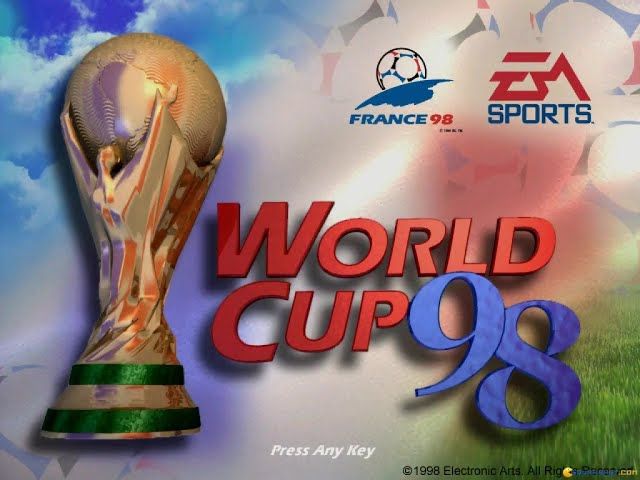
World Cup 98 is the first official FIFA World Cup video game developed by EA Sports, released in 1998 to coincide with the tournament in France. It marked a major technical leap for the series, moving from 2D to a 3D engine and featuring authentic team kits and stadiums. The game was praised for its atmosphere and gameplay, becoming a commercial success and a landmark title in sports gaming.
| Developer | EA Canada |
|---|---|
| Publisher | Electronic Arts (EA Sports) |
| Release | 1998 |
| Platforms | Microsoft Windows, PlayStation, Nintendo 64, Game Boy |
| Intro Song | Tubthumping by Chumbawamba |
| Game Engine | Based on FIFA: Road to World Cup 98 |
| Notable Feature | First EA Sports FIFA World Cup game in 3D |
| Japanese PS Title | FIFA World Cup 98: France Sōshūhen |
A New Era for FIFA Games
World Cup 98 represented a significant evolution for EA Sports' football series. After securing exclusive rights from FIFA in 1996 for all territories except Japan, the developer moved the franchise from its traditional 2D, top-down perspective to a full 3D engine, using DirectX for the PC version. This shift allowed for more realistic player models and animations. The game also introduced a new level of authenticity, featuring accurate national team kits complete with manufacturer logos, a first for the series. Goalkeepers, however, were issued a generic kit. The core gameplay was based on the earlier FIFA: Road to World Cup 98, with improvements made to in-game strategy adjustments and player positioning.
The game included all 32 nations that qualified for the 1998 World Cup finals, plus eight additional teams that did not make the tournament, such as Portugal, Russia, and Sweden. Every match in the World Cup mode was played in a digitally recreated version of its real-life stadium. The presentation was bolstered by commentary from John Motson and Chris Waddle in the UK version, with matches introduced by Des Lynam and Gary Lineker. In Japan, the PlayStation version was ported and published by Electronic Arts Square under a different title, FIFA World Cup 98: France Sōshūhen.
Game Modes and Historical Content
The primary mode was the World Cup tournament itself. Players could either follow the actual 1998 group draw or create random groups from the 40 available teams. The mode mirrored the real tournament rules, with group matches ending in draws and knockout games proceeding to extra time and penalty shootouts. After each match, a man of the match was awarded, and a clean sheet caption was shown if applicable. At the tournament's conclusion, virtual Golden Boot and FIFA Fair Play awards were presented. A standard friendly match mode was also included, where players could choose to finish a drawn game, play extra time with the golden goal rule, or go to a penalty shootout.
A standout feature was the World Cup Classics mode. This allowed players to relive fifteen historic matches from past tournaments. Winning the main World Cup mode unlocked the 1982 classic, and completing each match unlocked the next in chronological order. The mode featured period-accurate kits, except for goalkeepers, and hairstyles, with commentary for these matches provided by the BBC voice Kenneth Wolstenholme. For added nostalgia, matches from 1950, 1954, and 1966 were presented in black and white, while 1930 and 1938 matches used a sepia tone. The mode attempted historical accuracy by disabling substitutions for matches played before the rule was introduced, though this was also incorrectly applied to the 1970 final. Some inaccuracies remained, such as showing yellow and red cards in matches before 1970 and using generic brown leather balls for matches from 1970 onward instead of the period-correct Adidas designs.
Critical Reception and Commercial Success
World Cup 98 received generally favourable reviews across all platforms. Critics praised its fast reactions to controller commands, realistic player movement, clean graphics, excellent soundtrack, and adrenaline-pumping excitement. Reviewers noted it was an excellent companion to the real-world tournament and, for those who did not own FIFA 98, it was considered a must-buy for football or sports fans. The PC version was described by PC Guide as simply the best football game in the world, winning a group test against competitors like Actua Soccer 2 and Sensible Soccer '98.
However, a common critique was that the gameplay improvements over FIFA: Road to World Cup 98 were subtle but significant. Several reviewers, including those from Electronic Gaming Monthly and GamePro, advised that owners of the previous game might not find enough new content to warrant a purchase unless they were total soccer nuts. The game faced stiff competition from other football titles like International Superstar Soccer 64 and the upcoming International Superstar Soccer 98. Reviewers felt that while World Cup 98 played better than FIFA, it had less variety and its refinements were not huge. Despite this, World Cup 98 was a commercial hit. The PlayStation version was a bestseller in the UK, and the game earned a Gold prize at the 1999 Milia festival for generating over 48 million euros in EU revenue the previous year.
Awards and Deeper Critical Analysis
The game was recognized with several award nominations and wins. The PC version was a finalist for Computer Games Strategy Plus' 1998 Sports Game of the Year award, which ultimately went to Grand Prix Legends. The staff called the game superb, a tour de force of soccer simulation. Furthermore, the FIFA series collectively, including World Cup 98, FIFA: Road to World Cup 98, and FIFA 99, won the Best Sports award at Computer Gaming World's 1999 Premier Awards.
Individual reviews provided nuanced perspectives. Jeff Lackey of Computer Games Strategy Plus gave the PC version a perfect score, highlighting the improved player and goalie AI and the wonderful recreation of the World Cup atmosphere. Warren Christmas of PC Zone scored it 91 percent, calling it the finest football game on the PC. Brad Cook of AllGame noted its accessibility for novice players while offering wealth of options for experts. Conversely, Edge magazine scored the PC version a seven out of ten, stating that for owners of the previous title, it was a purchase for the completist or the extravagant. Cam Shea of Hyper awarded 90 percent across platforms but cautioned players who already owned FIFA 98 to think twice. James Ashton of N64 Magazine was less impressed with the Nintendo 64 version, scoring it 73 percent and calling it a highly desirable license but a flawed game.
Legacy and Technical Foundation
World Cup 98 confirmed EA Sports' hold on the official FIFA license and set a new standard for presentation and authenticity in football games. Its success led to future annual World Cup and FIFA series iterations. The game is remembered not just as a successful tie-in product, but as a technical and creative milestone. Its introduction of full 3D graphics, authentic licensing for team kits, and the inventive World Cup Classics mode created a template that would influence sports games for years to come.
The ability to customize national squads by selecting players from a reserves pool, a feature carried over from FIFA: Road to World Cup 98, allowed players to reflect the actual tournament rosters. This attention to detail, combined with the atmospheric stadium recreations and the energetic soundtrack led by Chumbawamba's Tubthumping, created a cohesive and immersive package. For many players, it defined the virtual experience of the 1998 World Cup, capturing the global excitement of the event in a way that few sports games had managed before. It proved that a licensed tournament game could be both a comprehensive simulation and a thrilling arcade-style experience.
FAQ
What platforms was World Cup 98 released on?
World Cup 98 was released for Microsoft Windows, PlayStation, and Nintendo 64. A separate version was also developed for the Game Boy by Tiertex Design Studios and published by THQ.
What was the intro song for World Cup 98?
The intro song for the game was Tubthumping by the band Chumbawamba.
Did World Cup 98 include teams that didn't qualify for the real tournament?
Yes, alongside all 32 qualified teams, the game included eight nations that did not qualify for the 1998 FIFA World Cup: Australia, Canada, China, Greece, Portugal, Republic of Ireland, Russia, and Sweden.
What was the World Cup Classics mode?
World Cup Classics was a special mode that let players replay fifteen famous matches from past World Cups. It featured period-accurate kits and commentary from Kenneth Wolstenholme. Matches from earlier eras were presented in black and white or sepia tone to mimic the television broadcasts of the time, though it contained some historical inaccuracies.
How was World Cup 98 different from FIFA: Road to World Cup 98?
World Cup 98 used the same 3D game engine as FIFA: Road to World Cup 98 but introduced minor gameplay improvements, such as better in-game strategy changes and player positioning. Its main focus was authentically recreating the 1998 World Cup tournament with correct stadiums and a dedicated Classics mode, whereas the earlier game had a broader international focus.
Source: English Wikipedia (CC BY-SA), rewritten by the Redington Cybersport desk.