FIFA: Road to World Cup 98
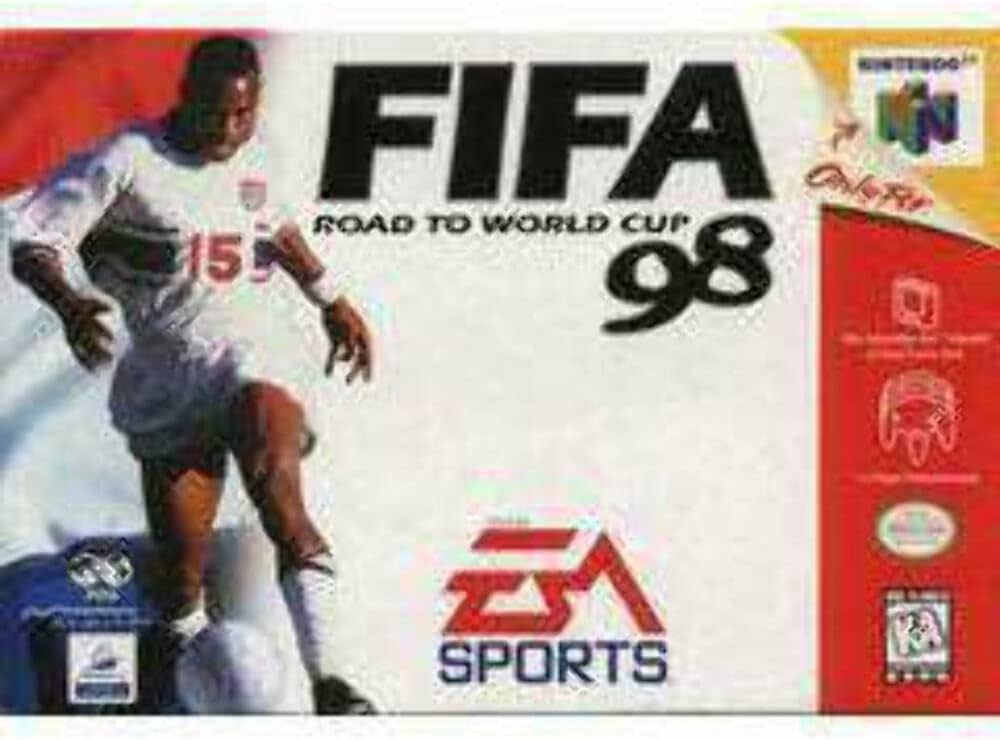
FIFA: Road to World Cup 98 is the fifth installment in EA Sports' football simulation series, released in 1997. It is remembered for its comprehensive content and 3D gameplay, which helped restore the franchise's reputation. The game's extensive licensing and innovative features established a new benchmark for sports video games.
| Developer | EA Canada |
|---|---|
| Publisher | EA Sports |
| Release Year | 1997 |
| Platforms | Windows, PlayStation, Nintendo 64, Sega Saturn, Sega Mega Drive, Super Nintendo Entertainment System (SNES) |
| Cover Athletes | David Beckham (UK), Roy Lassiter (US/Mexico/Brazil), David Ginola (France), Raúl (Spain/Portugal), Paolo Maldini (Italy), Andreas Möller (Germany) |
| Key Feature | Road to World Cup mode with 172 national teams |
| Soundtrack | Includes Blur's 'Song 2' and tracks by The Crystal Method |
| Motion Capture | David Ginola |
| Awards | PC Sports Game of the Year at the inaugural Interactive Achievement Awards (D.I.C.E. Awards) |
| Commercial Success | Bestseller in the UK; earned a 'Gold' prize at Milia 1999 for EU revenues above €37 million |
Unprecedented Scope and Depth
FIFA: Road to World Cup 98 offered a scale of content not seen in its era. The central Road to World Cup mode included every one of the 172 FIFA-registered national teams that took part in qualification for the 1998 tournament. This meant players could guide any country, from global powers to minnows, through a full qualification campaign. Brazil and France, as holders and hosts respectively, were also present despite their automatic qualification. This level of completeness was not seen again in the FIFA series until the 2010 World Cup game over a decade later.
Beyond the international game, FIFA 98 featured 11 domestic leagues with a total of 189 club teams. These clubs had accurate rosters, and for national teams, there were even reserve players available for call-up during the qualification modes. The game was the first in the series to give players individual faces, moving beyond generic models. It also introduced the series' first in-game editor, allowing players to customize teams and kits, and added a fast-paced five-a-side indoor mode. This combination of breadth and customizability provided a depth of play that was revolutionary for a sports title.
Gameplay Evolution and Technical Refinements
The game was built on the existing FIFA 97 engine but introduced significant improvements as the series' second full 3D entry on fifth-generation consoles. Sixteen stadiums were modeled, and artificial intelligence was enhanced. The animation was noted for its smoothness and the range of realistic moves, including header lobs, high volleys, and slide tackles. A crucial fix was made to the offside rule. In prior games, a player in an offside position was penalized even if the ball was passed backwards. FIFA 98 corrected this, awarding a free kick only if the pass was made forward toward the offside player.
Commentary was provided by the pairing of John Motson and Andy Gray, with Des Lynam handling the game's introduction. While critics praised the detailed player models and variety of actions, common criticisms focused on weaknesses in the AI, especially for goalkeepers, and occasional drops in the frame rate during matches. These were noted as areas where the game still had room for improvement.
A Landmark Licensed Soundtrack
FIFA: Road to World Cup 98 introduced a fully licensed soundtrack, a first for the series that influenced the identity of sports games. The theme was Blur's track 'Song 2', which became synonymous with the game. The soundtrack heavily featured the electronic music of The Crystal Method, including 'Keep Hope Alive', 'Busy Child' from their album 'Vegas', their debut single 'Now Is the Time', and an original track called 'More'. A song titled 'Hugga Bear' by the project Electric Skychurch rounded out the selection.
This move away from generic, in-house music to curated contemporary tracks created a distinct and energetic atmosphere. It connected the game directly to the music culture of the late 1990s and established a template of using popular music to enhance the overall experience, a practice that became standard in later sports titles.
Critical Acclaim and Platform-Specific Performance
The game was received as a strong return to form after FIFA 97. The dominant point of comparison for critics was Konami's International Superstar Soccer 64. The consensus held that ISS 64 retained an advantage in gameplay fluidity, but FIFA 98's legitimate strength was its exhaustive real-world licensing of players, teams, and leagues. Critics argued this official authenticity was a major draw for football fans, compelling enough to recommend owning both titles. One publication, GamePro, dissented from the majority view, stating FIFA 98 easily topped ISS 64 in overall gameplay.
Reception varied significantly across platforms. The Nintendo 64 version was lauded for effectively using the console's hardware. Reviewers said the PlayStation version was the best football game available on that system, praising its fast pace, graphics, and a slick new passing cursor. The Sega Saturn version, however, was a notable outlier. It suffered from technical issues like lagging commentary, broken player models, flat stadiums, and a slow frame rate that were not present in other versions. One magazine review was particularly harsh, questioning why anyone would buy it when a superior football game was already on the Saturn.
Commercial Success and Enduring Legacy
FIFA: Road to World Cup 98 was a major commercial hit. It was a bestseller in the United Kingdom for two consecutive months. At the 1999 Milia festival in Cannes, the game earned a Gold prize for generating revenues above 37 million euros in the European Union during the previous year. It also won the PC Sports Game of the Year award at the first-ever Interactive Achievement Awards, now known as the D.I.C.E. Awards.
The game marked the end of an era, being the final FIFA release for the 16-bit Sega Mega Drive and Super Nintendo Entertainment System, as well as the Sega Saturn. Its reputation has grown over time. On its 20th anniversary in 2017, it was argued that FIFA 98 should be considered one of the top sports video games. The argument centered on its depth of content, the full suite of national teams, multiple leagues, customization tools, and varied game modes. In an industry often defined by incremental annual updates, FIFA 98's package of features represented a major step forward in value and comprehensiveness, setting player expectations for years to come.
Development and Motion Capture
The development of FIFA: Road to World Cup 98 was led by EA Canada, building upon the technology base of FIFA 97. A key contributor to the game's improved animations was French international footballer David Ginola, who served as the motion capture actor for the project. His movements helped create more realistic player models and on-pitch actions.
The game's visual presentation was a step forward, with the player models receiving particular praise for their detail. The inclusion of individual faces for players, a series first, required significant artistic effort to differentiate the large roster of real-world athletes. This attention to authenticity extended to the kits and badges of the hundreds of licensed teams, confirming the game's claim as the most officially comprehensive football simulation of its time.
FAQ
What was the main game mode in FIFA: Road to World Cup 98?
The main mode was the Road to World Cup, which featured all 172 FIFA national teams that participated in qualification for the 1998 FIFA World Cup. This included teams that qualified automatically, like hosts France and holders Brazil.
Which famous song was the theme for FIFA 98?
The theme music for the game was 'Song 2' by the British band Blur. The soundtrack also included songs by The Crystal Method and Electric Skychurch.
Was FIFA 98 the first game to have real player faces?
Within the FIFA series, FIFA: Road to World Cup 98 was the first game to feature individual faces for players, adding a new layer of realism to the teams and rosters.
How did critics compare FIFA 98 to International Superstar Soccer 64?
Most critics felt International Superstar Soccer 64 had smoother, more fluid gameplay. However, they praised FIFA 98 for its extensive real-world licensing of teams and players, considering it a compelling reason for football fans to own both games. One publication, GamePro, argued that FIFA 98 topped ISS 64 in overall gameplay.
What award did FIFA: Road to World Cup 98 win?
The game won the award for PC Sports Game of the Year at the inaugural Interactive Achievement Awards, which are now known as the D.I.C.E. Awards.
Source: English Wikipedia (CC BY-SA), rewritten by the Redington Cybersport desk.