FIFA 97
FIFA 97 is the fourth installment in EA Sports' landmark football simulation series, released in 1996. It marked a significant visual leap with its polygonal player models and introduced a fast-paced indoor football mode, expanding the series' gameplay possibilities. While praised for its features and presentation, the game faced criticism for its sluggish pace on certain platforms.
| Developer | EA Sports |
|---|---|
| Publisher | EA Sports |
| Release Year | 1996 |
| Platforms | Windows, MS-DOS, PlayStation, Super Nintendo, Mega Drive, Sega Saturn (1997) |
| Cover Athlete (Europe) | David Ginola |
| Cover Athlete (Americas/Asia-Pacific) | Bebeto |
| Commentary | John Motson and Andy Gray |
| Presenter | Des Lynam |
| Key New Feature | Indoor football mode |
| Notable Leagues Featured | English Premier League, La Liga, Serie A, Bundesliga, others |
A Visual and Technical Step Forward
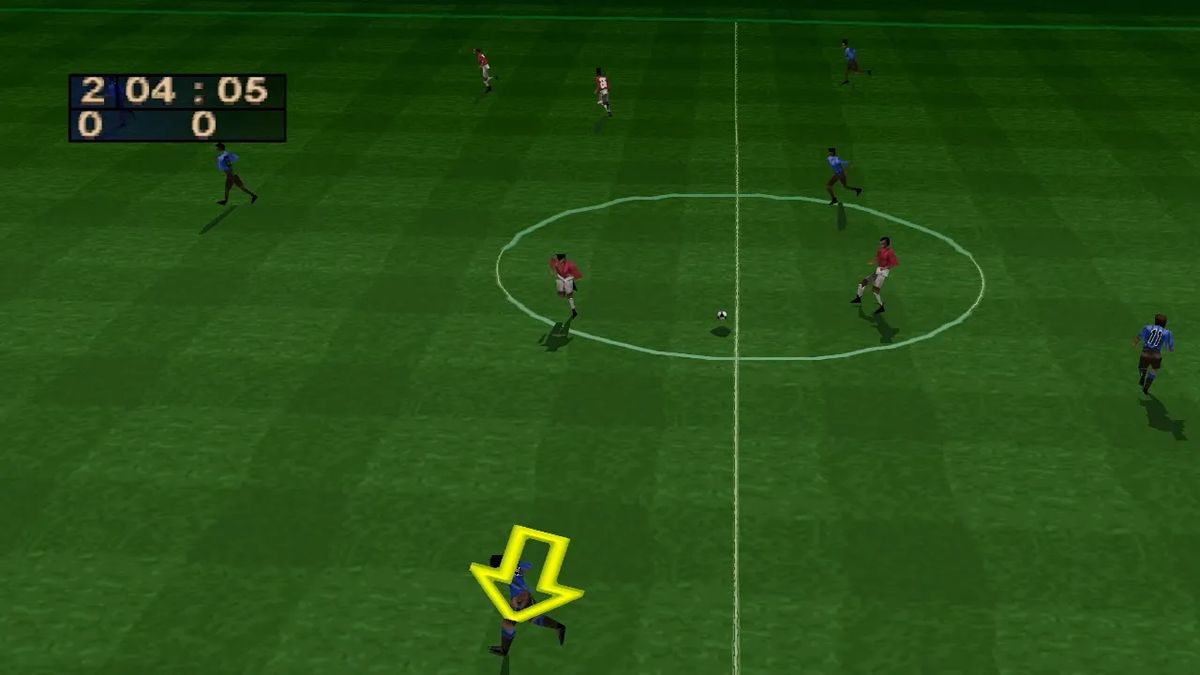
FIFA 97 represented a major graphical evolution for the series. It was the second game to use the Virtual Stadium engine but the first to replace the 2D sprites of FIFA 96 with fully polygonal player models. These models were animated using motion capture technology, with French star David Ginola, who also graced the European cover, serving as the capture subject. This shift aimed for greater realism in player movement and appearance.
The game was a multi-platform release, arriving on Windows, MS-DOS, PlayStation, Super Nintendo, and Mega Drive in 1996, with a Sega Saturn version following in 1997. The game utilized 32-bit AI and motion blending technology. Despite the visual upgrade, the core gameplay on the MS-DOS, Windows, and PlayStation versions was often described as sluggish, a point of contention among critics and players. The game's presentation was bolstered by a full commentary team from the BBC, with John Motson and Andy Gray providing match analysis and Des Lynam acting as the studio presenter. The game's trailer used the tagline 'FIFA 97, it will blow you away.'
Gameplay, Modes and Extensive Content
Beyond the new graphics, the headline addition to FIFA 97 was its indoor football mode. This six-a-side variant took place in an arena where the ball could bounce off the walls, eliminating throw-ins and creating a much faster, continuous style of play. The game offered six distinct ways to play, split between outdoor and indoor matches, as well as action and simulation modes. Multiplayer was robust, supporting up to 20 players via a Local Area Network and 8 players using a modem connection.
The roster was extensive for its time. It included most major European domestic leagues such as the English Premier League, La Liga, Serie A, Bundesliga, French Division 1, Eredivisie, Allsvenskan and the Scottish Football League, with clubs based on their 1995–96 season squads. The game also featured national teams, the Malaysian Liga Perdana, and American A-League clubs that were actually fictional teams named after the game's creators such as Bruce McMillan and Penny Lee. An unusual feature allowed players to create custom teams by selecting players from any real team, though these squads were restricted to friendly matches.
The Ambitious but Deeply Flawed Commentary System
FIFA 97's commentary was ambitious in scope, with John Motson recorded saying the names of the majority of players and all the teams in the game. To avoid a robotic sound, EA Sports had Motson record each phrase four different times, each in a different tone. However, this system was plagued by numerous logical and technical errors that became infamous among players.
Commentary mistakes included misidentifying players, such as calling Heart of Midlothian's John Millar 'Joe Miller', a player who was actually on Aberdeen in the game. The logic could also fail in basic play-by-play, describing a goal kick as being awarded to the wrong team or calling a kick-off a cross. A goal scored in the first minute might be inaccurately described as a goal that would surely win the match. Sometimes during Des Lynam's match introductions, Motson's voice would abruptly cut in with a single player's name instead of the team names. For example, an introduction for Partick Thistle versus Kilmarnock might be interrupted by Motson saying 'MacPherson.'
Player name pronunciation could also bizarrely change based on their in-game action, with Roy Aitken becoming 'Akin' during a defensive tackle or clearance. Similarly, Alessandro Del Piero, who was listed in the game as 'Del Piero Togon', would be referred to as 'Del Piero Tognon' followed by a hiccuping noise when he performed a tackle.
Critical Reception: A Divergence of Opinions
Critical reception for FIFA 97 varied significantly by platform and publication. The computer versions sold well, earning a Gold sales award from the Verband der Unterhaltungssoftware Deutschland for sales of at least 100,000 units across Germany, Austria and Switzerland. Reviews for the flagship PlayStation version were wide-ranging. GamePro gave it a rave review, particularly applauding the motion captured animations, crowd noises, and detailed commentary. GameSpot's Stephen Poole disagreed on the commentary, noting its inaccuracies, but opined that the slower pace of the gameplay was more realistic. He praised the indoor soccer feature and sharply rendered players, concluding the game did not disappoint.
Other critics were harsher. A reviewer for Next Generation called it the most disappointing EA Sports game in years, arguing the slow pace was simply boring rather than realistic, and criticizing the frame rate, control, and ball physics. The sports reviewers of Electronic Gaming Monthly took a middle ground, complimenting the graphics and realism but agreeing the play suffered from slow pace and controls. They rated it decent but not a contender against the leading soccer games. UK magazines Play and Official UK PlayStation Magazine both gave it middling scores, with Play noting it was graphically better than FIFA 96 but played worse.
Platform-Specific Ports and Comparisons
Reviews for the Sega Saturn port, released in 1997, were more uniformly middling. Critics often compared it unfavorably to Sega Worldwide Soccer 97. GamePro noted the graphics and audio were inferior to the PlayStation version. Saturn Power mentioned numerous aggravations with the controls and configurations, summarizing it as almost perversely entertaining for a game as flawed as it is. Sega Saturn Magazine found the AI too heavily flawed to provide an accurate simulation, concluding Sega Worldwide Soccer 97 was indisputably a wiser purchase. In 1998, Saturn Power ranked the game 95th on their Top 100 Sega Saturn Games, seeing it as an improvement over its predecessor despite flaws.
The 16-bit Genesis and Super NES versions were reviewed separately in GamePro. Both critics concluded the game was a must-have for newcomers to the series, but that existing FIFA fans would likely find it redundant due to minimal changes from previous installments. A separate brief review for the Game Boy version praised it for managing easy-to-follow graphics on the small screen, though noted the sprites moved at a sluggish pace. The reviewer found it fun to work through a lengthy tournament to the championship.
Legacy and Place in the Series
FIFA 97 occupies an important but flawed transitional place in the FIFA series. It is remembered for taking the bold step into 3D polygonal graphics, setting a visual standard for future titles, and for introducing the popular and fast-paced indoor mode that added lasting variety to the football simulation. The game's extensive league and team licenses, including lesser-known leagues like Malaysia's Liga Perdana, continued to establish EA Sports' reputation for breadth and authenticity.
However, the game is also remembered for its technical shortcomings and the perils of ambitious new technology. The sluggish gameplay on leading platforms and the famously glitchy, often illogical commentary are recalled as key weaknesses. The game demonstrated the challenges of transitioning a sports series to a new graphical generation while maintaining smooth performance. While it sold successfully and moved the series forward visually, its mixed and often platform-dependent reception highlighted that core gameplay, AI, and technical execution were critical areas needing refinement. These lessons directly informed the development priorities for subsequent FIFA games, making FIFA 97 a crucial, if imperfect, evolutionary step.
FAQ
What was the main new feature in FIFA 97?
The main new feature was the indoor football mode. This was a six-a-side game played in an arena where the ball could bounce off the walls, creating a faster pace with no throw-ins.
Which footballers were on the cover of FIFA 97?
David Ginola, then of Newcastle United, was on the cover for the European market. Brazilian striker Bebeto was featured on the cover for the Americas and Asia-Pacific markets.
What was wrong with the commentary in FIFA 97?
The commentary had numerous errors. It misidentified players, assigned goal kicks to the wrong team, and described actions incorrectly. Player name pronunciations could also change oddly based on whether they were attacking or defending, and Des Lynam's introductions were sometimes interrupted by John Motson saying a player's name.
Was FIFA 97 released on the Nintendo 64?
No, FIFA 97 was not released on the Nintendo 64. A game called FIFA Soccer 64 was initially announced as FIFA Soccer 97 but was released under a different name.
How was the Sega Saturn version of FIFA 97 received?
The Sega Saturn version received middling reviews. Critics often compared it unfavorably to Sega Worldwide Soccer 97, noting inferior graphics and audio compared to the PlayStation version, along with flawed AI and frustrating controls. One magazine later ranked it 95th on their list of top Saturn games.
Source: English Wikipedia (CC BY-SA), rewritten by the Redington Cybersport desk.