Defense of the Ancients
Defense of the Ancients (DotA) is a multiplayer online battle arena (MOBA) mod for Warcraft III that defined a genre. Its refined team-based gameplay, centered on controlling powerful heroes, became a global esports phenomenon and the direct inspiration for major commercial titles.
| Developer(s) | Community mod (Eul, Guinsoo, IceFrog) |
|---|---|
| Platform | PC (Warcraft III: The Frozen Throne) |
| Release | 2003 |
| Genre | MOBA |
| Mode | Multiplayer |
| Teams | Sentinel vs. Scourge |
| Map | Fixed |
| Legacy Title | Dota 2 (2013) |
Core Gameplay and Structure
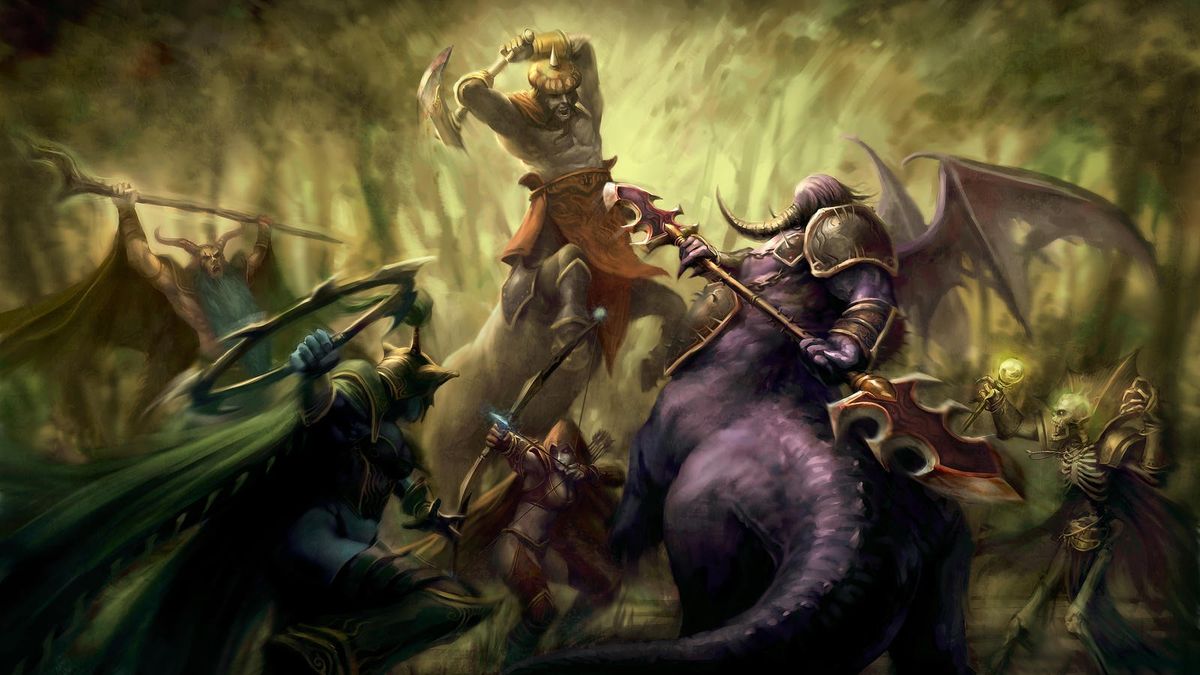
Defense of the Ancients is a five versus five team battle where the sole objective is to destroy the enemy team's Ancient, a heavily guarded structure in their base. The Sentinel team is based at the southwest corner of the map and the Scourge team at the northeast. Each base is defended by towers and waves of AI controlled units that guard the main paths. Players control a single hero unit chosen from a roster of over a hundred, each with its own abilities and tactical advantages. The game departs from traditional real-time strategy by removing base building and resource gathering, focusing entirely on hero combat and progression.
Heroes grow stronger by earning experience from defeating enemy units and neutral creatures. Accumulating enough experience allows the hero to level up, which improves their toughness and damage and allows players to upgrade their spells or skills. Gold, the game's primary resource, is earned through a small periodic income and, more importantly, by landing the killing blow on hostile units, structures, and enemy heroes. This creates the critical mechanic of last hitting. Gold is used to purchase items that strengthen the hero and grant new abilities. Certain items can be combined using recipes to create more powerful equipment, making strategic item choices a vital tactical element. The scenario is highly team oriented, making it difficult for one player to carry a team to victory alone.
Development and Key Figures
The mod's origins trace back to the Aeon of Strife custom map for StarCraft, where players controlled a single hero unit. Using the expanded Warcraft III World Editor, which allowed for the creation of custom heroes, modder Eul created the first version of Defense of the Ancients in 2003. After the release of the expansion The Frozen Throne, Eul did not update his scenario and instead made his map code open source. This led to a proliferation of Defense of the Ancients spinoffs that added new heroes, items, and features.
Among these variants was DotA Allstars, originally created by custom map makers Meian and Ragn0r, who compiled the most popular heroes into one map. In March 2004, Steve Guinsoo Feak assumed control of Allstars development. Feak introduced major systems like the item recipe system, which allowed equipment to scale with a hero's power, and added the powerful neutral boss Roshan, named after his bowling ball, who required an entire team to defeat. Feak used a Battle.net chat channel for players to congregate, but there was no official website.
Towards the end of 2005, development passed from Feak to Neichus and then to the pseudonymous IceFrog. IceFrog became the long term custodian, adding new features, heroes, and fixes. He maintained the map via official forums where users could post ideas, some of which were added to the game. IceFrog was known for quickly updating the map in response to feedback, though he was highly reclusive, with his authorship evidenced only by an email account and his name on the game's loading screen. Community infrastructure grew with the TDA clan. Member Steve Pendragon Mescon created the official dota allstars.com website, which by May 2009 had over 1.5 million registered users and over one million monthly visitors. After Mescon sold the domain to Riot Games, IceFrog moved the community to a new official site, playdota.com.
Rise as an Esport
DotA Allstars quickly transitioned from a popular custom map to a staple of competitive gaming. It was featured in a Computer Gaming World review of new Warcraft III maps in 2004. Its refined gameplay and high skill ceiling contributed to its widespread adoption in tournaments. Its debut at a major event was at Blizzard's BlizzCon convention in 2005.
It became a fixture at the Malaysia and Singapore World Cyber Games starting in 2005, and was included in the World Cyber Games Asian Championships from the 2006 season. The scenario was also part of the game lineup for the Cyberathlete Amateur League and the CyberEvolution leagues. Its inclusion in the 2008 Electronic Sports World Cup was noted by competition manager Oliver Paradis, who cited the game's high level of community support and worldwide appeal. The mod's extreme simplification of the real-time strategy formula, focusing on the spectacle of battles without complex management, made it more accessible for both players and spectators.
LAN tournaments were a major part of worldwide play, with events in Sweden and Russia. However, a noted lack of LAN tournaments and championships in North America led to several teams disbanding during the mod's peak. The game's popularity necessitated external tools for matchmaking, as Warcraft III custom games lacked such features. Programs were used to ping players' locations, and games could be named to exclude geographic regions. Clans and committees like TDA maintained official rules, and players could be kicked from matches via banlists.
Global Cultural Impact
Defense of the Ancients achieved extraordinary popularity in many parts of the world, especially in Europe and Asia. In the Philippines and Thailand, it was played as much as the game Counter-Strike. Its cultural reach was demonstrated in Northern Europe when Basshunter's song Vi sitter i Ventrilo och spelar DotA, inspired by the game, cracked the top ten singles charts in Sweden, Norway, and Finland.
In 2008, Michael Walbridge wrote that DotA was likely the most popular and discussed free, non supported game mod in the world. He pointed to the strong, self maintaining community as one of the map's greatest strengths. Former game journalist Luke Smith called DotA the ultimate RTS. Blizzard itself pointed to DotA as an example of what dedicated mapmakers could create using developer tools. Despite its popularity, the mod remained limited as a custom map, relying on manual matchmaking and updates, and containing no tutorials for new players.
Legacy and the Birth of a Genre
DotA is widely recognized as the most significant inspiration for the entire multiplayer online battle arena (MOBA) genre. It refined and popularized the core gameplay loop that became the genre standard. Its influence was immediate and direct on a wave of commercial titles often called DotA clones.
The 2009 game Demigod by Gas Powered Games was among the first to draw inspiration, with a review describing its aspiring gods as playing DotA in real life. Guinsoo, hired by Riot Games, applied the mechanics and lessons from Defense of the Ancients to the core design of League of Legends. Other direct descendants include Heroes of Newerth by S2 Games and Blizzard Entertainment's Heroes of the Storm. The MOBA design popularized by DotA also influenced games in other genres, such as third-person shooters and side scrolling platformers. Furthermore, DotA shed light on common genre challenges, including a steep learning curve for new players and the prevalence of toxic community behavior.
Transition to Dota 2 and Franchise
In October 2009, IceFrog was hired by Valve to lead a team in developing a standalone sequel. This move to commercialize the mod led to a legal dispute over the Dota trademark. Both Riot Games and Blizzard Entertainment legally challenged Valve's franchising of Dota. The dispute concluded in May 2012 with a settlement: Valve gained franchising rights for commercial use of the trademark, while non commercial use remained open to the public.
The resulting game, Dota 2, was officially released in July 2013. Its gameplay hewed closely to the original mod, maintaining its constants. Dota 2 added modern features like Steam support and profile tracking, which were intended to emphasize and support matchmaking and community, addressing some of the limitations of the original Warcraft III custom game system. This transition confirmed Defense of the Ancients as the foundation of a major esports franchise.
FAQ
What is the objective in Defense of the Ancients?
The objective is for a team of five players to destroy the enemy team's Ancient, a heavily guarded structure located in the opposing base. Each base is defended by towers and AI controlled units along the main paths.
Who created DotA?
The first version was created by modder Eul in 2003. The most popular version, DotA Allstars, was developed by Meian, Ragn0r, and later Steve Guinsoo Feak. Its long term maintenance and development from the mid 2000s onward was handled by the pseudonymous designer IceFrog.
Is DotA a standalone game?
No, the original Defense of the Ancients is a mod, or custom map, for the game Warcraft III: The Frozen Throne. It requires that base game to be played. A full standalone sequel, Dota 2, was released by Valve in 2013 after they acquired the commercial rights to the franchise.
Why was DotA so influential?
DotA refined and popularized the core MOBA mechanics of hero control, team fighting, and strategic item progression. Its massive popularity and competitive scene directly inspired major commercial games like League of Legends, Heroes of Newerth, and Demigod, effectively creating a new genre.
What was the community structure around DotA?
The community was initially organized through Battle.net chat channels and clans like TDA. The official website dota allstars.com, created by Steve Pendragon Mescon, grew to over 1.5 million users. After its sale, IceFrog moved the community to playdota.com. External tools and clan maintained rules and banlists were used to manage games and players.
Source: English Wikipedia (CC BY-SA), rewritten by the Redington Cybersport desk.