Tom Clancy's Rainbow Six: Vegas
Tom Clancy's Rainbow Six: Vegas is a tactical first-person shooter that revitalized the Rainbow Six franchise upon its 2006 release. It became a landmark title in competitive console esports as the first Xbox 360 game to be featured on the Major League Gaming Pro Circuit.
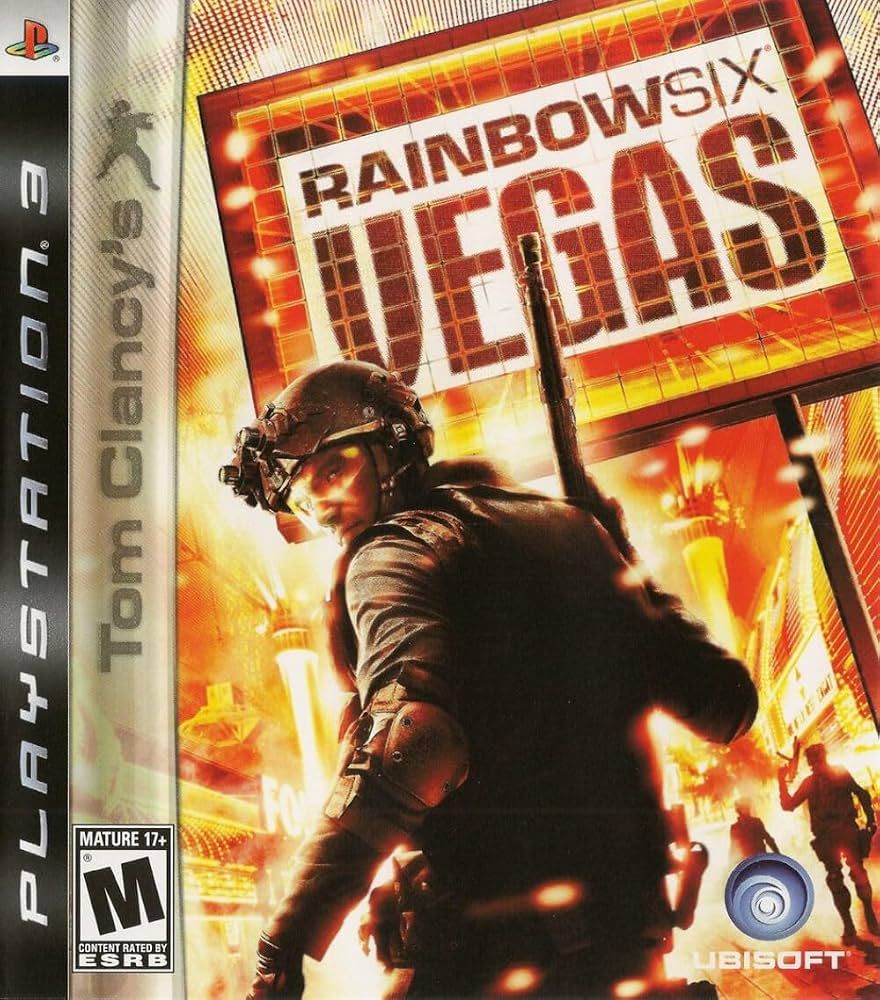
| Developer | Ubisoft Montreal |
|---|---|
| Release | November 2006 (Xbox 360), December 2006 (Windows), June 2007 (PlayStation 3, PSP) |
| Platforms | Xbox 360, Windows, PlayStation 3, PlayStation Portable |
| ESports Debut | 2007 Major League Gaming Pro Circuit |
| Notable Awards | First-Person Action Game of the Year (AIAS), Best Online Game (IGN, OXM), Best Action Game (Computer Games Magazine) |
| Sales (as of Mar 2007) | 1.7 million copies |
| Sequel | Tom Clancy's Rainbow Six: Vegas 2 (2008) |
A Tactical Evolution and Core Gameplay
Rainbow Six: Vegas marked a significant shift for the series, introducing mechanics that balanced tactical depth with more accessible action. The new regenerating health system allowed players to recover after breaking contact, a feature that became common in later shooters. This system had a critical limitation, as players could be killed instantly by grenades or close-range fire from powerful weapons like shotguns, especially to the head. When damaged, the player's vision became impaired, adding a layer of tension to combat encounters.
The game innovated with its perspective system. While aiming was done in a precise first-person view, players could switch to a third-person view to blind-fire around corners, a tactic useful for laying down suppression or covering fire without exposing oneself fully. Movement was greatly expanded with skills like rappelling up and down buildings while shooting and fast-roping into an area, which allowed for dynamic entries and vertical gameplay. The context-sensitive D-pad command system replaced the detailed mission planning of earlier games, giving players direct control over their AI squad's positioning and actions during combat. The game also omitted traditional cutscenes, instead telling its story through video feeds on an in-game heads-up display.
The Competitive Multiplayer Arena and MLG Circuit
The multiplayer component of Rainbow Six: Vegas was designed for intense, team-based play. Its tactical foundation, requiring coordination and map control, made it a natural fit for organized competition. This potential was recognized by Major League Gaming, which integrated the game into its 2007 Pro Circuit. Its debut at the season opener in Charlotte, North Carolina, was historic as the first Xbox 360 title to achieve this status. The game was featured throughout the entire 2007 season, culminating at the final stop in Las Vegas, Nevada, providing a fitting venue for its competitive farewell.
Post-launch support significantly enriched the competitive scene. Two major downloadable content packs, the Player's Pack Red Edition and Black Edition, added new maps and modes. The Red Edition, released in April 2007, introduced the Assassination mode, where one team protected a VIP, and Conquest, a capture and hold style game. It also added three new maps and two redesigned redux maps. The Black Edition, released in June 2007, added five more maps, including overhauls of classics from Rainbow Six 3. Notably, Ubisoft made both of these packs free of charge for the community, first on Xbox Live and later on PC. All new content remained compatible with the original game modes, ensuring a unified player base. The game's esports legacy was directly continued by its sequel, Rainbow Six: Vegas 2, which was featured on the 2008 MLG Pro Circuit.
Campaign Storylines: Console and Portable
The primary campaign follows Rainbow operative Logan Keller. After a mission in Mexico goes wrong, resulting in the capture of his teammates Gabriel Nowak and Kan Akahashi by terrorist Irena Morales, Keller is redeployed to Las Vegas. With a new team, he battles through a series of crises across the city, from the Calypso Casino to the luxury Vertigo Spire hotel. The team works to rescue hostages, disarm bombs, and uncover the terrorists' true objective. The narrative builds to a confrontation at the Nevada Dam, where Keller must stop a micro-pulse missile. The story concludes with a twist involving betrayal, and the player is given a choice regarding the fate of the traitor. A final news clip hints at unresolved mysteries.
The PlayStation Portable version is an entirely different game due to hardware limitations. It features a parallel storyline with new operatives, Brian Armstrong and Shawn Rivers. Their mission is initially to locate the kidnapped Rainbow operatives, but they uncover a separate biochemical plot by a villain named Lucas Picares to poison the Las Vegas water supply. This campaign is shorter, with about five missions each taking 20 to 30 minutes, and focuses on preventing this bio-weapon threat through locations like a private airport and a water filtration plant.
Critical Acclaim and Award-Winning Success
Rainbow Six: Vegas was released to very positive reviews from major outlets. The Xbox 360 edition was particularly praised, with IGN calling it the best first-person shooter on the platform and awarding a 9.3 out of 10. GameSpot scored it 9.1 out of 10, describing it as an excellent, immersive tactical shooter. Reviewers commended its fantastic visual design and game mechanics, though some criticized elements like certain voice acting.
The game's trophy case was extensive. It won Best First-Person Shooter, Best Xbox 360 First-Person Shooter, Best Online Game, and Best Xbox Live Game in IGN's Best of 2006 awards. It received an Editor's Choice Award from GameSpot. Official Xbox Magazine gave it the Best Online Game award in their annual rankings. Computer Games Magazine named it the Best Action Game of 2006 and the fourth-best computer game of the year. The highest industry honor came from the Academy of Interactive Arts & Sciences, which awarded it First-Person Action Game of the Year at the 10th Annual Interactive Achievement Awards, where it was also nominated for Outstanding Achievement in Art Direction.
Development, Sales, and Post-Launch Support
The game was in development for over two years, with a team of approximately 180 people at Ubisoft Montreal. This substantial investment resulted in a polished and feature-rich title. Commercially, it was a success, selling 1.7 million copies worldwide as of March 31, 2007. In the United Kingdom, the Xbox 360 version earned a Platinum sales award from ELSPA for selling at least 300,000 copies.
Ubisoft maintained active support for the title, confirming they would always provide support and working on multiple patches. The final patch updated the game to version 1.06. The company also released a Limited Collector's Edition at launch, featuring alternative cover art and a bonus disc containing a making-of documentary and a retrospective on the entire Rainbow Six series. The commitment to expanding the game was most evident in the Red and Black Player Packs. After a pricing error was corrected, the Black Edition was re-released for free, and Ubisoft reimbursed players who had paid. These packs were also included in the PlayStation 3 retail version, ensuring all console players had access to the expanded content.
Legacy and Place in Esports History
Rainbow Six: Vegas holds a distinct place in gaming history for bridging a hardcore tactical series with the emerging world of console esports. Its gameplay innovations, particularly the blend of first-person precision with third-person situational awareness and the regenerating health system, influenced the design of subsequent shooters. By proving that a tactical, team-based shooter could succeed on the MLG stage, it helped expand the types of games considered viable for professional console competition.
Its direct competitive legacy was carried forward by Rainbow Six: Vegas 2 on the 2008 MLG circuit. Furthermore, the game's longevity is attested by its continued playability on modern hardware, being playable on Xbox Series X with online features still available years after its release. From its award-winning critical reception to its pioneering role in esports, Rainbow Six: Vegas remains a defining chapter in the Rainbow Six saga and a milestone for competitive gaming on the Xbox 360 platform.
FAQ
When was Rainbow Six: Vegas released?
The game was released in stages. The Xbox 360 version launched in November 2006, followed by the Windows version in December 2006. The PlayStation 3 and PlayStation Portable versions were released in June 2007.
Was Rainbow Six: Vegas an esports title?
Yes. In early 2007, it became the first Xbox 360 game to be featured on the Major League Gaming Pro Circuit. It was played throughout the 2007 MLG season, with its final event held in Las Vegas.
What are the key gameplay features of Rainbow Six: Vegas?
Key features include a regenerating health system, the ability to switch to a third-person view for blind-firing, and new movement options like rappelling and fast-roping. It also introduced a context-sensitive command system for AI squadmates.
Did the game receive any downloadable content?
Yes. Two major DLC packs were released. The Player's Pack Red Edition added new game modes like Assassination and Conquest and new maps. The Player's Pack Black Edition added five more maps. Both were eventually made free for players.
How was the game received by critics?
The game received very positive reviews, especially on Xbox 360. It won multiple awards in 2006, including Best First-Person Shooter from IGN and First-Person Action Game of the Year from the Academy of Interactive Arts & Sciences.
Source: English Wikipedia (CC BY-SA), rewritten by the Redington Cybersport desk.