Super Smash Flash
Super Smash Flash is a popular series of fan-made browser fighting games inspired by Nintendo's Super Smash Bros. Developed by McLeodGaming, it has carved out a significant niche in the competitive gaming scene, evolving from a simple Flash project into a complex title with a dedicated online community.
| Developer | McLeodGaming (led by Greg McLeod/Cleod9) |
|---|---|
| First Release | Super Smash Flash (August 21, 2006) |
| Latest Release | Super Smash Flash 2 Beta (latest update: 1.4.0.1, May 13, 2025) |
| Platform | Web browser (Flash), PC |
| Genre | Crossover fighting game |
| Modes | Single-player, local multiplayer, online multiplayer |
| Notable Feature | Proprietary online network (McLeodGaming Network) |
| Inspiration | Super Smash Bros. series, primarily Super Smash Bros. Melee |
Gameplay Evolution and Core Mechanics
The core objective of both Super Smash Flash games mirrors the official Smash Bros. series. Players fight to knock opponents off the stage, with damage tracked by a percentage that increases knockback. The original 2006 game was a simplified interpretation. Characters had only five attacks each, activated by pressing the P key with an arrow key, and some had an extra jump attack. Multiplayer was limited to two human players with a camera that followed only player one, creating a noticeable disadvantage for the second player.
Super Smash Flash 2 represents a complete rebuild. It brought controls much closer to the official games, adding support for external game controllers. It introduced a dynamic camera system for up to four human players. The game also incorporated advanced mechanics like Special Smash, a mode where players can apply game modifiers. These include Mini, which shrinks all characters, Slow, which lowers game speed, and Turbo, a mechanic taken with permission from the fan game Project M that allows any attack to be cancelled on hit. Another modifier, called Super Smash Flash, recreates the glitchy engine of the original game, making attacks hit once per frame with no hitlag and removing ledge grabbing.
Characters and Roster Philosophy
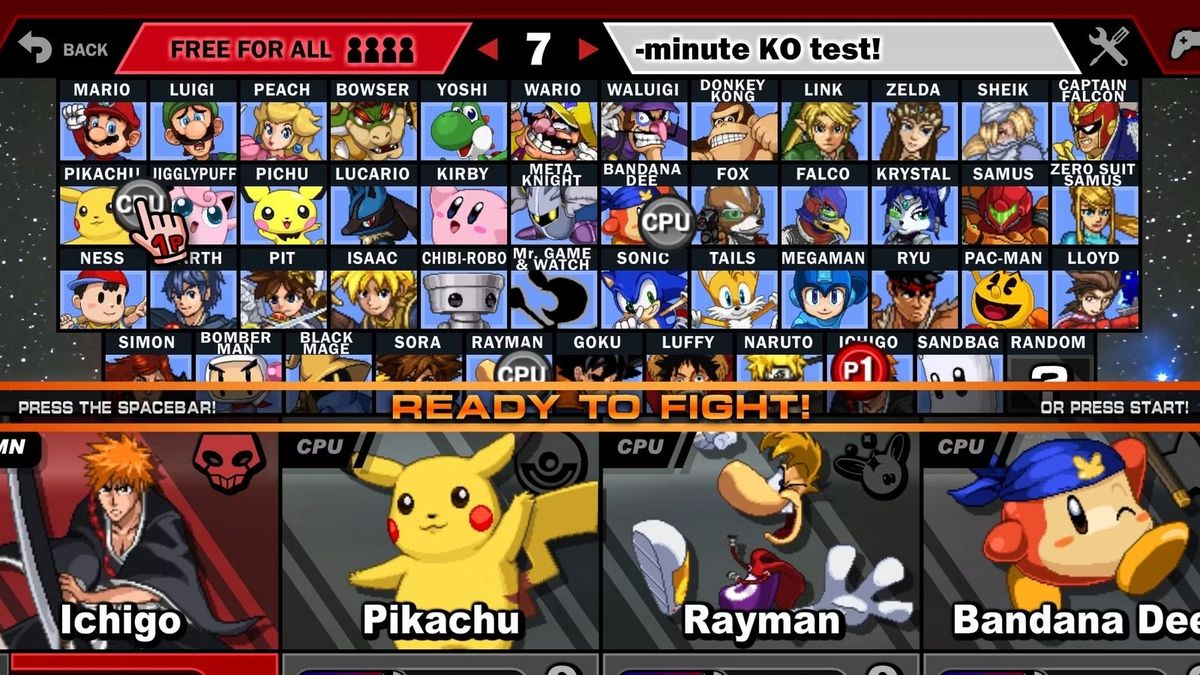
The original Super Smash Flash featured 30 playable characters drawn from a wide array of sources, including video games, manga, animated films, and original fan creations like the Sonic fan-characters Blade and Blue. Many characters required unlocking through gameplay. This eclectic mix was possible because it was a fan-made project not bound by official licenses.
For the reboot, the developers aimed for a more professional tone. Super Smash Flash 2 Beta currently features 48 characters, a number still subject to change as development continues. Fan-made newcomers from the first game were intentionally left out. The roster planning saw a major shift. In the v0.7 release on January 1, 2011, Black Mage was included as a hidden character unlocked after ten battles. This surprise addition, as he was not on the originally planned roster, shocked the fanbase and directly led McLeodGaming to announce a complete overhaul of the planned character lineup.
Expansive Single-Player and Stadium Content
Both games offer extensive single-player content designed to reward players with collectibles. The original featured three main modes. Regular Match contained Classic and Adventure Modes, with All-Star Mode unlocking later. Stadium offered minigames like Target Test, where players destroyed eight targets with each character's abilities, and Multi-Man Melee, fighting grey-shaded versions of the roster. A Training Mode was also available.
Super Smash Flash 2 greatly expanded these ideas. Its Classic Mode has a greater variety of opponents. All-Star Mode features a fixed order of opponents and more fighters per match. The Stadium was renamed and enriched. Target Smash offers four selectable levels with set patterns and a fifth level designed for each character's specific abilities. Multi-Man Smash now pits players against black-palette versions of Mario, Link, Kirby, and Pikachu with limited movesets and high stamina. The game reintroduced the Home-Run Contest from official Smash games, where players launch a Sandbag as far as possible, and added original modes like Crystal Smash, where the goal is to destroy many crystals quickly. An Event Mode with 51 specific missions provides further structured challenges.
Multiplayer Evolution and Online Infrastructure
Local multiplayer has always been a staple, though the original was limited by its Flash potential to two human players per match. Super Smash Flash 2's upgrade to four-player battles was a major improvement. The game also introduced an original multiplayer mode called Arena Mode, which uses the Sandbag for minigames. In Sandbag Soccer, players on red and blue teams in an enclosed stage try to score goals with the Sandbag. Sandbag Basketball features a similar premise with hoops.
A landmark addition was online multiplayer, introduced in demo version 0.9b via the proprietary McLeodGaming Network. This system typically uses peer-to-peer connections through Adobe RTMFP technology. Players can choose a high latency setting, which hands them off to a server instead. This feature allowed the community to grow beyond local play and was critical for competitive practice and casual matches.
Development History and Key Milestones
Development of the first Super Smash Flash began around mid-2006 as Cleod9's first major Flash project after learning Flash coding. It started not as a fighting game but as a combat-oriented platformer starring Sonic fan-characters, with the goal of destroying robotic Buzzers on suspended platforms. It was eventually reworked into what Cleod9 called a flash Smash engine, based on Super Smash Bros. Melee. Built in roughly six months without outside help, it was released on Newgrounds in August 2006. It is currently the 15th most played game ever on that site. Voice actor Kira Buckland, early in her career, was the announcer and voiced Naruto. Its accessibility was later affected by the discontinuation of Adobe Flash Player in 2020.
Work on Super Smash Flash 2 began in 2007. It was initially planned as a direct sequel but was rebooted as a completely new game, keeping the familiar title because of its recognition. Development updates were occasionally posted on a site called the Smash Flash DOJO and on social media. The project had two major turning points. Version 0.4a, released January 1, 2009, marked where the game became more complex, with Cleod stating the difficulty of adding new characters increased exponentially. The second was version 0.7 in 2011 with the Black Mage inclusion. The final demo, dubbed Super Smash Flash 2 Beta, was announced in January 2015 and released in May 2017 after almost three years of work. Updates to this beta version use a separate numbering system starting at 1.0.
Reception, Awards, and Tournament Presence
The original Super Smash Flash received a mixed critical reception. It earned a Newgrounds daily feature award, over 11 million views, and a four-star rating, and was later categorized as making Flash Portal History for 2006. However, some later reviews, like one on FlashGN, found it lacking control and called it a buggy and flawed attempt.
Super Smash Flash 2 has achieved greater acclaim and visibility. It was listed as number five in GamesRadar's 10 fan games that shouldn't be ceased or desisted while still in its infancy. A writer for Polygon praised its low-fi pixel art aesthetic and sense of freedom, saying it was more appealing than the real thing. Its demos maintained over 400,000 plays a day on McLeodGaming alone, peaking at over 1 million daily plays on January 20, 2013. Crucially, the game found a place in the competitive scene. The work-in-progress v0.9a demo was featured as an indie game at the worldwide Super Smash Bros. tournament Apex 2013, and returned the following two years with subsequent updates, giving it legitimacy within the fighting game community.
Legacy and the Path to Original Development
The Super Smash Flash series demonstrated the potential and passion of fan game development. It provided an accessible, browser-based Smash experience for years and fostered a dedicated community that played millions of times. The transition to SSF2 showed a commitment to professional quality and competitive depth, incorporating feedback and expanding mechanics far beyond the original's scope.
While SSF2 continues to receive updates like version 1.4.0.1 in 2025, McLeodGaming is also working on an original crossover fighting game called Fraymakers. This move indicates the team's evolution from creating fan projects based on existing properties to developing their own intellectual property, building on the technical and community management experience gathered through the long development of the Super Smash Flash series.
FAQ
What is Super Smash Flash?
Super Smash Flash is a series of fan-made, browser-based fighting games inspired by Nintendo's Super Smash Bros. series. The original was released in 2006, with a reboot, Super Smash Flash 2, currently in ongoing development.
Can you play Super Smash Flash online?
Yes, but only in Super Smash Flash 2. Starting with demo version 0.9b, the game features online multiplayer through a proprietary system called the McLeodGaming Network, using peer-to-peer connections or a server-based option for high latency.
How many characters are in Super Smash Flash 2?
The Super Smash Flash 2 Beta currently features 48 playable characters. This number is subject to change as the game is still in development. The roster does not include the fan-made characters from the original game.
What happened to the original Super Smash Flash game?
The original Super Smash Flash was released in 2006 on Newgrounds, where it was very popular. Its accessibility on standard web browsers was compromised after the discontinuation of Adobe Flash Player in 2020.
Has Super Smash Flash 2 been in tournaments?
Yes. The work-in-progress demo of Super Smash Flash 2 was featured as an indie game at the major Super Smash Bros. tournament Apex in 2013 and returned for the following two years, gaining recognition in the competitive scene.
Source: English Wikipedia (CC BY-SA), rewritten by the Redington Cybersport desk.