Pro Evolution Soccer 2019
Pro Evolution Soccer 2019 is the 18th installment in Konami's long-running football simulation series, released in August 2018. The game was notable for a significant expansion of licensed leagues and club partnerships, even as it marked the end of a decade-long licensing deal with UEFA's club competitions.
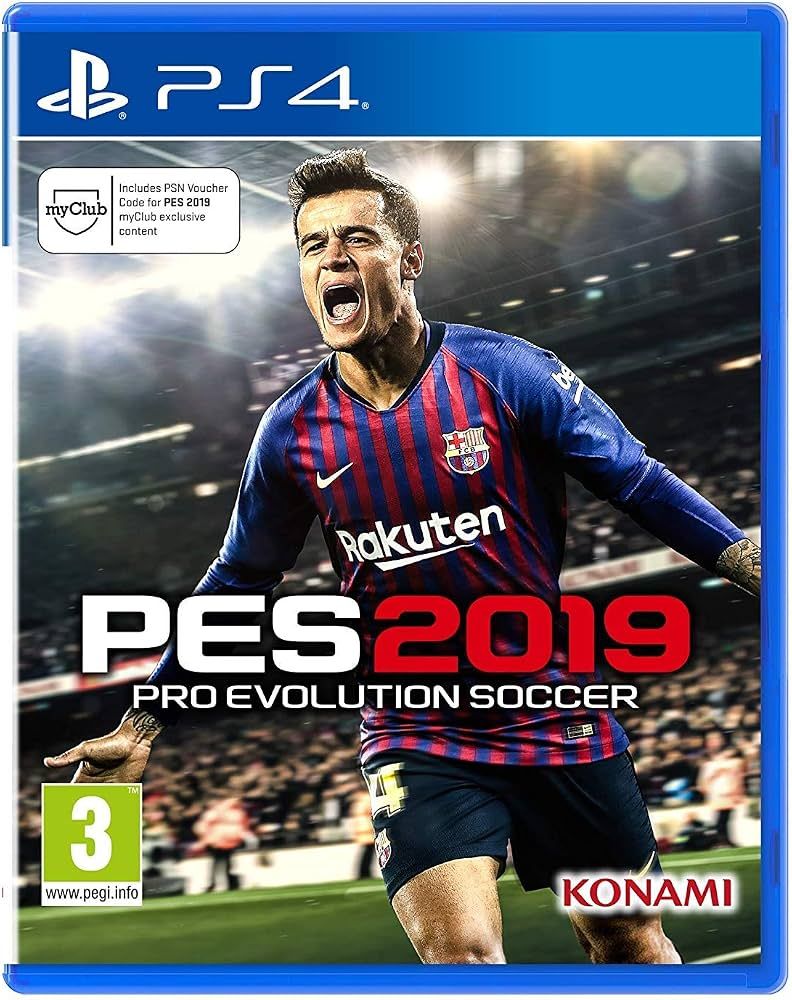
| Developer | PES Productions |
|---|---|
| Publisher | Konami |
| Release Date | 28 August 2018 (NA), 30 August 2018 (JP, EU, AU) |
| Platforms | Microsoft Windows, PlayStation 4, Xbox One |
| Cover Athlete | Philippe Coutinho (Standard), David Beckham (Legend) |
| Total Clubs | 355 (293 licensed) |
| Licensed Leagues | 17 (14 fully licensed) |
| Official Partner Clubs | 19 |
| Successor | eFootball Pro Evolution Soccer 2020 |
Gameplay and Technical Advancements
PES 2019 aimed to replicate real football by emphasizing distinct player skills and styles. Lionel Messi was modeled with a low center of gravity and powerful left foot to mirror his real-world play. The game introduced 11 new skill traits, including edge turn, control loop, dipping shot, and rising shot, designed to make player individuality more prominent during matches. Players could also customize goal celebrations for personalization.
Technical development focused on graphical fidelity. The game used Enlighten software to rework both natural and stadium lighting. Stands and pitches were designed to closely mirror their real-life appearances depending on the time of day. PES 2019 offered 4K HDR support across all compatible platforms and enhanced the full body touch system introduced in the previous installment. These improvements sought to create a more immersive visual and physical simulation of football.
Licensing Expansion and Major Loss
Konami significantly increased the number of official licenses in PES 2019. The game contained 355 clubs, with 293 licensed, marking an increase of 22 clubs and 79 more licensed sides compared to PES 2018. Seventeen leagues were playable, with fourteen fully licensed, a net gain of four leagues and ten new licensed leagues from the prior edition. New fully licensed leagues included the Argentine Primera División, Belgian First Division A, Danish Superliga, Portuguese Primeira Liga, Scottish Premiership, and Swiss Super League. An exclusive license was secured for the Russian Premier League.
This expansion was countered by a major loss. Konami did not renew its partnership with UEFA, ending a ten-year agreement after the 2018 Champions League final in Kyiv. This removed licenses for the UEFA Champions League, UEFA Europa League, and UEFA Super Cup from the game. UEFA marketing director Guy-Laurent Epstein thanked Konami for its commitment, while Konami's Jonas Lygaard stated the company would shift its focus to other areas while exploring alternative ways to work with UEFA on national team football.
Official Club Partnership Deals
Konami signed partnerships with 19 clubs to ensure faithful recreations with scanned players, kits, and stadiums. Twelve clubs continued deals from previous seasons, including FC Barcelona, Liverpool, Inter Milan, AC Milan, Arsenal, and several South American sides like Flamengo and River Plate. Five new clubs announced partnerships for PES 2019. These were Celtic, Rangers, AS Monaco, FC Schalke 04, and São Paulo.
The partnership with Schalke 04 came days after Borussia Dortmund prematurely terminated its existing agreement with Konami. Schalke's marketing director noted the deal highlighted the club's leading role in esports. The AS Monaco deal made captain Radamel Falcao a local ambassador, featuring on the French edition cover. Partnerships with Celtic and Rangers added the famous Old Firm derby, with their stadiums, Celtic Park and Ibrox, included via DLC. These agreements guaranteed player face scans and stadiums for these clubs, even if their leagues were already licensed.
League and Competition Details
Beyond the partner clubs, PES 2019 featured a complex mix of licensed and unlicensed content. Fully licensed leagues meant all teams featured real players, kits, and logos. The Brazilian Série A, French Ligue 1 and Ligue 2, and Dutch Eredivisie licenses were retained. The Argentine Primera División, which appeared unlicensed in PES 2018, became fully licensed. An exclusivity agreement was later reached with Argentine side Boca Juniors.
Major European leagues like the English Premier League, Spanish La Liga, and Italian Serie A appeared unlicensed with generic names. All Serie A clubs were licensed except Juventus. Fictional versions of the Italian and Spanish second divisions were removed. The AFC Champions League license was retained. Other individually licensed clubs not in fully licensed leagues included Bayer Leverkusen, Dinamo Zagreb, Shakhtar Donetsk, and several Greek teams. Notably, Borussia Dortmund and RB Leipzig, present in PES 2018, were absent from this edition.
New Features and Promotional Integration
PES 2019 introduced new modes and systems under the Magic Moments banner. The International Champions Cup preseason tournament was added. Club management saw improvements with a revised negotiation system, budget management tools, and new strategic options like re-selling players and clean sheet bonuses.
The game's integration into real-world football marketing reached a new level when Liverpool used PES 2019 in-game footage to unveil their new third kit, claiming to be the first club to launch a jersey with video game graphics. This demonstrated the increasing visual authenticity and cultural reach of the series. These features combined aimed to enhance both the immediate match experience and the long-term strategic depth of the game's various modes.
Legacy and Transition
Pro Evolution Soccer 2019 represented a peak in the series' push for broad licensing, securing more leagues and club partnerships than ever before. The detailed partnerships with clubs like Celtic, Rangers, and Schalke 04 showed a strategy of securing deep authenticity for specific teams amid ongoing competition for league-wide licenses.
The game was the final installment to be branded simply as PES. Konami decided to rebrand the series, with PES 2019 succeeded by eFootball Pro Evolution Soccer 2020, which later transitioned to the eFootball title. This edition, therefore, stands as the culmination of the traditional PES era, defined by its expanded roster of 355 clubs and its dual identity as a gameplay-focused simulator handling a complex landscape of football rights.
FAQ
When was Pro Evolution Soccer 2019 released?
PES 2019 was released on 28 August 2018 in North America and on 30 August 2018 in Japan, Europe, and Australia.
Which leagues are fully licensed in PES 2019?
Fully licensed leagues include the French Ligue 1 & Ligue 2, Dutch Eredivisie, Argentine Primera División, Belgian First Division A, Scottish Premiership, Portuguese Primeira Liga, Russian Premier League, and the AFC Champions League, among others.
Does PES 2019 have the UEFA Champions League?
No. Konami's 10-year partnership with UEFA ended after the 2018 final, so the Champions League, Europa League, and UEFA Super Cup licenses are not in PES 2019.
Which clubs were new official partners in PES 2019?
New partner clubs included Celtic, Rangers, AS Monaco, FC Schalke 04, and São Paulo. These partnerships ensured detailed player scans and stadiums for those teams.
What are some of the new gameplay features in PES 2019?
New features included 11 new skill traits like the no look pass and rising shot, an enhanced full body touch system, improved lighting graphics, and better management options like a re-sell function and clean sheet bonuses.
Source: English Wikipedia (CC BY-SA), rewritten by the Redington Cybersport desk.