Pro Evolution Soccer 2014
Pro Evolution Soccer 2014, officially abbreviated as PES 2014, was an association football video game developed and published by Konami in 2013. It represented a major technical overhaul for the series as the first installment built on the new Fox Engine. The game is historically significant as the final retail release for the PlayStation 2 console in Europe.
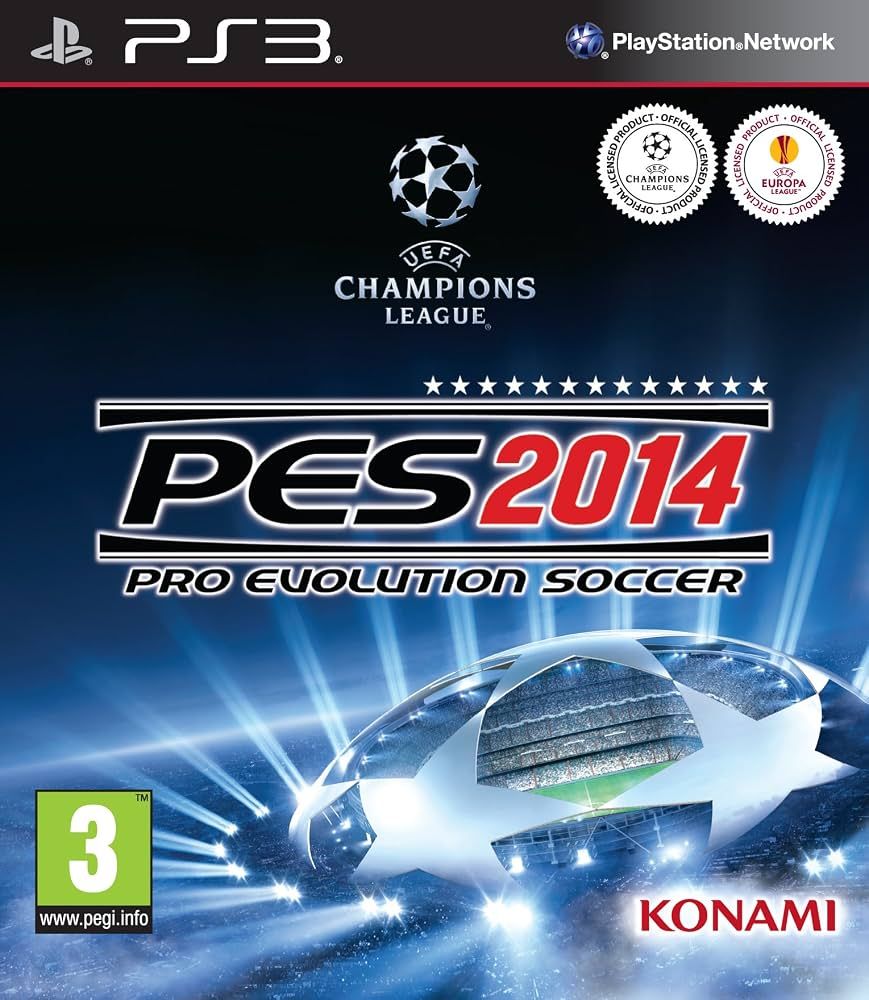
| Developer | Konami |
|---|---|
| Publisher | Konami |
| Release Date (EU) | September 19, 2013 |
| Release Date (UK) | September 20, 2013 |
| Release Date (JP) | November 14, 2013 |
| Platforms | Microsoft Windows, Nintendo 3DS, PlayStation 2, PlayStation 3, PlayStation Portable, Xbox 360 |
| Engine | Fox Engine |
| Preceded by | Pro Evolution Soccer 2013 |
| Succeeded by | Pro Evolution Soccer 2015 |
| Server Shutdown | November 17, 2015 |
The Fox Engine Transition and Core Design
PES 2014 was built on the Fox Engine, a cross-platform game engine developed by Kojima Productions and revealed by Konami in 2011. This engine was designed to shorten development time for multiplatform games and represented a move away from single-platform development. For PES 2014, the engine facilitated a new physics-based approach defined by six key elements, with all gameplay centered on the behavior of the ball. Factors like the physics of the ball itself, player stature, and the speed and height of passes were calculated to create a more realistic simulation. The engine integrated Havok technology to simulate each on-field player based on their individual mass and physique, with uniforms reacting to movement and speed. It is crucial to note that the PlayStation 2 version was the sole release not developed with the Fox Engine, instead retaining the technical profile of earlier versions.
Gameplay Innovations: M.A.S.S. and Tactical Depth
The Motion Animation Stability System, or M.A.S.S., was a central new feature powered by the Fox Engine. It aimed to drastically increase the realism of physical contacts between players, tackles, and decisions made by the artificial intelligence to produce more open, flowing matches. The system simulated the mass and physique of players to generate realistic collisions and movements. Critics noted that this could sometimes lead to an excessive amount of tussling on the pitch. Beyond physics, the game's atmosphere played a role, as the virtual audience was programmed to influence team performance. Furthermore, the performance of an individual player, whether brilliant or poor, would have a direct effect on team morale, either providing a boost or forcing teammates to offer extra support.
PES 2014 also expanded on existing systems. The Player ID feature, which first appeared in PES 2013 to replicate the movements and skills of star players, was increased in scope to cover more athletes and was applied to complete squads. This allowed the game to replicate a team's authentic playing style. The new Combination Plan feature gave users advanced tactical control, enabling the set-up of plays using three or more players in key areas. These players could execute specific runs, such as curved runs or overlapping flank play, to exploit spaces in the opponent's defense or midfield.
Licenses, Commentary, and Game Modes
The game maintained and expanded its portfolio of official licenses. It continued to feature fully licensed versions of the UEFA Champions League, UEFA Europa League, and UEFA Super Cup. For the first time in the series, PES 2014 secured an exclusive license for the AFC Champions League. League licenses included the Argentine Primera División and the Chilean Primera División. Commentary was a strong point, offered in multiple languages. The English commentary team was Jon Champion and Jim Beglin. Regional options included Arabic commentary by Rhaouf Khelif of beIN Sports, Argentine commentary by Mariano Closs and Fernando Niembro, and Chilean commentary by Fernando Solabarrieta and Patricio Yáñez of Fox Sports Latinoamérica. A Japanese commentary team of Jon Kabira, Tsuyoshi Kitazawa and Hiroshi Nanami was also featured.
In Master League, players gained the new ability to change clubs and also take charge of a national team. The game introduced the ability for users to create third and fourth kits for teams, with some of these kits being officially licensed. The UEFA Europa League appeared as a standalone mode playable without entering Master League or other career modes. Notably, certain features present in earlier games were absent. Rain effects were removed due to the engine upgrade, and the Stadium Editor and licensed La Liga stadiums were missing because of licensing restrictions.
Release, Regional Variations, and Post-Launch Support
Konami officially announced PES 2014 on March 10, 2013. The game was released on September 19 in Europe, September 20 in the United Kingdom, and November 14 in Japan. A playable demo became available for download on September 11. The PlayStation 2 version was released only in Europe. Beyond being the last PES game on the system in that region, it was the final game released on the PlayStation 2 platform overall. PES 2014 was also the last retailed PlayStation Portable game released in Europe and Mainland Asia.
A special Japanese version, World Soccer: Winning Eleven 2014 - Aoki Samurai no Chousen, was released on May 22, 2014. This edition included two new modes: the Japan Challenge, where the Japan national team competes to win the FIFA World Cup, and the fully licensed J.League, though the league was only included in the PlayStation 3 and Nintendo 3DS versions of this release. In March 2014, a downloadable content pack added the World Challenge mode, a tournament structured like the FIFA World Cup. This DLC provided official World Cup kits for licensed teams qualifying for the 2014 FIFA World Cup and made several unlicensed national teams playable, albeit with fictional player names and incorrect strips.
Critical Response and Legacy
PES 2014 received generally positive reviews from major publications. Reviewers widely praised the high-quality graphics enabled by the Fox Engine, noting that player movement and small details were delivered with a high level of craftsmanship. The improved ball control and passing received acclaim, with critics describing passing as crisp and zippy on the ground, while lofted balls could be driven or floated effectively. The introduction of a directional indicator for free kicks was highlighted as a positive addition, allowing for precise targeting of areas of the goal.
Criticisms were directed at technical and gameplay elements. Several reviews pointed out frame rate problems. The new M.A.S.S. system was cited by some as creating an overly physical game with unnecessary tussling. The artificial intelligence was sometimes criticized for ignoring loose balls that should have been easy to intercept. Some reviewers felt the game had lost a degree of the direct control and feel that characterized its predecessors, and commentary was noted as a weak point. The game's online and single-player modes also faced some criticism. Despite these points, the consensus acknowledged that PES 2014, with its improved visuals and core mechanics, could provide a fun and realistic game of football. Konami announced the shutdown of the game's online servers on August 11, 2015, with services terminating on November 17, 2015, to focus support on newer titles.
FAQ
What was the big new feature in PES 2014?
The most significant change was the move to the new Fox Engine, which powered improved graphics and physics. It also introduced the M.A.S.S. system for more realistic physical collisions and expanded the Player ID feature to affect whole teams' playing styles.
Was the UEFA Champions League in PES 2014?
Yes, PES 2014 featured full licenses for the UEFA Champions League, UEFA Europa League, and UEFA Super Cup. It also added an exclusive license for the AFC Champions League for the first time.
What was the World Challenge DLC?
Released in March 2014, the World Challenge was a downloadable tournament mode similar to the FIFA World Cup. It added official World Cup kits for licensed teams and made several unlicensed national teams playable for the first time.
Why is PES 2014 notable for the PlayStation 2?
PES 2014 was the last game ever released at retail for the PlayStation 2 in Europe. Its European PS2 release marked the final overall release for the entire PlayStation 2 platform.
When did the online servers for PES 2014 shut down?
Konami announced the shutdown of the PES 2014 game servers in August 2015, with the service officially ending on November 17, 2015, to focus resources on newer titles.
Source: English Wikipedia (CC BY-SA), rewritten by the Redington Cybersport desk.