Pro Evolution Soccer 2009
Pro Evolution Soccer 2009 (PES 2009) was a major entry in Konami's long-running football simulation series, notable for securing the exclusive license for the UEFA Champions League. It introduced significant gameplay innovations and a new career mode, confirming its place in the competitive gaming scene of the late 2000s.
| Developer | Konami |
|---|---|
| Release | 2008-2009 |
| Platforms | PlayStation 3, Xbox 360, PC, PlayStation 2, PSP, Wii |
| Exclusive License | UEFA Champions League |
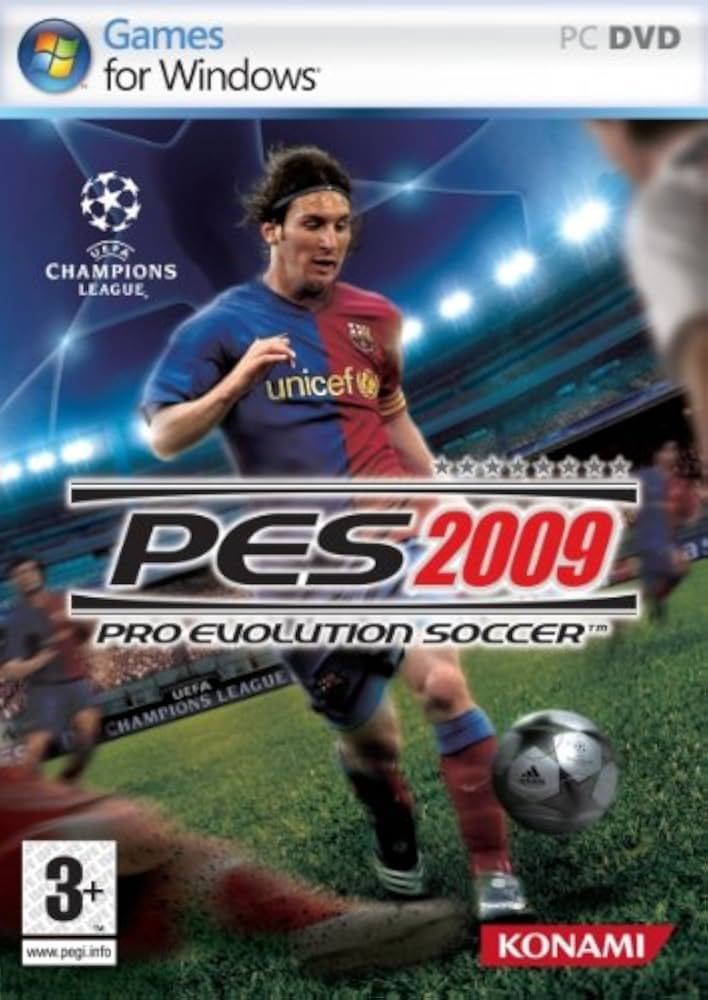
| Cover Athletes | Lionel Messi, Andrés Guardado |
| New Game Mode | Become A Legend |
| English Commentators | Jon Champion, Mark Lawrenson |
| Demo Release | October 2, 2008 |
Core Gameplay and AI Advancements
Pro Evolution Soccer 2009 built upon its predecessors with substantial changes to the on-pitch simulation. The Teamvision AI system was a central upgrade, designed to make computer-controlled teams react intelligently during a match. This system allowed tactics to change according to the situation, improved off-the-ball movement, and enabled the AI to recognize and remember strategies that worked against the player. This data accumulation occurred dynamically within the Master League and standard League modes, creating a more challenging and adaptive opponent.
Ball physics received a comprehensive rework, aiming for greater realism. New calculations for air resistance affected the ball's trajectory in the air. On the ground, new friction routines simulated different pitch conditions. The implementation of backspin routines meant the ball would slow down more realistically, and players could use the bounce of the ball in new ways. Skilled players could flick the ball up to set themselves for a volley or lift it over a defender's leg, adding a layer of technical flair to the attacking game. These changes collectively raised the skill ceiling for competitive play, rewarding precise control and strategic thinking.
The Become A Legend Mode and Demo
A defining new feature was the Become A Legend mode, which shifted focus from managing an entire team to forging the career of a single player. In this mode, the player started as a 17-year-old prospect and had to earn a place in the first team. Performance was everything. A series of strong displays could attract interest from Europe's biggest clubs and lead to a major transfer. Conversely, poor performances could see the player struggle in lower divisions and potentially be released by their club. This mode, originally introduced in Japanese editions as Fantasista, added a long-form, narrative-driven element to the PES experience.
Anticipation for the game was built with a playable demo, released on October 2, 2008, for the PlayStation 3, Xbox 360, and PC. The demo offered a five-minute exhibition match with a choice of six teams: Manchester United, Liverpool, Real Madrid, FC Barcelona, Italy, or France. It also included multiplayer options and promotional videos that detailed the new Become A Legend and online Legends modes, giving players a direct preview of the new single-player career journey.
Licensing Landscape and Presentation
The acquisition of the UEFA Champions League license was a major achievement for Konami, marking the first time the series featured the elite club competition. This license brought official branding and structure to the tournament within the game. However, the license did not automatically grant rights to all participating clubs. Many club licenses were held exclusively by EA Sports, the developer of the rival FIFA series. As a result, not every club in the Champions League was fully licensed or even present in PES 2009.
Club licensing remained a mixed area. In the Premier League, only Manchester United and Liverpool were fully represented with authentic kits, badges, and names. The rest of the league was integrated but unlicensed, featuring real player names but fictional club names, badges, and kits, all of which could be edited by the user. The game also included a separate league of 18 completely generic teams, labeled Team A through Team R, which could be fully edited. This feature was absent from the PlayStation 2 version, and the PSP version included only two teams in this extra league. The presentation package was bolstered by an association with Setanta Sports, which provided branding, and by a full suite of localized commentary teams led by Jon Champion and Mark Lawrenson in English.
The Distinct Wii Experience
Pro Evolution Soccer 2009 on the Nintendo Wii, released in March 2009 under the name Winning Eleven Play Maker 2009 in Japan, was developed as a separate product with its own mechanics. It expanded on the control system of its predecessor, focusing on the concept of players controlling both the athlete with the ball and the teammates around them. This was facilitated by the Wii Remote and Nunchuk.
The development team introduced an enhanced shooting system offering greater control and reworked defensive mechanics to provide more ways to close down attackers. A new AI system led to more sophisticated movement from computer-controlled teammates based on the player's commands. A notable addition was a cooperative play system where one player could use the Wii Remote and Nunchuk to control the team at a macro level, while a second player used a Classic Controller to direct individual players. The Wii version also received fresh game modes, including the Master League, an enhanced Champions Road competition, improved Edit Mode and online play, and a mode for training a player's Mii character.
Critical Reception and Sales Performance
Critical reception for PES 2009 ranged from positive to average, with significant variance between platforms. Review aggregate scores highlight this disparity. The Wii version was the most acclaimed, with scores of 85.46% on GameRankings and 84 out of 100 on Metacritic. The PlayStation 3 version scored 77.27% and 77 out of 100, the PC version 76.62% and 79 out of 100, the Xbox 360 version 73.54% and 74 out of 100, and the PSP version 77.20% and 75 out of 100. The PlayStation 2 version received the lowest scores at 68.67% and 72 out of 100.
In the Japanese market, the game found commercial success. The PlayStation 3 version was the 32nd best-selling game of 2008, selling 297,896 copies within that year. The PlayStation 2 version was the 100th best-selling game of 2008, with 135,128 copies sold that year, and achieved lifetime sales in Japan of 680,152 copies. These figures indicate a strong continued user base on the previous generation console alongside adoption on the newer PS3.
Role in Competitive Play and Legacy
Within the esports and competitive gaming community, Pro Evolution Soccer 2009 served as a standard for football simulation during its active period. The gameplay refinements, particularly the advanced Teamvision AI and realistic ball physics, demanded a higher level of mastery from players, distinguishing casual play from professional-level competition. The presence of the official UEFA Champions League license added a layer of prestige to tournaments, allowing events to mirror the structure and gravitas of the real-world competition.
The game's multi-platform availability meant it reached a wide audience, though the core competitive scene typically centered on the PlayStation and PC versions. While the Wii version offered innovative controls, its mechanics were distinct from the traditional simulation focus of other platforms. PES 2009 maintained the series' reputation for deep, tactical gameplay against its rival, ensuring its place in competitive circuits. The introduction of the Become A Legend mode, while not directly an esports feature, contributed to the game's overall depth and player engagement, factors that support a healthy competitive ecosystem. The title is remembered as a consequential release that balanced innovation with the core simulation values that defined the Pro Evolution Soccer series.
FAQ
What was the major new license in Pro Evolution Soccer 2009?
Pro Evolution Soccer 2009 secured the exclusive license for the UEFA Champions League, a first for the series. However, this license did not include rights to all participating clubs, so not every team in the tournament was fully licensed or even present in the game.
Which clubs from the Premier League were fully licensed in PES 2009?
Only two Premier League clubs were fully licensed in PES 2009: Manchester United and Liverpool. The rest of the league was represented with real player names but fictional club names, badges, and kits, which could be edited by players.
What was the 'Become A Legend' mode?
Become A Legend was a new career mode where players controlled a single footballer, starting as a 17-year-old prospect. Performance dictated their career path, with good play leading to transfers to top European clubs, while poor form could result in being relegated to lower leagues or released.
How did the Wii version of PES 2009 differ from others?
The Wii version, released in March 2009, used a control system letting players command both the ball carrier and surrounding teammates. It featured enhanced shooting and defense, a new AI system, cooperative play using different controllers, and exclusive modes like training a Mii character.
Who were the cover athletes and commentators for PES 2009?
Lionel Messi and Andrés Guardado were the global cover athletes, with Messi featured on all versions. The English commentary was provided by Jon Champion and Mark Lawrenson, with separate commentary teams for Japanese, German, French, Italian, and Spanish audiences.
Source: English Wikipedia (CC BY-SA), rewritten by the Redington Cybersport desk.