Pokémon video game series competitive play
Competitive Pokémon is the player versus player battle format of the mainline video game series, where trainers pit specially trained teams of creatures against each other. The scene has evolved from early fan simulations into a global competitive circuit with official world championships. It is defined by deep strategic team-building and its own, simultaneous turn-based battle system.
| First official video game championship | 2009 |
|---|---|
| Primary official format | Double battles (4v4) |
| Primary fan format | Single battles (6v6) |
| Key battle simulators | Pokémon Showdown, NetBattle |
| Major fan community | Smogon |
| Notable removed mechanics | Mega Evolution, Z-Moves |
| Recent mechanic | Terastallization |
| Developer | Game Freak |
Core Gameplay Mechanics
The foundation of competitive Pokémon is the turn based battle system where each trainer commands a team of creatures. Victory is achieved by knocking out all of the opponent's Pokémon. Each Pokémon possesses a type, such as Fire or Water, which creates a rock paper scissors system of strengths and weaknesses affecting damage. Beyond types, strategic depth comes from a Pokémon's six core stats HP, Attack, Defense, Special Attack, Special Defense, and Speed.
These stats are modified by hidden values. Individual Values, or IVs, are innate genetic strengths. Effort Values, or EVs, are points earned through training to boost specific stats. A Pokémon's nature will increase one stat while decreasing another. Pokémon can also hold items for passive benefits. A critical tactical layer is switching, where a trainer can recall a Pokémon to send out another, though this uses a turn and the incoming Pokémon may face an attack.
Moves are the actions a Pokémon can use in battle, ranging from direct damage to inflicting status conditions like paralysis. Abilities provide passive effects, like immunity to certain moves. The official tournament format uses double battles, where each trainer has two Pokémon active at once from a team of four. The broader fan community often prefers single battles, with one active Pokémon from a team of six.
Evolution of the Metagame
The competitive environment has shifted dramatically with each new game generation. The earliest games featured a unified Special stat and powerful Psychic type Pokémon. The second generation introduced Dark and Steel types to counter Psychic dominance. A major change came with Pokémon Diamond and Pearl, which split moves into physical and special categories based on the move itself, not its type, allowing for greater move variety.
Pokémon X and Y significantly rebalanced the game. It introduced the Fairy type, which is immune to Dragon attacks, nerfing a previously dominant type. It also limited permanent weather effects and added Mega Evolutions, temporary powerful forms for specific Pokémon. While popular, Mega Evolution was criticized for centralizing play around only the strongest forms. These changes signaled official interest in shaping competitive play.
Later generations introduced and then removed major mechanics. Sun and Moon brought one time use Z Moves, which were often disliked for their unpredictability. Sword and Shield removed both Mega Evolution and Z Moves, replacing them with Dynamax, which makes a Pokémon giant for three turns. The latest games, Scarlet and Violet, removed Dynamax and added Terastallization, allowing a Pokémon to change its type mid battle, opening new strategic avenues.
The Rise of the Community
Competitive play began in fan circles long before official support. In the early 2000s, players used text based simulators and message boards to share strategies. The 2004 release of the graphical simulator NetBattle and the founding of the Smogon community helped unite players. The scene gained mainstream traction with 2006's Pokémon Diamond and Pearl, which introduced online battling, making competition more accessible.
The community has developed its own robust ecosystem. The fan site Smogon creates usage based tiers for Pokémon and frequently holds Suspect Tests to ban overpowered strategies, though these rules only apply within its community. The battle simulator Pokémon Showdown, launched in 2011, is a fundamental tool for practice and fan competition, averaging over a million monthly visitors. Fans have also created their own formats, like draft leagues inspired by professional sports.
Game developers have gradually added features to lower the barrier to entry. Tools like Super Training for EV training, nature mints to change a Pokémon's nature, and online team rental have made constructing competitive teams less tedious. The Pokémon Global Link once provided data on popular strategies, though it was discontinued in the Sword and Shield era, which also introduced a proper ranked online mode.
Official Tournament Circuit
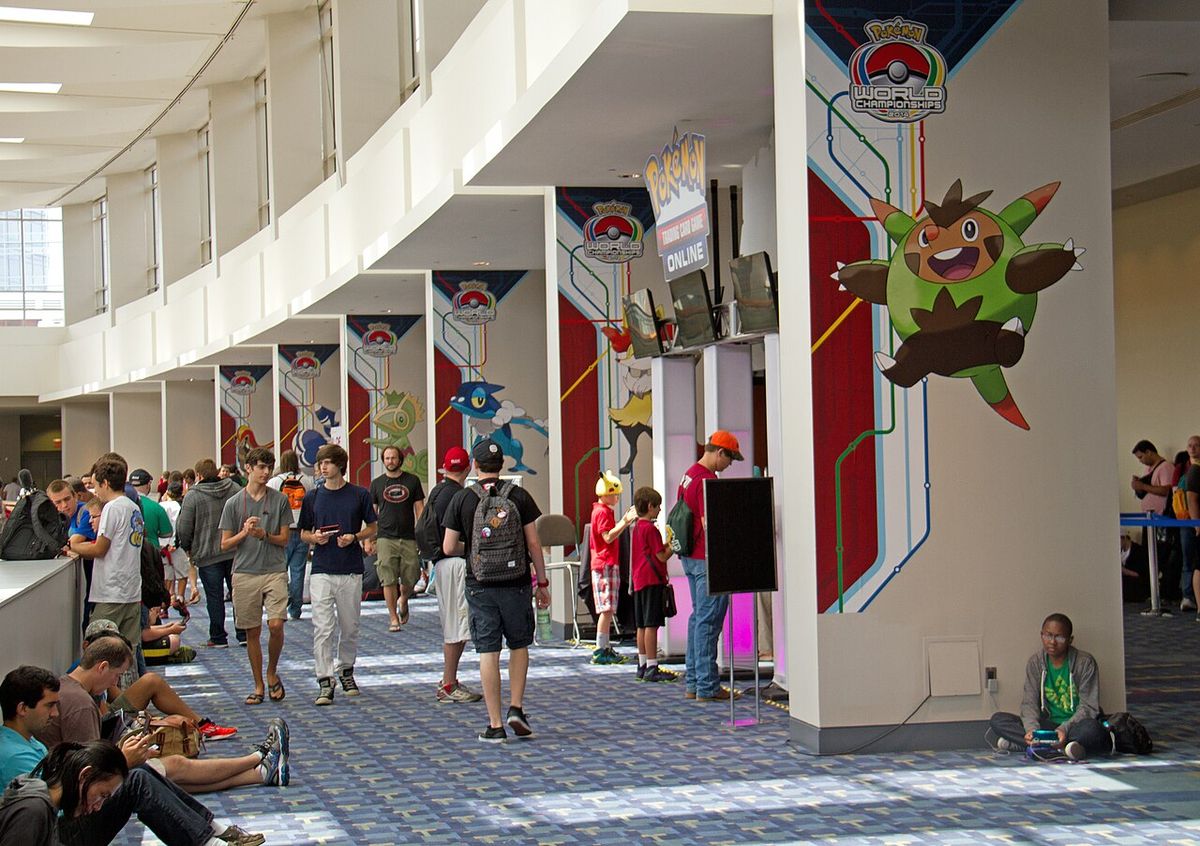
The Pokémon Company formalized competition with the Pokémon World Championships. While the event started for the Trading Card Game in 2004, video game competitions were added in 2009. The championships are typically held yearly, though they were cancelled in 2020 and 2021 due to the COVID 19 pandemic. To qualify, players must earn enough points by competing in official events in their country.
The World Championships is a three day tournament beginning with Swiss rounds before moving to elimination stages. The official format always uses double battles, contrasting with the fan community's preference for singles. This official circuit represents the top level of competitive play, with players dedicating significant time and resources to train teams and travel to events. The existence of this circuit has encouraged the integration of more competitive friendly features into the main series games.
Strategies and Team Composition
Competitive team building is a complex puzzle of synergy and prediction. Teams are built around specific strategies beyond simply dealing damage. Weather teams utilize abilities or moves to summon rain, sun, or sandstorm, powering up compatible Pokémon. Other strategies focus on controlling the battlefield with entry hazards that damage opponents when they switch in, or using moves like Trick Room to make slower Pokémon move first.
Speed control is a universal concern. Moves like Tailwind boost a team's speed, while paralysis slows foes. Terrain moves set zones on the battlefield that provide passive effects, like boosting certain move types or preventing sleep. Successful teams must balance offensive power, defensive resilience, and strategic utility, all while anticipating the popular tactics of the current game generation. This constant adaptation is central to high level play.
Debates and Criticisms
The competitive scene, while generally seen as welcoming, faces several points of contention. A significant barrier is the substantial time and sometimes monetary investment required to breed and train ideal Pokémon for official events. This has led to widespread debate over the use of hacked or generated Pokémon that have perfect stats, with some players viewing them as a necessary equalizer and others as cheating.
There is also a philosophical divide on how the game should be played. The official double battle format differs from the fan preferred single battles, creating two parallel competitive scenes with different balances and strategies. Decisions by game developers, such as Sword and Shield reducing the battle timer to twenty minutes or removing certain Pokémon species entirely, have been met with mixed reactions from competitive players, even when controversial in the wider fanbase.
FAQ
What is the difference between official and fan competitive Pokémon?
The official tournament circuit run by The Pokémon Company uses a double battle format, where each trainer has two Pokémon active from a team of four. The fan community, led by sites like Smogon, primarily uses a single battle format with teams of six. Official events follow the game's standard rules, while fan communities often create their own tier lists and bans.
How do players get Pokémon with perfect stats for competition?
Players use in game systems like breeding to obtain Pokémon with high Individual Values (IVs) and the correct nature. They then train them using Effort Values (EVs) to boost specific stats. Modern games have added features like nature mints and easier EV training to simplify this process. The use of hacked or generated perfect Pokémon is a topic of significant debate in the community.
What are Smogon and Pokémon Showdown?
Smogon is a major fan community that creates usage based tiers for Pokémon and hosts its own competitive forums and rulesets. Pokémon Showdown is a popular online battle simulator launched in 2011 that allows players to quickly build and test teams using Smogon's rules, averaging over a million visitors per month. They are central to the fan competitive scene but separate from official events.
What was the impact of Pokémon Diamond and Pearl on competitive play?
The release of Pokémon Diamond and Pearl in 2006 was a major turning point as it introduced online battling to the main series games. This made player versus player competition far more accessible and convenient, kickstarting the mainstream popularity of the competitive scene and leading to the growth of online communities and eventual official support.
What is the Pokémon World Championships?
The Pokémon World Championships is the premier official tournament for the video game and trading card game, first including video games in 2009. Players earn invites by collecting points from national events. It is typically a yearly three day event featuring Swiss and elimination rounds, though it was cancelled in 2020 and 2021 due to the COVID 19 pandemic.
Source: English Wikipedia (CC BY-SA), rewritten by the Redington Cybersport desk.