FIFA World Cup: Launch Edition
FIFA World Cup: Launch Edition is a football simulation video game released in June 2026 to coincide with the FIFA World Cup. It marked FIFA's first gaming venture after its split from EA Sports and was available exclusively through Netflix Games as part of a subscription.
| Developer | Refactor Games |
|---|---|
| Publisher | Delphi Interactive |
| License | FIFA |
| Release Date | 11 June 2026 |
| Platform | Netflix Games |
| Game Modes | Single-player, Multiplayer (up to 4 players) |
| Launch Teams | 48 national teams |
| Launch Players | Over 1,200 licensed players |
| Launch Stadiums | 16 tournament stadiums |
A New Era for FIFA Gaming
The release of FIFA World Cup: Launch Edition represented a significant shift in the digital football landscape. Following the end of FIFA's long partnership with EA Sports, the organization sought a new direction for its gaming strategy. This title, described as a Launch Edition, was positioned as the first step in a broader plan to reach fans directly. FIFA President Gianni Infantino framed the collaboration with Netflix and Delphi Interactive as a key milestone in innovation, aiming to reach billions of football fans of all ages everywhere in the world. He stated this reimagined game marked the beginning of a new era of digital football. The game was offered for free to all Netflix subscribers, making it a highly accessible entry point into the sport. Alain Tascan, President of Games at Netflix, stated the goal was to bring football back to its roots with something everyone could play with just the touch of a button, calling the FIFA World Cup the cultural event of 2026.
Gameplay and Features
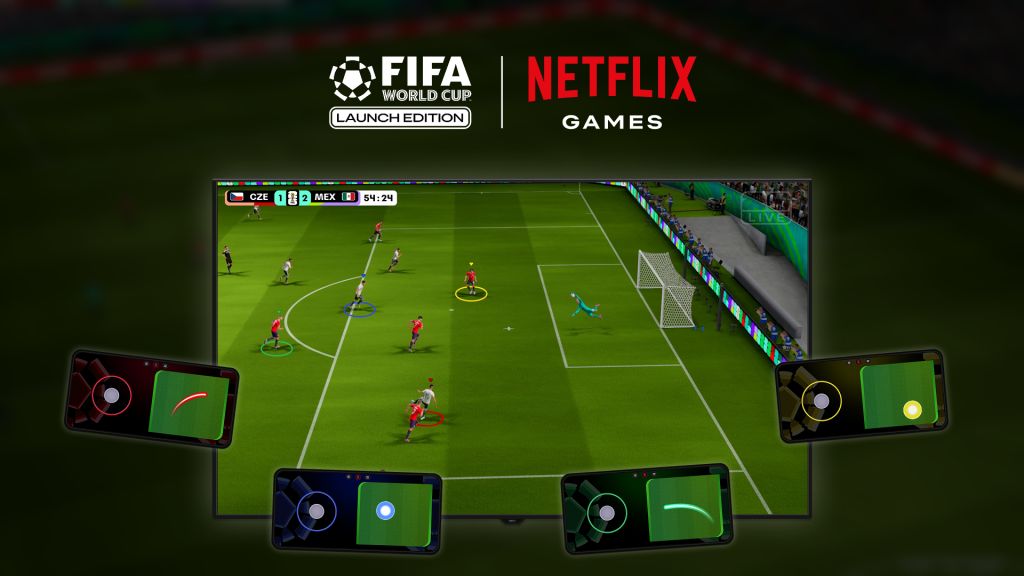
FIFA World Cup: Launch Edition was designed as a fast paced and easy to learn football game, built for casual and social play. Its core feature was a control scheme where a player's mobile phone, connected to a television via a QR code, served as the controller. This allowed for quick setup and intuitive play, with the phone functioning as the controller and the TV as the stadium. The game supported matches with up to four players simultaneously. At launch, it featured the complete official setting of the 2026 World Cup, including all 48 qualified national teams, all 16 tournament stadiums across the United States, Mexico, and Canada, and over 1,200 licensed players, specifically noted as 1248 players. The game format was promoted as fast to learn and thrilling to master, built for anyone to jump in, whether playing solo or with friends, and was intended to deliver the emotion and drama of the tournament in its purest and most joyful form.
Development and Strategic Rollout
The project was first announced in December 2025 as a collaboration between Netflix, FIFA, and publisher Delphi Interactive. The full title and release date were revealed on 4 June 2026, with the game launching globally on Netflix Games on 11 June, the same day as the World Cup's opening match. This careful timing was designed to maximize engagement with the real world tournament. Prior to the full release, a limited test was conducted in Brazil and Germany starting 4 June. The initial global rollout included a specific list of countries: the United States, Canada, the UK, France, Italy, Mexico, Spain, Austria, Australia, Belgium, Finland, Ireland, the Netherlands, New Zealand, Poland, South Africa, Sweden, and Switzerland. Plans were in place to expand to more countries, and users could sign up for email updates to be notified when the game became playable in their region. This phased approach indicated a live service model for the game's availability.
Marketing and Cross-Platform Promotion
Netflix leveraged its platform and brand identity in a comprehensive marketing campaign for the game. A notable advertising campaign featured Brazilian football legend Ronaldo, a two time World Cup winner, facing off against well known Netflix characters like the Front Man from Squid Game and Thing from Wednesday. This crossover highlighted the game's position within the Netflix ecosystem and aimed to attract subscribers from different fan bases. Executives consistently described the title as bringing football back to its roots with simple, accessible fun. The game was heavily promoted as an exclusive benefit for Netflix members, included in all subscription plans without extra cost. Promotional material emphasized that all a player needed was Netflix and their phone, with the tagline that only one hand could take the trophy. The marketing framed the experience as a way for fans to celebrate their fandom by bringing the game right into their living rooms.
Critical Reception and Specific Criticisms
Critical response to FIFA World Cup: Launch Edition was largely negative. Reviewers were critical of several technical aspects. Luke Plunkett of Aftermath was particularly harsh, citing dated graphics, poor artificial intelligence, and the touchscreen controls as major flaws. He argued the game mishandled the World Cup license and symbolized broader problems in modern sports and entertainment, stating that the game encapsulated the greed, laziness, and contempt of the cost cutting executive class, calling it the encapsulation of almost everything wrong with modern sports, modern entertainment and the cost cutting executive class. Video Games Chronicle's Chris Scullion echoed these criticisms about the gameplay and presentation. However, Scullion did offer some praise for the game's licensed soundtrack, which was a rare positive note in otherwise poor reviews. These reviews contrasted sharply with the official messaging of a pure and joyful football experience.
Place in the Market and Future Plans
FIFA World Cup: Launch Edition served as the inaugural product in FIFA's post EA Sports gaming strategy. It was explicitly framed as a starting point, a streamlined version intended to receive additional features and updates over time. FIFA described the Launch Edition as representing the kickoff, a streamlined, high energy version of the game focused on immediate fun. The organization stated that as the tournament progressed and the FIFA World Cup: Launch Edition community grew, Netflix would lay on more features. Its release on Netflix Games two weeks before the competing title FIFA Heroes signaled a new phase for football video games, creating direct competition. By tying the game directly to a Netflix subscription, it tested a new distribution model for major sports licenses, aiming for mass accessibility rather than traditional retail sales. This model was part of FIFA's stated commitment to innovation in the football gaming space.
Technical Access and Platform Integration
Accessing the game was deeply integrated into the Netflix platform's interface. Users were instructed to scroll to the Games tab on their television to find FIFA World Cup: Launch Edition. They would then scan the on screen QR code with their phone to set up the controller and jump into the action. The game could be played instantly on a TV or through a web browser, with the phone functioning as the primary input device. This design choice was central to its identity as a living room social game, removing the need for dedicated console hardware or traditional game controllers. The requirement of a Netflix membership was the only barrier to entry, as the game was included in all Netflix membership plans without additional purchase. This smooth integration was a key selling point, emphasizing instant playability for subscribers.
Post-Launch Context and Legacy
Following the conclusion of the 2026 FIFA World Cup, the game remained available on Netflix, allowing fans to continue playing a newly reimagined FIFA soccer simulation. Promotional material after the tournament highlighted this enduring access, framing the game as a way to relive the event. The project demonstrated FIFA's attempt to control its digital future directly through partnerships with streaming and gaming companies. The critical panning of the Launch Edition posed a significant challenge to this strategy, questioning whether the accessible, phone controlled model could satisfy core gaming audiences. The promise of ongoing updates positioned it as a live service, but its initial reception set a difficult precedent for future development. The game's existence fundamentally altered the dynamics of football gaming licenses, introducing a major streaming platform as a primary games publisher.
FAQ
What is FIFA World Cup: Launch Edition?
It is a football simulation video game released in June 2026 to coincide with the FIFA World Cup. It was the first FIFA game released after the split from EA Sports and was available exclusively through Netflix Games as part of a subscription.
How do you play FIFA World Cup: Launch Edition?
Players use their mobile phone as a controller by scanning a QR code displayed on their television or web browser. The game supports matches for up to four players simultaneously and is designed to be fast and easy to learn.
What content is included in the game?
At launch, the game included all 48 national teams from the 2026 World Cup, 1248 licensed players, and all 16 official tournament stadiums located across the United States, Mexico, and Canada.
Is FIFA World Cup: Launch Edition free?
Yes, the game is included at no extra cost with any Netflix subscription. It was promoted as being free for all Netflix members worldwide and was part of all membership plans.
How was the game received by critics?
The game received negative reviews from critics. Common criticisms included dated graphics, poor artificial intelligence, and problematic touchscreen controls. One reviewer said it mishandled the license and represented broader problems in sports entertainment, though the licensed soundtrack received some praise.
Source: English Wikipedia (CC BY-SA), rewritten by the Redington Cybersport desk.