FIFA Soccer 64
FIFA Soccer 64 was Electronic Arts' ambitious but flawed debut soccer simulation for the Nintendo 64. While praised for its depth of options and realistic simulation, it was critically panned for its technical shortcomings and was widely considered inferior to its main competitor on the platform.
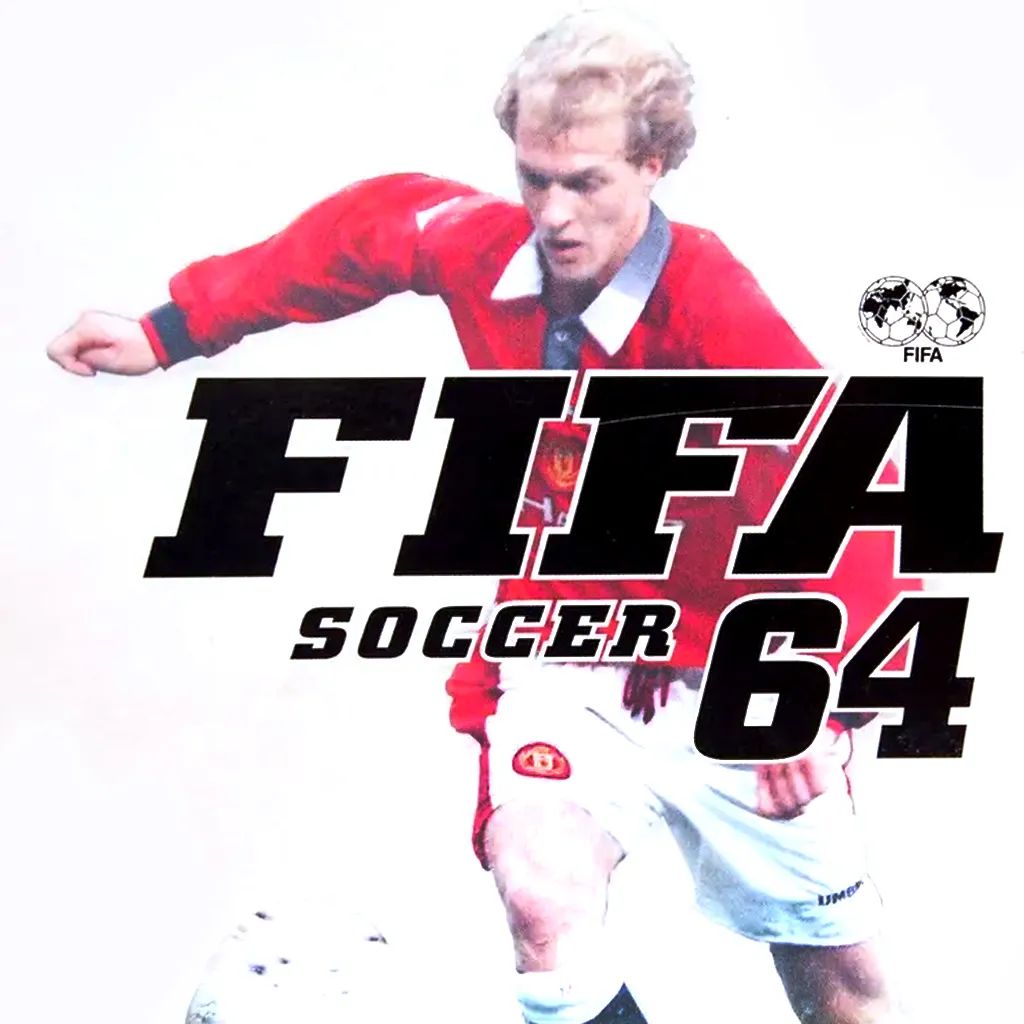
| Developer | EA Canada |
|---|---|
| Publisher | Electronic Arts |
| Platform | Nintendo 64 |
| Release | 1997 |
| Game Modes | Friendly, Exhibition, Playoff, Tournament, League |
| Control Setups | Novice, Simple, Semi-Pro, Pro, Complex |
| Teams | 160 international teams |
| Commentary | John Motson, Desmond Lynam, Andy Gray |
| Special Feature | First Nintendo 64 game with Dolby Surround sound |
A Complex Pitch of Options and Modes
FIFA Soccer 64 offered players an extensive and highly customizable soccer experience. The game included five distinct play modes: Friendly, Exhibition, Playoff, Tournament, and League. Within these, players could choose from Simulation, Arcade, or Action styles of play. Control was tailored through five set-ups, from Novice, where passes and special moves were automatic, to Pro and Complex, which offered no computer assistance.
With 160 international teams available, including nations from Argentina to Zambia, plus club teams from the United States, England, Italy, Germany, and France, the roster was vast. Match settings were deeply customizable, allowing adjustments to time up to a full 90 minutes, weather, clock display, auto replay, and the inclusion of fouls, injuries, and the offside rule. The game also introduced a team management layer, letting users position individual players on the field and select from six formations and five strategies.
On-Field Mechanics and Introduced Features
Gameplay built upon previous FIFA entries with several key introductions. The Nintendo 64 analog stick allowed for granular control over player speed, with walk, jog, run, and sprint options. The velocity of a pass or shot was determined by how long a button was held. The move set was expanded to include trapping, rainbow kicks, bicycle kicks, butterfly kicks, various tackles, lobs, fakes, and headers.
A Passback mode activated during free kicks and when the goalie had possession. This mode let the player control a passer's movements before commanding the ball carrier to either shoot or kick back. The audio presentation featured commentary from John Motson, Desmond Lynam, and Andy Gray, which critics noted was varied, neutral, and timely. The game offered eight different camera angles, a series first.
The Picture-in-Picture Innovation and Its Problems
A major new feature for the series was the Picture-in-Picture display. This allowed a separate view, which could be switched between all eight camera angles and a radar display, to appear on screen during play. Nintendo Power called the ability to switch camera angles innovative, and the magazine stated the game had more variety than any other soccer title.
However, this feature became a focal point for criticism. Reviewers found that activating Picture-in-Picture further slowed the already choppy frame rate. The separate view was criticized for being poorly implemented. Some said it was too large and obscured a chunk of the main action, making it difficult to focus, while others complained it was too small to see any useful detail. Electronic Gaming Monthly dismissed it as a good novelty but ultimately useless.
Development and Strategic Importance for the N64
FIFA Soccer 64 was a strategically vital title for the Nintendo 64. It was the console's first soccer simulation and the first game on the system to use Dolby Surround sound. Its development followed a significant corporate reversal by Electronic Arts. High pre-order numbers for the game, then announced as FIFA 64, led EA to cancel a recent decision to withdraw from Nintendo 64 software development. Instead, the company announced plans to release several EA Sports games for the platform over the next year.
The game was similar to the 32-bit versions of FIFA 97. Its Japanese counterpart, released as J. League Live 64, featured only officially licensed players and teams from Japan's J. League. The release was part of Nintendo's push to position the N64 as the leading sports platform.
Critical Reception: Praise for Realism, Pan for Execution
The game received mixed reviews, with critics sharply divided. Positive appraisals focused on its simulation qualities. Reviewers praised the realistic player names, attire, movements, and artificial intelligence. The sound was considered true to a real soccer game, with good crowd effects and commentary. Some critics, like Joe Kidd of GameFan, called it the best all-time soccer video game, while writers for Consoles + claimed it was the best in the FIFA series. AllGame stated it demonstrated why EA Sports was the leader in sports games.
The most consistent praise was for the sheer number of options and modes, which offered significant depth. The four-player mode was frequently highlighted as a positive aspect. Critics acknowledged the game's ambition in trying to deliver a complete, management-friendly soccer package.
Overwhelming Technical and Gameplay Criticisms
Negative critiques were far more numerous and specific. The game was lambasted for jerky animation, choppy frame rates, and unresponsive controls described as unwieldy, fiddly, slow, imprecise, confusing, and sluggish. Reviewers reported a noticeable delay on buttons for shooting and switching players, leading to inconsistent results and player frustration. One critic noted that executing passes felt more based on luck than skill, with players sometimes back-heeling unexpectedly.
The graphics were criticized for not utilizing the Nintendo 64's capabilities. Critics noted the game looked inferior to the PlayStation FIFA titles, with animations nowhere near as fluid. The console's characteristic blur was said to give a fuzzy look. Reviewers also cited unnatural ball physics, unconvincing tackling animations, and goal nets that billowed out in a ludicrous fashion.
The Shadow of Konami and Lasting Legacy
A defining element of FIFA Soccer 64's legacy is its direct and unfavorable comparison to Konami's International Superstar Soccer 64. Reviews, even positive ones, almost universally stated Konami's title was the superior soccer game on the platform. Next Generation argued FIFA Soccer 64 lacked the playability and realism of the Konami title, and critics recommended gamers purchase International Superstar Soccer 64 instead.
The game was named Most Disappointing Sequel in Electronic Gaming Monthly's 1998 Video Game Buyer's Guide. The publication noted that while FIFA had demonstrated the power of the 3DO years earlier, this N64 entry let down gamers hoping for a similar introduction. The consensus was that the game felt rushed, plagued by confusion, recycled designs, and hampered execution. It was seen as a missed opportunity that failed to bring the expected pizzazz and originality to the Nintendo 64 sports library.
Specific Flaws and Reviewer Grievances
Critics documented a range of specific flaws beyond core performance. The tactics screen was criticized for being of little practical help. Menu screens contained typos and inaccuracies, such as Düsseldorf being misspelled and Canadian teams falsely listed as US teams. Nintendo Power found the otherwise praised commentary to become repetitive over time.
Reviewers were disappointed by missing features present in other versions, such as the lower number of teams compared to FIFA 97 on PlayStation, the absence of a stadium editor, and the inability to trade players between teams. The problem of slow down was considered inexcusable by some, who compared it unfavorably to other N64 games like Blast Corps, which managed more on-screen elements with better performance. The general sentiment was that the unusual elements were only superficial additions to the options menu, not meaningful improvements to the gameplay experience.
FAQ
Was FIFA Soccer 64 well-received when it came out?
No, FIFA Soccer 64 received mixed to negative reviews. Critics praised its realistic simulation and depth of options but heavily criticized its jerky animation, choppy frame rates, unresponsive controls, and failure to fully utilize the Nintendo 64's capabilities.
What was the main competitor to FIFA Soccer 64 on the Nintendo 64?
The main competitor was Konami's International Superstar Soccer 64, released in 1997. Reviewers almost universally declared it the superior soccer title, recommending it over FIFA Soccer 64 for its better playability and realism.
What unique feature did FIFA Soccer 64 introduce?
A key new feature was Picture-in-Picture, which allowed a secondary camera angle or radar display to be shown on screen during gameplay. However, this feature was often criticized for slowing performance and having poor implementation.
How many teams were in FIFA Soccer 64?
The game featured 160 international teams to choose from, including national teams and clubs from leagues in England, Italy, Germany, France, and the United States.
Why was FIFA Soccer 64 significant for the Nintendo 64?
It was the Nintendo 64's first soccer simulation and the first game on the system to use Dolby Surround sound. Its strong pre-orders also caused publisher Electronic Arts to reverse a decision to stop developing for the N64.
Source: English Wikipedia (CC BY-SA), rewritten by the Redington Cybersport desk.