FIFA 15
FIFA 15 is the 22nd installment in EA Sports' long-running football simulation series, released in September 2014. It is remembered for bringing a new level of visual and emotional authenticity to the virtual pitch, fully licensing the English Premier League for the first time.
| Developer | EA Canada |
|---|---|
| Publisher | Electronic Arts (EA Sports) |
| Release Date | 23 September 2014 (NA), 25 September 2014 (EU/AU), 26 September 2014 (UK/IE) |
| Platforms | PlayStation 3, PlayStation 4, PlayStation Vita, Nintendo 3DS, Wii, Xbox One, Xbox 360, Microsoft Windows, iOS, Android, Windows Phone |
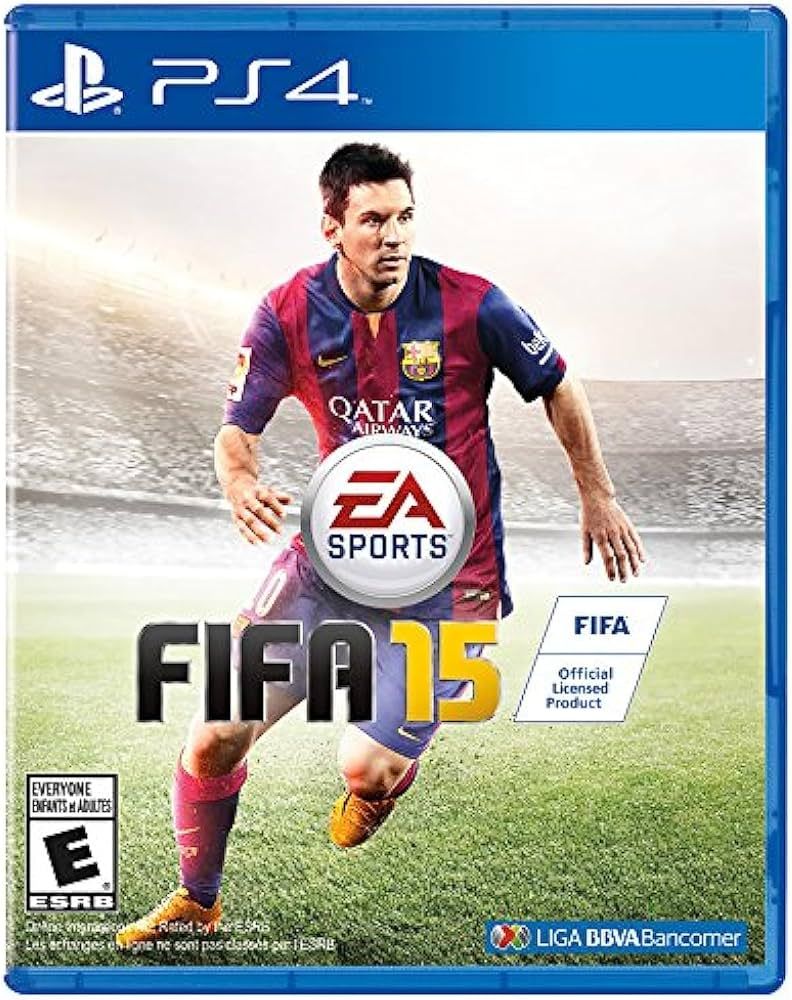
| Cover Athlete | Lionel Messi (global), with regional variants |
| Major New Features | Emotional Intelligence, Full 20 Premier League stadiums, Revamped goalkeepers, Concept Squads in Ultimate Team |
| Licensed Leagues | 35 leagues |
| Licensed Clubs | Over 600 clubs |
| Licensed Players | Over 16,000 players |
| Award | Sports Game of the Year at the 18th Annual D.I.C.E. Awards |
A Leap in Authenticity and Presentation
FIFA 15 marked a significant step forward in replicating the atmosphere and emotion of real football. A key pillar was the new Emotional Intelligence system, which for the first time modeled the attitudes and reactions of all 22 players on the pitch based on match events. This was complemented by Dynamic Match Presentation, which aimed to keep players immersed with region-specific crowd chants and behaviors. The game also featured Physically Correct Contacts, a system designed to make every touch, pass, and shot interact with the ball in a realistic way, affecting its spin and trajectory.
Visually, the game pushed for greater realism with Authentic Player Visuals and Living Pitches, where the grass would visibly wear down as the match progressed. For the PlayStation 4, Xbox One, and PC versions, the game utilized EA's Ignite engine, bringing these features to the forefront. The commentary team of Martin Tyler and Alan Smith returned for their third consecutive edition, joined by Clive Tyldesley and Andy Townsend for international matches. New goal celebrations from stars like Luis Suárez and Cristiano Ronaldo were also captured and added to the game.
The Premier League Era Begins
A landmark achievement for FIFA 15 was securing a full license for the English Premier League as the Official Sports Technology Partner. This deal brought unprecedented authenticity to the game, including all 20 official Premier League stadiums, complete with the seven carried over from FIFA 14. It also introduced official league scoreboards, television graphics, real referees, and authentic advertising hoardings. This commitment to league-wide authenticity set a new standard for the series.
Beyond England, the game boasted 35 licensed leagues, over 600 clubs, and more than 16,000 players across 41 licensed stadiums. The Italian Serie A was fully licensed, and the Turkish Süper Lig returned. However, not all leagues were included. The Brazilian Série A was absent due to a failed rights agreement, though the Brazil national team remained in the game. Some Serie B teams and several Argentine clubs also featured with generic crests and kits. Lionel Messi returned as the global cover star, a position he had held since FIFA 13.
Evolution of Gameplay and Ultimate Team
On the pitch, FIFA 15 introduced more physical Man-to-Man Battles and Full-Body Defending, making dispossessing an opponent more rewarding. The most requested improvement from fans, however, was a complete overhaul of the goalkeepers. They were rewritten with a new intelligence system to better anticipate shots and passes and featured fluid, responsive movement alongside a wide array of new save animations.
The popular Ultimate Team mode received several key additions. The new Concept Squads feature allowed players to use the entire FUT database to plan dream teams and test chemistry before spending coins in the transfer market. These concept players were represented by grey cards. Another new option was the ability to sign loan players for a limited number of matches. Players like Franz Beckenbauer, Roberto Carlos, Peter Schmeichel, and Hristo Stoichkov were added, though they were exclusive to Xbox One and Xbox 360 consoles.
Wide Release and Platform Specifics
FIFA 15 launched across a vast array of platforms in late September 2014, from the new-generation PlayStation 4 and Xbox One to legacy systems like the PlayStation 3, Xbox 360, Wii, and handhelds. It was the final FIFA title released for the Nintendo 3DS, Wii, and PlayStation Vita. For the PC, it was the first game in the series to run on the Ignite engine, matching the feature set of the PlayStation 3 and Xbox 360 versions. A playable demo was released on 9 September 2014, featuring teams like Chelsea, Liverpool, and Napoli.
Lionel Messi starred on the global cover, continuing his run from FIFA 13, with some regions featuring a local player alongside him. Nintendo's platform versions sometimes did not have these localized cover variants. Pre-ordering the game offered 15 gold packs over 15 weeks for use in Ultimate Team.
Critical Reception and Lasting Issues
The game was met with generally positive reviews. Review aggregators showed average scores in the low 80s out of 100 for the PlayStation 4 and Xbox One versions. Critics from IGN and GameSpot praised the superb animation, big-match atmosphere, and exciting, entertaining football. It won Sports Game of the Year at the 18th Annual D.I.C.E. Awards. Common criticisms included repetitive commentary from Martin Tyler and Alan Smith, and game modes that felt relatively unchanged from prior years.
However, the game was not without technical problems. Some users reported issues with lagging, stuttering, audio looping, and gameplay bugs. The PC version was particularly criticized for the number of bugs at release. While patches fixed several problems, a major stuttering issue was noted as remaining unresolved for many players.
Legacy and Lasting Impact
FIFA 15's legacy is defined by its pursuit of holistic authenticity. By securing the full Premier League license and integrating it deeply into the presentation with real stadiums and broadcast elements, it changed how real-world leagues could be represented in sports games. The focus on player emotion through the Emotional Intelligence system and stadium atmosphere became core tenets for future iterations.
The game also confirmed Ultimate Team's position as the franchise's most popular mode, introducing permanent planning tools like Concept Squads. While later titles would build upon its foundations, FIFA 15 is remembered as the entry that successfully translated the next generation of console power into a more visceral and visually convincing football simulation. It set a new benchmark for in-stadium immersion in the series, despite the technical hurdles that accompanied its ambitious scope.
FAQ
When was FIFA 15 released?
FIFA 15 was released on 23 September 2014 in North America, 25 September in Europe and Australia, and 26 September in the United Kingdom and Ireland.
What was new in FIFA 15 Ultimate Team?
New features included Concept Squads, a planning tool to build teams with all FUT players using grey concept cards, and the ability to sign loan players for a limited number of matches. Legend cards for players like Franz Beckenbauer were added, but were exclusive to Xbox One and Xbox 360.
Which leagues were fully licensed in FIFA 15?
FIFA 15 fully licensed the English Premier League for the first time, including all 20 stadiums. The Italian Serie A was also fully licensed, and the Turkish Süper Lig returned. The game featured 35 licensed leagues, over 600 clubs, and 16,000+ players in total.
What were the major gameplay improvements in FIFA 15?
Key improvements included the Emotional Intelligence system for player reactions, a complete rewrite of goalkeeper AI and animations, more physical Man-to-Man Battles and Full-Body Defending, and the Physically Correct Contacts system for realistic ball physics.
What awards did FIFA 15 win?
FIFA 15 was awarded Sports Game of the Year at the 18th Annual D.I.C.E. Awards by the Academy of Interactive Arts & Sciences.
Source: English Wikipedia (CC BY-SA), rewritten by the Redington Cybersport desk.