Dead or Alive Ultimate
Dead or Alive Ultimate is a 2004 fighting game compilation for the Xbox that remastered the first two entries in the series. Its inclusion of online multiplayer made it a pioneering title in the console fighting game genre and a significant early title for the competitive Dead or Alive scene.
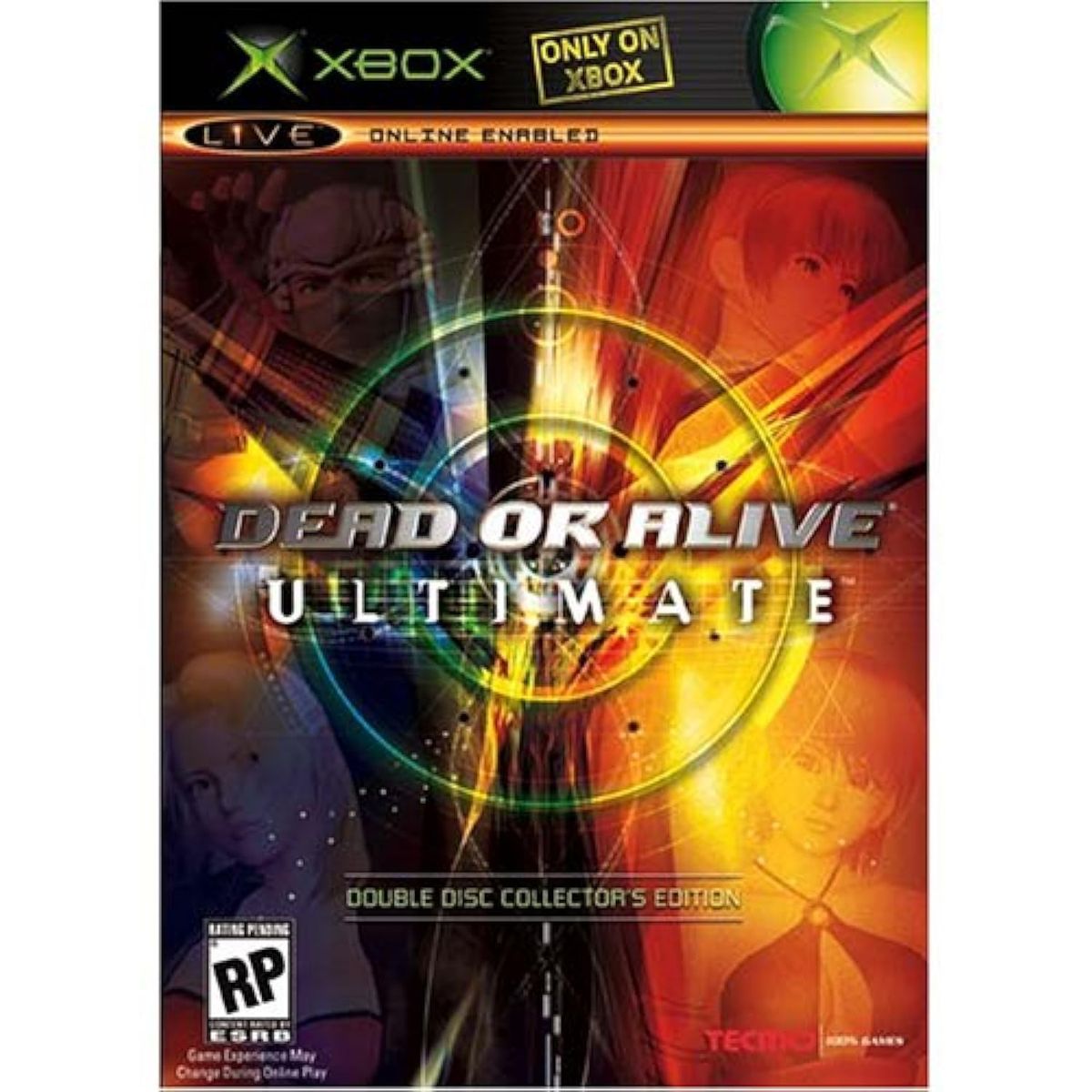
| Developer | Team Ninja |
|---|---|
| Publisher | Tecmo |
| Release | 2004 |
| Platform | Xbox |
| Genre | Fighting game compilation |
| Competitive Debut | 2005 World Cyber Games |
| Notable Feature | Online multiplayer via Xbox Live |
| Legacy | First Japanese online console fighting game |
| Awards | Fighting Game of the Year (2004 NAVGTR) |
| Backwards Compatible | Xbox 360, Xbox One, Xbox Series X/S |
A Definitive Two-Game Collection
Dead or Alive Ultimate brought together the series' foundational titles for the Xbox generation. The package contained an enhanced version of the original 1996 Dead or Alive, based on the Sega Saturn release with smoothed graphics. This version lacked some content from the later PlayStation release, such as the characters Bass and Ayane and extra costumes, making it more of a collector's piece. The main attraction was a full remake of 1999's Dead or Alive 2, rebuilt with a new graphics engine and incorporating gameplay mechanics from the then-recent Dead or Alive 3. This gave the classic DOA2 gameplay a modern feel with freer 3D-axis movement. The compilation also introduced Hitomi from DOA3 as an unlockable playable character in the DOA2 portion, accessible from the start if the player owned a copy of Dead or Alive 3. A new CG opening sequence was added to flesh out the ninja clan backstory, revealing the village of the Mugen Tenshin ninjas and characters like Shiden, Genra, and Ayame, and detailing the events leading to Hayate's injury and Kasumi's quest for vengeance.
Pioneering Online Play and the Arcade Lobby
The compilation's most notable feature was its online multiplayer, a rarity for console fighting games at the time. It required an Xbox Live subscription and was the first Japanese fighting game to offer online play, and the second in America and Europe after Mortal Kombat: Deception. The online system was designed by Tecmo to mimic an arcade environment. Players entered shared lobbies to watch matches and wait their turn to fight, with lobby creators able to set specific gameplay parameters for tournament-style play. This innovative setup was praised for going beyond what had been done in fighting games and even rivaling some online first-person shooters. Although the original Xbox Live service was discontinued in 2010, the game became playable online again through the replacement Insignia servers. This online functionality, alongside similar modes in Mortal Kombat: Deception and the Xbox Street Fighter Anniversary Collection, helped connect players across different regions during a period of stagnation for the fighting game community.
Gameplay Mechanics and Specific Changes
The DOA2 remake in Ultimate was a hybrid, blending elements from both DOA2 and DOA3. While it adopted DOA3's freer 3D movement, it retained many core mechanics from the original DOA2. This included higher-damage counter holds compared to DOA3, environmental hazards that did not cause instant knockouts, and a counter system that was much harder to execute. Crucially, despite the 3D movement, most character moves could not be sidestepped as they could in DOA3. A major change was the completely revamped holding system. The most visually distinct new feature was the addition of slopes as environmental hazards. Characters knocked onto a slope would roll down it, taking continuous damage as they fell. The game also featured remixed character music tracks that played only on specific stages like the Dance Floor and The Ray House. Players could also switch between the original and re-recorded voice lines for Kasumi using a Voice History setting.
Development, Release and Special Editions
Developed by Team Ninja after the release of Dead or Alive 3, the project was originally named Dead or Alive Online during planning stages to highlight its new online support. It was renamed to Dead or Alive Ultimate before launch, with Tecmo stating the new name better described the ultimate feeling players would experience. In Japan, a special crystal-clear blue Xbox system bundle was released containing the game, a matching controller, and Kasumi-themed extras. The North American release included two random trading cards with character pictures as part of a collector's edition. The game disc itself was packed with extra content. It contained the Booster Pack for the North American version of Dead or Alive 3, adding numerous character costumes found in the European and Japanese releases. The disc also included a G4-produced documentary segment from their Icons series detailing the history of Dead or Alive, with interviews from series creator Tomonobu Itagaki and other industry figures. A Prima Games official guide was released in November 2004, and a budget-priced Platinum Collection version followed in 2005.
Critical Reception and Award-Winning Success
Dead or Alive Ultimate received generally favorable reviews, with aggregate scores of 84.14% on GameRankings and 83 out of 100 on Metacritic. Famitsu in Japan scored it 32 out of 40. Reviewers consistently highlighted the innovative and well-implemented online play as a landmark achievement for the genre. IGN called it one of the best games of the year, praising the online setup, improved arenas, large number of costumes, and new slope moves. GameSpot termed it a landmark achievement, praising how the DOA gameplay formula held up and the impressive online component, though it noted the absence of DOA3 characters Hayate, Christie, and Brad Wong. The game was a commercial success in Japan, debuting at number four on the charts and selling over 52,000 copies in its first week, eventually selling over 56,000 copies there. It won several awards, including Fighting Game of the Year at the 2004 National Academy of Video Game Trade Reviewers Awards. IGN awarded it Best Fighting Game of 2004 and Best Xbox Graphics of 2004. It was also a runner-up for Best Fighting Game in GameSpot's 2004 awards, losing to Mortal Kombat: Deception.
Competitive Legacy and Esports Entry
Dead or Alive Ultimate has a distinct place in fighting game history. In 2005, it became the first fighting game ever included in the World Cyber Games, marking its formal entry into a major international esports circuit. This recognition highlighted its technical achievements and the competitive viability fostered by its online systems. The game was an early online pioneer, as it helped demonstrate the potential for connected console play in a genre traditionally centered on arcades and offline tournaments. The game's competitive mechanics, particularly the high-damage counters and challenging hold system from the DOA2 portion, defined the early esports meta for the series on console.
Longevity and Modern Availability
The game has enjoyed long life through backwards compatibility programs. With an update on December 14, 2006, the Xbox release was made playable on the Xbox 360. In November 2021, Dead or Alive 1 Ultimate and Dead or Alive 2 Ultimate became available for separate digital download worldwide on Xbox Live. Days later, on November 15, 2021, all three classic Xbox Dead or Alive games were added to the backwards compatible lineup, making them fully playable on Xbox One and Xbox Series X/S consoles. This digital re-release has preserved the game's pioneering online functionality for modern systems through new services, ensuring its place as a playable piece of fighting game history.
FAQ
What games are included in Dead or Alive Ultimate?
The compilation includes an enhanced version of the original 1996 Dead or Alive and a fully remade version of Dead or Alive 2 from 1999, updated with a new graphics engine and mechanics from Dead or Alive 3.
Did Dead or Alive Ultimate have online multiplayer?
Yes, it was a pioneering feature. It was the first Japanese console fighting game with online play, and the second in America and Europe, using Xbox Live to enable multiplayer matches in a lobby system designed to feel like an arcade.
What new character was added to Dead or Alive Ultimate?
Hitomi, who debuted in Dead or Alive 3, was added as an unlockable playable character in the Dead or Alive 2 Ultimate portion of the compilation. Owning a copy of DOA3 made her immediately accessible.
Can you play Dead or Alive Ultimate on modern Xbox consoles?
Yes. Since November 2021, both games in the compilation have been available for separate digital download and are part of the backwards compatible game library, playable on Xbox One and Xbox Series X/S.
What was Dead or Alive Ultimate's competitive significance?
It was the first fighting game included in the World Cyber Games in 2005. Its online mode, alongside other early online fighters, helped connect the global fighting game community during a period of stagnation.
Source: English Wikipedia (CC BY-SA), rewritten by the Redington Cybersport desk.