Overwatch Champions Series
The Overwatch Champions Series (OWCS) is a global competitive esports circuit for Blizzard Entertainment's Overwatch, established in January 2024 following the closure of the Overwatch League. It represents a fundamental shift to an open format managed by regional partners, featuring international tournaments and a revenue-sharing partnership program for teams.
| First held | 2024 |
|---|---|
| Game | Overwatch |
| Developer | Blizzard Entertainment |
| Regions | North America, EMEA, Asia, China |
| Operators | ESL FaceIt Group (NA & EMEA), WDG (Asia), Thunder Fire Group (China) |
| 2024 Int'l Events | Dallas Major, Stockholm Finals |
| 2025 Int'l Events | Champions Clash, Midseason Championship, OWCS Finals |
| Key Feature | Promotion/Relegation system (from 2025) |
| Key Feature | In-game team pack revenue sharing |
The End of the League and a New Beginning
The Overwatch Champions Series was born from the dissolution of the Overwatch League in January 2024. The Overwatch League, launched in 2018 as a city-based franchised league with slots reportedly sold for $20 million, faced sustained challenges. These included a slow initial growth, severe logistical disruptions during the COVID-19 pandemic, and the impact of a 2021 sexual harassment lawsuit against Activision Blizzard. The 2019 announcement and subsequent 2022 release of Overwatch 2, which changed the game's format and gameplay to a mixed response, added further instability. This mounting pressure led teams to seek an exit, which was offered before Microsoft's acquisition of the company, culminating in the league's closure.
Blizzard Entertainment's new strategy abandoned the closed franchise model. Instead of managing the league independently, Blizzard partnered with established tournament organizers to run regional circuits. ESL FaceIt Group took over operations for North America and the Europe, Middle East, and North Africa (EMEA) region. The Korean esports tournament organizer WDG was selected to operate the Asia region. This partnership model defined the new Overwatch Champions Series as an open circuit, immediately attracting a mix of organizations. Former Overwatch League teams like the Toronto Defiant and the San Francisco Shock, the latter competing under the name NRG Shock, transitioned with new rosters. They were joined by established esports brands like Fnatic and TSM, as well as new entrants such as ENCE and Team Falcons.
The 2024 Inaugural Season Format
The 2024 season operated across three regions: North America, EMEA, and Asia. It was built on a fully open tournament format, allowing any team to enter open qualifiers. The season was structured around two international events: the Dallas Major in late May and early June at the Kay Bailey Hutchison Convention Center in Texas, and the season-ending Stockholm Finals at DreamHack Stockholm in November.
North America and EMEA followed an identical four-stage format. Each stage had three phases. It began with a Swiss phase accommodating up to 512 teams, from which the top 16 advanced. These teams then entered a Group stage, competing in groups of four. The top two teams from each group moved to the stage's Main Event, an eight-team, double-elimination tournament. Performance in these Main Events earned teams circuit points, which determined qualification for the international majors.
The Asia region, due to its vast size, had a different two-stage structure and was subdivided into three competitive subregions: South Korea, Japan, and the Pacific. Each stage began with Open Qualifiers in each subregion, feeding into Regional Tournaments. The top teams from these then advanced to the OWCS Asia Championship, an eight-team event held at the WDG Esports Studio. Success here secured slots for Asian teams at the Dallas Major and, later, the Stockholm Finals.
Structural Evolution for 2025
The 2025 season introduced major structural changes based on the first year's experience. The most significant expansion was the addition of China as a fourth competitive region in January 2025, marking Overwatch's return to the country after Blizzard's partnership with NetEase ended in 2023. The China region is operated by Thunder Fire Group.
The league sizes were streamlined. North America and EMEA leagues were reduced to eight teams each, while Asia's structure saw adjustments in the Japan and Pacific subregions, including the elimination of the Wild Card round. The season moved to a three-split structure for all regions, with each split culminating in an international tournament.
A core competitive change was the introduction of a promotion and relegation system. After each split, the bottom two teams in North America, EMEA, and the Pacific subregion, the bottom three in Korea, and the bottom four in Japan, were required to defend their spots. They faced the best teams from the FACEIT Master Series, which is the top of FACEIT's competitive Overwatch structure, or equivalent regional qualifiers. This system replaced the previous open qualifier model for maintaining a league spot, adding stakes to every match.
The International Tournament Circuit
The OWCS global narrative is told through its international tournaments. In 2024, the circuit featured two such events. The Dallas Major served as the mid-season championship. The Stockholm Finals acted as the world championship event to conclude the season.
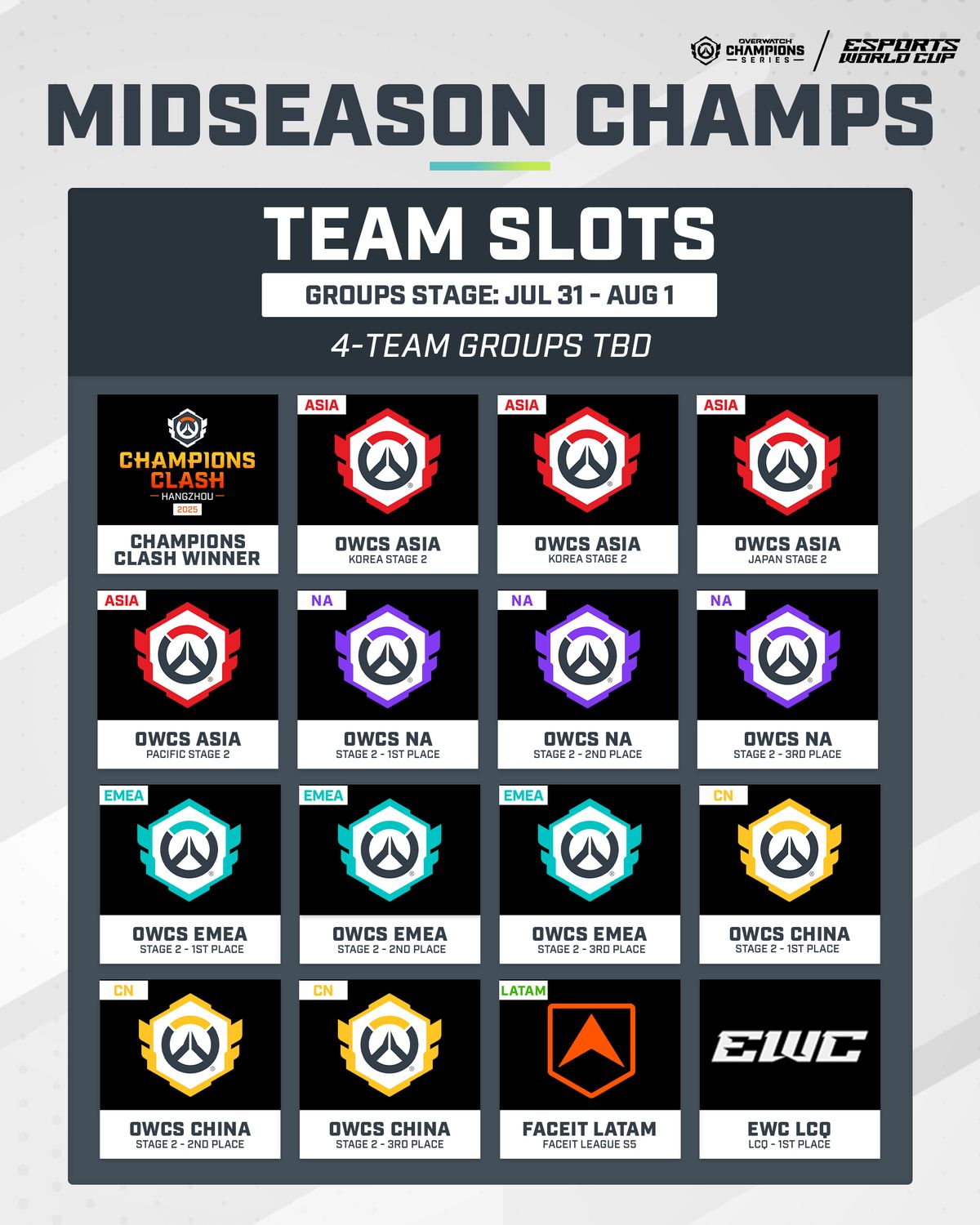
The 2025 calendar expanded to three global events, each concluding a competitive split. The top two teams from every region's split advance to these tournaments. The first split ended with the Champions Clash in Hangzhou, China. The second split's tournament was the Midseason Championship, held in Riyadh, Saudi Arabia as an official part of the 2025 Esports World Cup. The season culminates with the OWCS Finals, returning to DreamHack Stockholm. This consistent schedule of high-profile international competitions provides clear competitive milestones and global exposure for teams throughout the year.
The Team Partnership Program
Initiated for the 2025 season, the OWCS partnership program is a financial and structural pillar designed to support selected organizations. On January 17, 2025, nine teams were announced as the inaugural partners: four from Asia, three from EMEA, and two from North America.
These partnered teams receive a direct share of all revenue generated from the sale of their in-game team packs. This model mirrors revenue systems like team bundles in the Valorant Champions Tour or sticker sales at Counter-Strike Majors. The partnership also confers competitive benefits. For the first split, partnered teams from North America and EMEA received automatic entry into the regular season, while Asian partners automatically entered their regional tournament, bypassing open qualifiers.
The program is designed for annual renewal. Plans for the 2026 season indicate an evolution of the model, with four partnered teams each from Asia and North America, three from EMEA, and its own structure for China featuring three permanent partner teams and one temporary partner team.
Broadcast, Engagement, and Early Challenges
OWCS matches are broadcast on a wide array of digital platforms tailored to their regions. In North America and Europe, primary broadcasts are on YouTube and Twitch. Asian broadcasts are more decentralized, utilizing platforms like YouTube, the Korean service CHZZK, AfreecaTV for Korean audiences, and specific Twitch channels run by WDG and PlayOverwatchJP for Japanese viewers.
The series employs viewer engagement tactics like Twitch Drops, where fans can earn exclusive OWCS-themed in-game cosmetic items by watching official match streams. This incentivizes viewership and connects the esport directly to the game client.
Despite the fresh start, the OWCS faced early concerns. Analysts and fans noted a lack of well-defined prize pools and a clear long-term roadmap at its launch. Furthermore, the series encountered challenges in maintaining the consistent viewership levels that the Overwatch League, with its city-based storytelling and regular season broadcasts, had achieved at its peak. The success of the new open format and partnership model in building a sustainable ecosystem remains a central narrative for the series.
FAQ
Why did the Overwatch League end and the OWCS begin?
The Overwatch League closed in January 2024 after facing years of challenges including pandemic disruptions, a sexual harassment lawsuit, and team dissatisfaction. Blizzard then launched the OWCS as an open-circuit alternative, partnering with third-party organizers to run regional competitions instead of managing a single franchised league.
How do teams qualify for the OWCS?
In the open format, teams start in open qualifiers. From 2025, a promotion/relegation system was added. The lowest-placed teams in each region's league must requalify against top teams from circuits like the FACEIT Master Series to keep their spot for the next split.
What are the OWCS international tournaments?
The circuit features major global events. In 2024, these were the Dallas Major and Stockholm Finals. In 2025, the three tournaments are the Champions Clash in China, the Midseason Championship in Saudi Arabia as part of the Esports World Cup, and the OWCS Finals in Stockholm.
What benefits do OWCS partnered teams get?
Partnered teams receive a portion of all revenue from sales of their in-game team packs. They also get competitive advantages, such as automatic entry into the regular season or regional tournaments, bypassing the initial open qualifiers for the split in which they are partners.
How is the Asia region structured differently?
Due to its size, the Asia region is subdivided into competitive subregions: South Korea, Japan, and the Pacific. These subregions run their own qualifiers and tournaments, with the top teams advancing to the OWCS Asia Championship, which then feeds into the international events.
Source: English Wikipedia (CC BY-SA), rewritten by the Redington Cybersport desk.