South Korea national esports team
The South Korea national esports team is the official representative of the nation in international esports competitions. Organized by the Korea e-Sports Association, it fields squads in major events like the Asian Games, where its players compete for national honor and significant rewards.
| Governing body | Korea e-Sports Association (KeSPA) |
|---|---|
| Founded | 2000 |
| First major appearance | 2018 Asian Games (demonstration) |
| First official medal event | 2022 Asian Games |
| Notable titles | EA Sports FC Online (2022), League of Legends (2018*, 2022), PUBG Mobile (2022), StarCraft II (2018*) |
| Key administrative status | Semi-member of Korean Sport & Olympic Committee (reinstated 2018) |
| Military service exemption | Available for gold medalists at Asian Games |
Organization and Governance
The South Korea national esports team operates under the authority of the Korea e-Sports Association, known as KeSPA. This body was founded in 2000 with a government-authorized mandate to develop a healthy esports ecosystem in the country. KeSPA is responsible for selecting national teams, coordinating training, and managing the country's participation in international events.
For many years, KeSPA held a semi-membership status with the Korean Sport & Olympic Committee. This relationship was crucial for official recognition. However, the association lost this status in August 2017 after failing to meet new membership standards introduced in late 2015. This created a significant obstacle for sending a national team to the 2018 Asian Games where esports was a demonstration event.
The situation was resolved when the city of Daejeon formally recognized KeSPA as a sporting affiliate. This move allowed KeSPA to regain its semi-membership with the national Olympic committee just in time. Consequently, South Korea was able to dispatch its first official esports delegation to an Asian Games in 2018.
Historical Context and Development
South Korea's deep connection to esports began in the late 1990s with the hosting of amateur tournaments. The country's organizational skill was demonstrated when it hosted the inaugural World Cyber Games. The establishment of KeSPA provided a formal structure for this growing sector, building on this early foundation.
The 2018 Asian Games in Jakarta and Palembang marked a historic moment as esports was included as a demonstration event. South Korea's participation was secured after the last-minute reinstatement of KeSPA's status. The team competed in titles like League of Legends and StarCraft II, setting a precedent for future involvement.
A major change occurred at the 2022 Asian Games in Hangzhou, where esports transitioned from a demonstration to an official medal event. This shift carried great significance for South Korean athletes. Winning a gold medal at these games now grants an exemption from the country's mandatory military service, adding a strong national incentive to competitive success.
Competitive Achievements and Titles
The national team has achieved success across multiple game titles at the Asian Games. In the demonstration events of 2018, South Korean squads claimed victory in League of Legends and StarCraft II. These wins established the country as a formidable force in team-based and individual esports disciplines on the continental stage.
At the first official medal-awarding esports competition in 2022, the team continued its winning ways. South Korea secured gold medals in EA Sports FC Online, League of Legends, and PUBG Mobile, also known as Peacekeeper Elite. These victories contributed to the nation's overall medal tally and confirmed its reputation as a leading esports team.
Team Composition and Selection Process
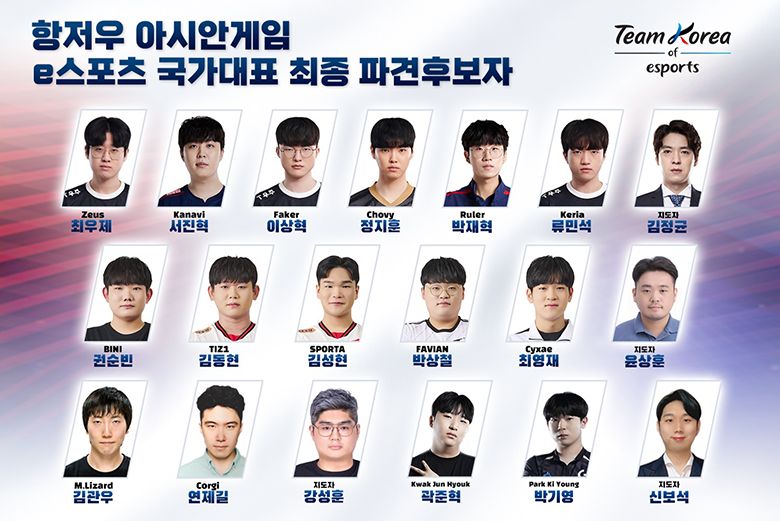
The South Korea national esports team is not a permanent, year-round squad. Instead, it is assembled specifically for major international tournaments like the Asian Games. Rosters are formed by selecting the top professional players from the domestic leagues for each included game title.
For example, the League of Legends squad for the 2026 Asian Games has been previewed to include star players like Zeus, Canyon, Faker, Zeka, Gumayusi, and Keria. These players are typically drawn from elite South Korean club teams such as T1, Gen.G, and Dplus KIA. The selection process aims to create the strongest possible lineup to represent the nation.
The delegation sent to competitions can be quite large, reflecting the number of game genres contested. For one Asian Games, South Korea sent a team of 44 people, which included 36 athletes competing across nine different esports genres. The teams are often sponsored by commercial partners like Sidiz, Logitech G, and Levion.
Cultural Significance and National Recognition
The national team's activities are treated with considerable seriousness and ceremony, mirroring traditional sports. Prior to major events like the Asian Games, official send-off ceremonies are held for the athletes. These events, such as one held at the Sangam stadium, underscore the national importance placed on their mission.
The military service exemption for gold medalists is a clear indicator of esports' standing in South Korea. This policy places elite esports athletes on the same footing as Olympic medalists in traditional sports. It provides a powerful motivation for players and validates esports as a legitimate and respected career path that serves the national interest.
Beyond the Asian Games, South Korean national teams have also seen success in other international competitions. The country has won the Overwatch World Cup three times and the PUBG Nations Cup twice, demonstrating its strength across a wide range of titles. These achievements contribute to the nation's global identity as a leader in competitive gaming.
Current Structure and Future Outlook
The team continues to operate under KeSPA's guidance as esports gains more institutional acceptance. With esports now a regular medal event at the Asian Games, the national team's schedule and preparation have become more structured. The selection of players for future games, such as the 2026 Asian Games in Aichi-Nagoya, is a process that draws significant public and media attention.
The national team also participates in other international friendlies and competitions. For instance, a national team friendly match between South Korea and the United States in League of Legends was broadcast on platforms like Disney+, indicating the commercial and broadcast appeal of these national team events.
Looking forward, the integration of esports into multi-sport events like the Asian Games suggests a stable future for the national team. The continued possibility of military service exemption for top performers ensures that representing South Korea remains a paramount goal for the country's best esports athletes.
FAQ
What is the South Korea national esports team?
It is the official team that represents South Korea in international esports tournaments. It is organized and managed by the Korea e-Sports Association.
Who organizes the South Korean national esports team?
The team is organized under the Korea e-Sports Association, a government-authorized body founded in 2000 to foster the national esports ecosystem.
Has the South Korean esports team won any major titles?
Yes, the team has won gold medals at the Asian Games in several titles, including League of Legends in 2018 and 2022, EA Sports FC Online in 2022, PUBG Mobile in 2022, and StarCraft II in 2018.
Do South Korean esports players get military exemption?
Yes, South Korean players who win a gold medal at the Asian Games, where esports is an official medal event, are granted an exemption from mandatory military service.
When did South Korea first participate in esports at the Asian Games?
South Korea first sent an esports delegation to the Asian Games in 2018 when esports was held as a demonstration event in Jakarta and Palembang.
Source: English Wikipedia (CC BY-SA), rewritten by the Redington Cybersport desk.