Tetris
NES Tetris, the 1989 Nintendo Entertainment System port of the classic puzzle game, has evolved from a living room pastime into a demanding esport. Its scene is defined by a race against an accelerating 'kill screen' and transformed by novel physical techniques, producing feats once thought impossible. The game's resurgence in the 21st century is marked by young players pushing its code to its absolute limits.
| Developer | Nintendo |
|---|---|
| Publisher | Nintendo |
| Platform | Nintendo Entertainment System (NES) |
| Release | 1989 |
| Primary Competitive Mode | A-Type |
| Key Tournament | Classic Tetris World Championship (since 2010) |
| Notable Speed Technique | Rolling (developed 2020) |
| Historic 'Kill Screen' | Level 29 |
| First 'Game Beat' (Crash) | December 21, 2023 by Willis Gibson |
| First 'Rebirth' (Level 255) | October 6, 2024 by Michael Artiaga |
The Game and Its Competitive Core
The competitive version of Tetris is the 1989 Nintendo Entertainment System port. It features two main modes. A-Type is the primary competitive mode, where the goal is to achieve the highest score before the game becomes unplayable. B-Type involves clearing 25 lines from a field with randomized obstacles. In A-Type, the game's speed increases as players clear lines, advancing through levels. The core challenge is scoring efficiently, as clearing four lines at once with the long bar piece, known as a Tetris, awards significantly more points than clearing the same number of lines individually.
The game was designed with a finite endpoint. After level 10, speed increases become less frequent, culminating at level 29 where pieces fall at one grid cell per frame. This was originally considered an insurmountable wall, a kill screen meant to end the game. The scoring system incentivizes aggressive play, as points for line clears are multiplied by the current level plus one. This makes scoring Tetrises at high levels vastly more valuable, shaping the entire strategy of high-level competition.
Players can select a starting level from 0 to 9, or from 0 to 19 by holding the A button during selection. Starting on a higher level means the level will not advance until the player clears as many lines as it would have taken to reach that level from zero, though a bug causes levels to advance earlier than intended when starting on level 10 or higher. The game also awards points for soft dropping pieces, giving 1 point per cell regardless of level.
The Evolution of Play: From Hypertapping to Rolling
For decades, the game's built-in delay for moving pieces sideways limited how fast players could react at high speeds. On the NTSC version, holding a direction causes an initial move, a 16-frame pause, and then subsequent moves every 6 frames. The first technique to overcome this was hypertapping, pioneered by Thor Aackerlund. This involved rapidly tapping the D-pad more than ten times per second by flexing the arm to create a tremor in the thumb. The technique was rare, with Japanese player Koji Nishio being another early adopter, until Joseph Saelee popularized it by winning the 2018 world championship with it.
A revolutionary shift occurred in 2020 with the development of the rolling technique by Chris Martinez. Instead of tapping with the thumb, a player places a stationary finger on the D-pad and drums the fingers of their other hand across the back of the controller. To reduce friction, a glove may be worn on the drumming hand. This method is faster and less physically taxing, allowing horizontal shifts up to 30 times per second. Rolling enabled consistent play far beyond level 29 and has become the standard technique for top players, reshaping record books and tournament play since 2021.
The physical demands of these techniques are intense. Hypertapping was described as turning the thumb into a jackhammer. Rolling, while less straining, requires precise coordination. These methods transformed the game from a test of efficiency before level 29 into a test of sustained high-speed control, allowing players to effectively play indefinitely at the old kill screen speed.
Redefining the Impossible: Beyond the Kill Screen
The concept of beating NES Tetris has been rewritten several times. Initially, reaching the maximum displayed score of 999,999 points, or a maxout, was the top achievement. Nintendo Power listed Scott Anderson with this score in 1992, and the first independently verified recording was by Harry Hong in 2009. Earlier unverified claims came from Thor Aackerlund around 1990 and Jonas Neubauer around 2002. The kill screen at level 29 was thought to be the ultimate barrier. However, hypertappers proved it could be passed, with Aackerlund reaching level 30 in 2011 and Joseph Saelee reaching level 31 in 2018.
The rolling technique shattered previous limits. By 2020, hypertappers had reached level 38, but rollers soon surpassed that. The 2022 Classic Tetris World Championship final saw Eric Tolt and Justin Yu reach levels 73 and 69 with scores over two million points. This forced tournaments to implement a new super killscreen at level 39, where pieces fall two blocks per frame, to prevent excessively long matches. The ultimate victory condition became triggering a crash in the game's code, which occurs after clearing about 1550 lines. Thirteen-year-old Willis Gibson achieved this first on December 21, 2023, reaching level 157 and being hailed as the first person to beat the game.
Beyond the crash lies another frontier, the rebirth game. This involves reaching level 255, which causes the level counter to overflow back to zero. This feat requires dealing with multiple severe graphical bugs and an integer underflow that halts level progression at 2190 lines cleared. Using a modified crash-resistant version, Michael Artiaga achieved the first rebirth on October 6, 2024, effectively reaching what would be level 347. The game's developers never intended play past level 29, as the level counter stops working correctly afterward, further evidenced by levels past 29 not displaying properly.
Technical Quirks and Visual Challenges
As players push deeper into the game, they encounter unintended behaviors stemming from the original programming. An integer overflow bug first appears at level 138, causing the game to load color palettes from wrong parts of memory, creating bizarre piece colors. Levels 146 and 148, nicknamed dusk and charcoal, render pieces in near-black colors that blend into the black background, presenting a severe visual challenge that Willis Gibson first completed in December 2023.
The most famous bug is the game-crashing condition triggered after clearing approximately 1550 lines, corresponding to level 155. This is caused by an inefficient multiplication operation in the score-counting code. Successfully inducing this crash is considered beating the game. To pursue a rebirth game past this point, players must use a modified version of the software that prevents the crash, as Michael Artiaga did for his 2024 achievement. If the crash is avoided, players must also contend with the level counter underflow bug at 2190 lines before they can progress toward level 255.
The Competitive Scene and Tournament Structure
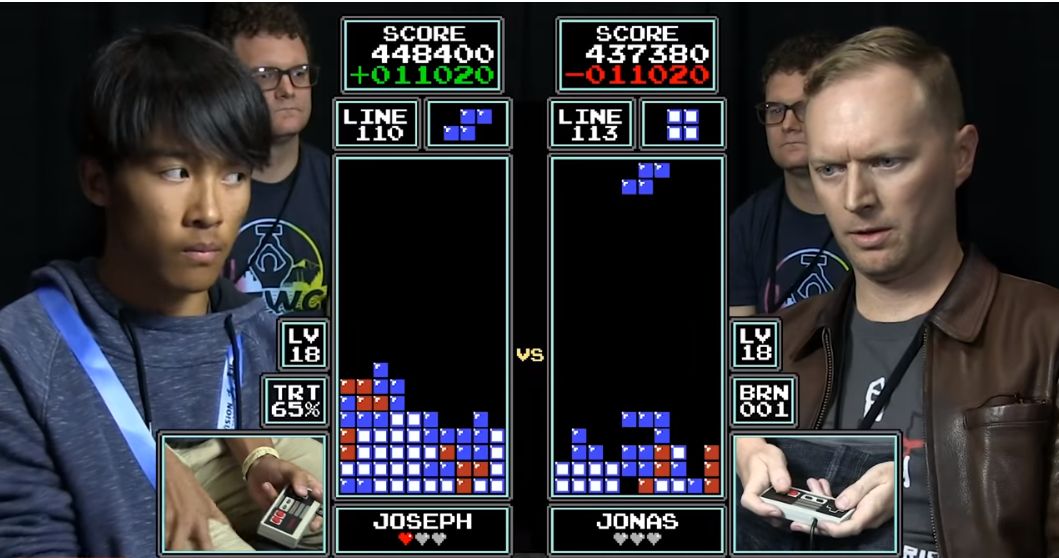
The modern esports scene for NES Tetris is anchored by the Classic Tetris World Championship (CTWC), an annual tournament running since 2010. It features a one-on-one format where players compete to score the most points in A-Type. Specialized cartridges ensure both competitors receive the same sequence of pieces, removing luck from the equation. To manage the new extremes of play enabled by rolling, the CTWC now caps competition at level 39, either by stopping play or using a mod that implements a super killscreen at that level.
Complementing the CTWC is Classic Tetris Monthly (CTM), a more accessible online tournament series that began in 2017. It uses a similar one-on-one format but allows the use of emulators and third-party hardware, with rules more relaxed than the CTWC. Both tournaments have been central to the game's resurgence, providing a platform for the new generation of players.
The game's competitive history includes the 1990 Nintendo World Championships, where Tetris was a key component alongside Super Mario Bros. and Rad Racer. Contestants had six minutes total, and because the Tetris score was multiplied by 25 in the final tally, the dominant strategy was to rush the other two games to maximize time playing Tetris. This early event highlighted the game's scoring potential as a competitive focal point.
Development and Lasting Legacy
The NES version emerged from a complex legal battle. Nintendo secured exclusive home console rights from Soviet authorities, while Atari Games, operating under a different license, released their own NES port. Nintendo's legal action forced Atari to recall its version, which some reviewers considered superior. Nintendo's version, with its deliberate kill screen, became the definitive competitive edition.
The game's endings reflect its era. A high score in A-Type triggers an animated sequence of a rocket launch in front of Saint Basil's Cathedral, with the rocket's size based on the score. The best ending features a UFO. High-level B-Type games show Nintendo characters performing in front of the cathedral. These charming rewards were designed for achievements that have since been vastly exceeded.
The resurgence since 2018, driven by young players and new techniques, has brought renewed media attention and recognition from the game's creators. After Willis Gibson's crash achievement, Tetris Company CEO Maya Rogers congratulated him for a feat that defies all preconceived limits. Co-founders Alexey Pajitnov and Henk Rogers later met Gibson, calling his playthrough an amazing achievement. The game continues to be a platform for human skill challenging the boundaries of vintage software.
FAQ
What is the 'kill screen' in NES Tetris?
The kill screen traditionally refers to level 29 in the NTSC version of the game. At this level, pieces fall at the maximum speed of one grid cell per frame, which was originally thought to be unplayable and designed to end the game. With modern techniques like rolling, players can now consistently play far beyond this level.
Who was the first person to beat NES Tetris?
Thirteen-year-old Willis Gibson, known as Blue Scuti, is credited as the first to beat NES Tetris on December 21, 2023. He achieved this by playing until he triggered a crash in the game's code at level 157, a feat considered beating the game since it was released in 1989.
What is the rolling technique?
Rolling is a high-speed control technique developed in 2020 by player Chris Martinez. A player places a stationary finger on the D-pad and drums the fingers of their other hand across the back of the controller. This pushes the buttons upward, allowing piece movement up to 30 times per second, enabling play past the old kill screen.
What is the main Tetris tournament?
The premier tournament is the Classic Tetris World Championship (CTWC), an annual one-on-one competition that started in 2010. Players use special cartridges to get identical piece sequences and compete to score the most points in A-Type mode, with a cap now at level 39 to prevent overly long games.
What is a 'maxout' score?
A maxout is the maximum score the game can display, which is 999,999 points. Before players could pass the kill screen, reaching this score was the highest possible achievement. The first independently verified recording of a maxout was by Harry Hong in 2009.
Source: English Wikipedia (CC BY-SA), rewritten by the Redington Cybersport desk.