Teamfight Tactics
Teamfight Tactics is a strategic auto battler game developed by Riot Games, spun off from the world of League of Legends. Since its launch, it has grown into a major competitive title with a dedicated esports scene and millions of players worldwide.
| Developer | Riot Games |
|---|---|
| Initial Release | June 26, 2019 (Windows, macOS) |
| Standalone Release | March 19, 2020 (Android, iOS) |
| Platforms | Windows, macOS, Android, iOS |
| Game Engine | Hextech engine (until 2026), Unreal Engine (from 2026) |
| Primary Game Modes | Normal, Ranked, Double Up |
| Key Feature | Cross-platform play |
| Content Cycle | Sets and mid-set updates |
Core Gameplay Loop and Structure
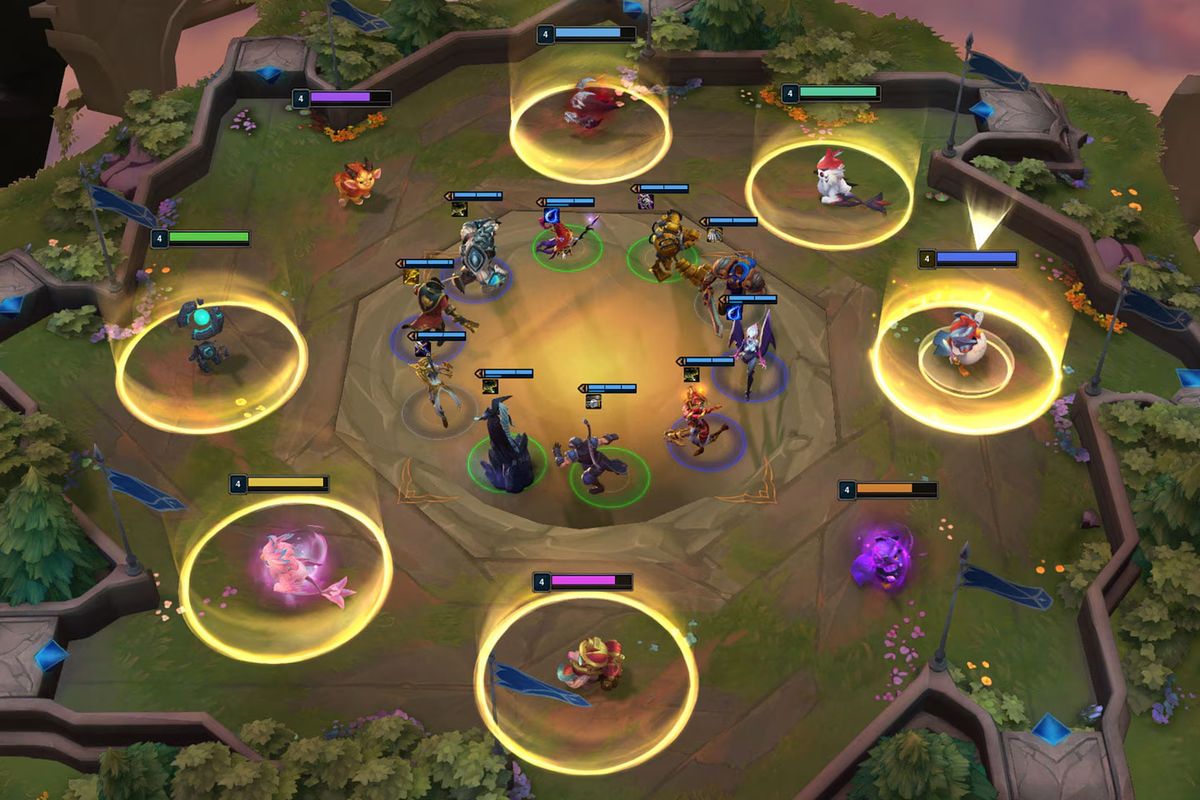
Teamfight Tactics is an auto battler where eight players compete to be the last one standing by constructing teams of champions from League of Legends. Players place their units on a hexagonal game board and engage in automated battles each round against a randomly assigned opponent or computer controlled enemies. Losing a round costs the player health, with the amount lost based on the number of surviving enemy units and the current stage of the game. The game is structured into stages, with each stage typically consisting of seven rounds. Special rounds include the Carousel, where players select a free unit with a random item, and a mandatory round against computer enemies at the end of each stage. The first stage is its own, consisting only of three introductory PvE rounds.
Units, Traits, and Itemization
Units, or champions, are the foundation of a player's team. They are directly taken from League of Legends, inheriting their skins, abilities, and general role. Each unit has a gold cost, typically ranging from 1 to 5, which correlates with its rarity and power. By collecting three copies of the same unit, players can combine them to upgrade the unit to a 2 star version, significantly boosting its stats and abilities. Collecting three 2 star units creates a 3 star champion. Units also belong to traits, such as Mage or Assassin. Fielding multiple units that share a trait activates synergy bonuses that provide combat advantages or economic benefits. Items are equally critical, providing stat bonuses and effects. Basic component items can be combined on a unit to form more powerful completed items. Each unit has three inventory slots for any combination of items.
Economy, Leveling, and the Augment System
Gold is the primary resource. Players earn a base amount each round and can generate more through two key mechanics. By saving unspent gold, players earn interest, with more gold saved yielding higher interest. Players also earn streak bonuses for consecutively winning or losing multiple rounds. Gold is spent to purchase units from the shop, refresh the shop's offerings, or buy experience points. Spending experience increases the player's level, which allows them to field more units on the board and improves the average rarity of units found in the shop. A defining modern mechanic is the Augment system, introduced in Set 6. On specific rounds, players choose one of three augments, which provide permanent effects for the rest of the game. These can grant direct combat buffs, extra resources like gold or items, or modify core rules. Augments have three rarities, silver, gold, and prismatic, with higher rarities offering stronger potential benefits.
Development History and Post-Launch Support
Teamfight Tactics was inspired by the popularity of the Dota 2 mod Dota Auto Chess. A small team of twelve developers at Riot Games aimed to improve upon its design, completing the project in an 18 week timeline. It launched as a game mode within the League of Legends client in June 2019. By September 2019, it had amassed over 33 million monthly players. It became a standalone, cross-platform app in March 2020. The game receives continuous support through regular balance patches and major content updates called sets, which completely overhaul the unit pool and traits. Every three months, a mid set update rotates out problematic traits and units to refresh the meta. In a significant technical shift, the game migrated from the shared League of Legends Hextech engine to Unreal Engine in August 2026 with the release of Set 18.
Cosmetics and Monetization
As a free-to-play game, Teamfight Tactics generates revenue through cosmetic items. The player's avatar, called a Tactician, was previously known as a Little Legend. These avatars can be customized with various designs obtained from the in game store, from loot boxes called Little Legend eggs, or from the seasonal battle pass. The treasure tokens system is another method to obtain these avatars. In November 2024, a new type of avatar called an Unbound Champion was introduced, representing a champion at the height of their power fantasy. Other cosmetics include themed game boards, which can be interactive, and visual damage effects called Booms. In April 2025, Riot added Portals, cosmetic features that change the visual effects when a Tactician moves around the map, available in Standard and Legendary tiers.
Game Modes: Permanent and Temporary
Beyond the standard Normal and Ranked queues, Teamfight Tactics features several distinct game modes. Double Up, released in early 2022, is a team based mode where four pairs of players compete. Each duo shares a health bar and can send champions, items, or other resources to assist their partner during a match. The faster paced Hyper Roll mode was launched in April 2021 but was retired in May 2025. Riot stated it failed to meet its goal as an effective, straightforward learning tool for new players due to its demanding tempo. The studio also runs temporary modes, such as Fortune's Favor and Soul Brawl. Starting in January 2025, a new recurring mode called Set Revivals was added, reintroducing past sets like Festival of Beasts with modern enhancements to create nostalgic, overpowered gameplay experiences.
The Competitive Ecosystem
Teamfight Tactics has cultivated a structured competitive scene. Players can qualify for major events through circuits like the TFT Pro Circuit (TPC). Open tournaments, known as the TFT Open Series, have been held in locations such as Las Vegas (2023), Macao (2024), and Paris (2025). These feed into larger championships like the TFT Open Championship (TOC). The game has also been featured in major multi game festivals, including the Esports World Cup (EWC). This ecosystem provides a clear path for top players to compete at the highest level, supporting the game's status as a serious esport with global reach.
FAQ
What is Teamfight Tactics?
Teamfight Tactics is an auto battler game from Riot Games where eight players build teams of champions and battle until one remains. It is a spinoff of League of Legends and was inspired by Dota Auto Chess.
Is Teamfight Tactics free to play?
Yes, the game is free to play. Riot Games monetizes it through the sale of cosmetic items for Tacticians, game boards, Portals, and Booms, as well as through seasonal battle passes.
What are sets and mid-set updates?
Sets are major content updates that happen every few months, completely changing the available champions, traits, and items. Approximately halfway through a set, a mid set update occurs to rotate out problematic traits and units, refreshing the game's meta.
What is the Double Up game mode?
Double Up is a permanent team mode where four teams of two players compete. Each pair shares a health bar and has mechanics to send champions, items, or other resources to their teammate during a match.
What happened to the Hyper Roll mode?
Hyper Roll was a faster paced game mode launched in 2021. It was retired in May 2025 after Riot Games determined it did not successfully serve as an introductory mode for new players due to its high tempo and required game knowledge.
Source: English Wikipedia (CC BY-SA), rewritten by the Redington Cybersport desk.