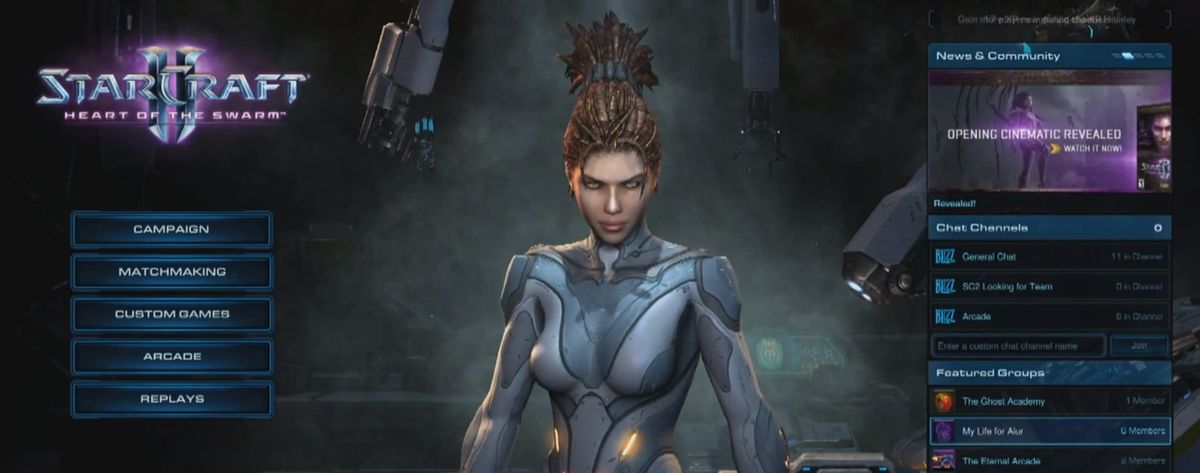
StarCraft II: Heart of the Swarm
StarCraft II: Heart of the Swarm is the second expansion in the StarCraft II trilogy, released in 2013. It introduced a major new single-player campaign centered on the Zerg race and brought significant changes to the game's competitive multiplayer landscape.
| Developer | Blizzard Entertainment |
|---|---|
| Release Date | March 12, 2013 |
| Genre | Real-time strategy |
| Platform | PC |
| Expansion to | StarCraft II: Wings of Liberty |
| Campaign Focus | Zerg |
| Multiplayer Status | Free-to-play (since 2017) |
A Defining Chapter in the Trilogy
Heart of the Swarm is the second part of the StarCraft II trilogy, following Wings of Liberty and preceding Legacy of the Void. Released in March 2013, the expansion continued the military science fiction story while making substantial alterations to the real-time strategy gameplay that defined the professional scene. Its core addition was a single-player campaign of twenty missions, plus seven evolution missions, focusing on the Zerg race and the character Sarah Kerrigan. The expansion's impact was long-lasting, with Blizzard's 2017 decision to make StarCraft II free-to-play opening the multiplayer to everyone while keeping the Heart of the Swarm campaign as a paid product, a model supported by microtransactions for skins, commanders, and War Chests.
Campaign Mechanics and the Primal Zerg
The Heart of the Swarm campaign is played from the perspective of Kerrigan, recently returned to human form. The player's base is the Leviathan, a massive Zerg bioship, where interactive areas like the evolution pit allow for unit upgrades. A key gameplay feature is the ability to evolve each Zerg combat unit into one of two alternative versions, each with a powerful trait, such as the Ultralisk strain that can revive itself upon death. The plot also introduces primal Zerg, which are independent, evolving creatures that avoided the control of the fallen Xel'Naga Amon and sport a radically different appearance from standard Zerg. These primal Zerg, like the Ancient One Zurvan or the pack leader Dehaka, cannot be produced by the player but are central to the story as Kerrigan seeks their essence to regain her power.
The campaign narrative sees Kerrigan travel from Char to the frozen planet Kaldir and the Zerg origin world Zerus. She is advised by the Protoss Zeratul and later aided by the infested Alexei Stukov. Her journey involves battling Dominion forces, Protoss armies, and primal Zerg leaders before culminating in the invasion of the Terran Dominion throne world, Korhal, and the final confrontation with Emperor Arcturus Mengsk.
Multiplayer Unit Overhaul and Development
Blizzard revealed at BlizzCon 2011 that Heart of the Swarm would feature seven new multiplayer units while removing three from Wings of Liberty. The development process involved significant internal testing and feedback from a closed beta, leading to changes before the final release. For example, the Terran faction originally had two planned units, the Shredder and the Warhound. The Shredder, a mobile burrowing turret, was replaced by the Widow Mine after testing showed it was too powerful. The Warhound, a bipedal walker, was removed from multiplayer entirely after professional gamers criticized its function during the beta, though it remains in the campaign.
The Protoss also saw a major revision of their planned units. The Replicant, a unit that could clone any other unit in play, was cut because it reduced unit diversity. It was replaced by three new units: the Oracle, Tempest, and Mothership Core. The Tempest itself had a complex history, having been developed in the Wings of Liberty beta as a Carrier replacement before being revised for Heart of the Swarm to provide aerial splash damage.
Detailed Unit Changes by Race
For Terrans, the Hellion gained the ability to transform into the Hellbat, a bipedal walker whose flamethrower attacks in a fan shape. The Hellbat is classified as both biological and mechanical, allowing it to be repaired by SCVs or healed by Medivacs. The Medivac itself received an Ignite Afterburners upgrade for a speed boost. The Reaper was extensively changed, losing its bonus damage to light units and its building attack grenade. It gained a passive health regeneration ability and no longer requires a Tech Lab, allowing two to be produced at once from a Barracks with a Reactor.
Protoss units saw specific ability changes. The Void Ray's Prismatic Beam became an active ability that temporarily increases damage only against armored units. The Mothership Core, with its Photon Overcharge, Mass Recall, and Time Warp abilities, could later transform into the Mothership after constructing the advanced Fleet Model structure, gaining a mass cloaking field but losing the Vortex ability, which was removed to make room for Time Warp.
Zerg received the Viper, a flying spellcaster with abilities like Blinding Cloud to reduce enemy range, Abduct to pull units, and Consume to steal health from friendly structures for energy. The Swarm Host, a burrowing unit, periodically spawns free Locusts that deal high damage but cannot attack air units. Existing Zerg units were also adjusted, with the Hydralisk regaining its speed upgrade from the original StarCraft, and research for Burrow and Overlord speed moved to the Hatchery instead of requiring a Lair.
The Shift to Free-to-Play and Sustained Support
During BlizzCon 2017, Blizzard announced that StarCraft II would be re-branded as a free-to-play game. This opened the multiplayer mode to all players and changed the availability of the campaigns. The Wings of Liberty campaign became completely free, while Heart of the Swarm and Legacy of the Void campaigns remained paid content. Players who had already purchased Wings of Liberty before the announcement were granted the Heart of the Swarm campaign at no extra charge. This new model was part of Blizzard's long-term vision to support the game, with microtransactions for cosmetic items and cooperative content proving successful enough to sustain StarCraft II as both a story-driven title and an esport.
The changes introduced in Heart of the Swarm created a distinct period in the game's competitive history. Units like the Swarm Host promoted new siege tactics, while the Oracle and Viper became essential for high-level harassment and army support. These additions and modifications ensured the multiplayer meta-game continued to evolve, maintaining professional and community interest throughout the expansion's lifecycle and beyond.
FAQ
When was StarCraft II: Heart of the Swarm released?
Heart of the Swarm was released on March 12, 2013.
What is the main story of the Heart of the Swarm campaign?
The campaign follows Sarah Kerrigan as she returns to the Zerg swarm to seek revenge on Emperor Arcturus Mengsk of the Terran Dominion after believing her ally Jim Raynor has been killed.
What new Zerg units were added in Heart of the Swarm multiplayer?
The expansion added two new Zerg units for multiplayer: the Viper, a flying spellcaster, and the Swarm Host, a burrowing unit that spawns free Locusts.
Is Heart of the Swarm free to play?
The multiplayer portion of StarCraft II, including Heart of the Swarm's multiplayer changes, became free-to-play in 2017. However, the Heart of the Swarm single-player campaign itself still requires purchase.
What happened to the Terran Warhound unit?
The Warhound was a planned Terran unit that was removed from the multiplayer game during closed beta testing after professional gamers criticized its functionality. It only appears in the single-player campaign.
Source: English Wikipedia (CC BY-SA), rewritten by the Redington Cybersport desk.