Riftbound
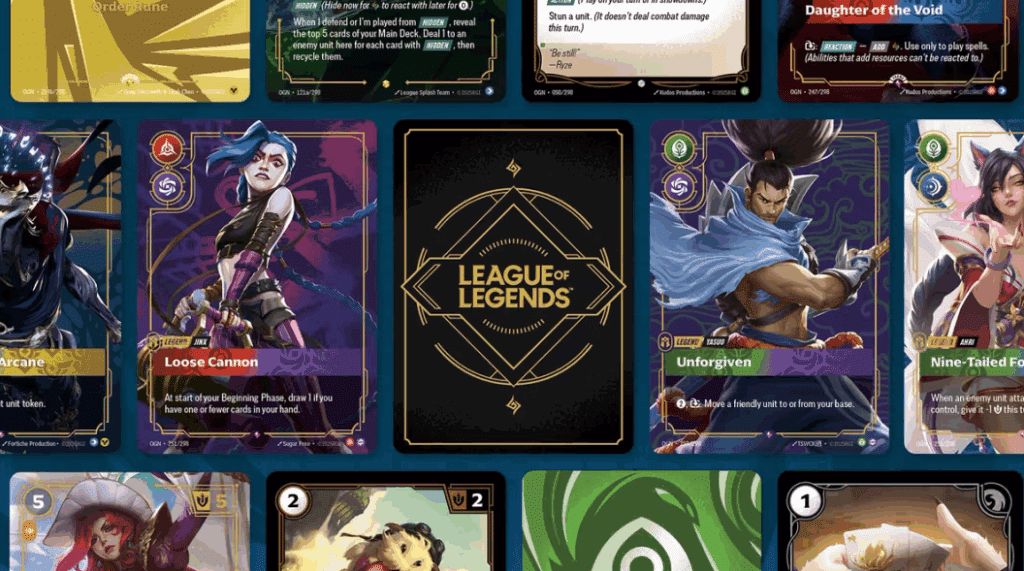
Riftbound: League of Legends Trading Card Game is a physical trading card game developed by Riot Games. Set in the League of Legends universe, it represents Riot's first major foray into the physical TCG market, aiming to appeal directly to its existing fanbase while establishing a competitive organized play circuit.
| Developer | Riot Games |
|---|---|
| Release | October 31, 2025 (English) |
| First Set | Origins |
| Publisher (English) | UVS Games |
| Publisher (China) | Shining Soul |
| Game Director | Dave Guskin |
| Executive Producer | Chengran Chai |
Development and Launch
Development of Riftbound began in 2023 under the leadership of game director Dave Guskin and executive producer Chengran Chai. The game was first revealed to the public through a leaked trailer in September 2024 under the name Rune Battlegrounds. Riot Games officially announced it in December 2024 under the working title Project K, confirming an initial release planned for early 2025 exclusively in China.
In February 2025, UVS Games was announced as the official publishing and distribution partner for English-speaking countries. The following month, Riot revealed the final title, Riftbound: League of Legends Trading Card Game, and set a Summer 2025 launch for China. The first set, Origins, was released in China in August 2025, with the English-language version following on October 31, 2025.
The launch faced several challenges. Supply could not meet the high initial demand. Some cards had manufacturing defects like rough edges. A collation error also meant a percentage of booster packs contained fewer rare cards than intended. This issue persisted into the second set, prompting Riot to offer replacement cards with strict per-person limits.
Gameplay Overview
Riftbound is designed for two or more players, each representing a Champion from League of Legends. Players must construct two decks for a match. The main deck must contain at least 40 cards, including spells, units, and gear. The separate rune deck consists of exactly 12 rune cards, which are used as the primary resource for playing cards from the main deck.
Each player also selects a Champion Legend card and a number of Battlefield cards, the quantity of which depends on the chosen game mode. Victory is achieved through area control. Players score points by capturing and holding these Battlefields. The first player or team to reach the target score, which varies by mode, wins the game.
Set Releases and Global Expansion
The game's release schedule began with the Origins set. Following its staggered launch in China and English-speaking markets, Riot pursued a strategy of global expansion. A Korean release of the Origins set was announced for September 2026.
A significant milestone was reached with the Vendetta set, which was the first to receive a simultaneous release in both English and Chinese. Riot has stated that this practice of synchronized multi-language releases will be maintained for all future sets, ensuring a unified competitive environment and player experience worldwide.
Organized Play Structure
Riftbound was built with a formal competitive structure from the outset. The organized play system is designed to guide players from casual local events to the highest level of competition. The pathway begins with local store events, where players can learn the game and test strategies.
From there, players can advance to larger Skirmish tournaments. The next tier is Regional-level competitions, which serve as qualifiers for the ultimate goal: the Riftbound World Championship. This pyramid structure is intended to foster community, build lasting friendships among players, and create a clear path for competitive growth.
Critical Reception and Market Position
Early critical reception highlighted the game's accessibility and connection to its source material. Reviewers noted that Riftbound is easy for newcomers to pick up, even those without prior trading card game experience, while still offering meaningful tactical depth. The distinct feel and playstyle of different champions were also praised for capturing the essence of the League of Legends universe.
However, analysts expressed concerns about the game's long-term prospects in a highly saturated trading card game market. Riftbound enters a field dominated by established giants like Magic: The Gathering, the Pokémon Trading Card Game, and newer entrants like Disney Lorcana. Its success is seen as dependent on its ability to convert the massive League of Legends fanbase into dedicated physical card game players.
Design Philosophy and Audience
Riot Games approached Riftbound with a specific philosophy. Rather than focusing solely on competing in the broader trading card game arms race, the development team prioritized appealing to existing League of Legends fans first. The goal was to rethink how these fans could engage with the world of Runeterra in a new, physical format.
This player-centric design is reflected in the game's mechanics and its competitive ecosystem. The developers have stated that their players are competitors at heart, and the organized play structure is built to serve that competitive drive. The integration with systems like the Riftbound Gaming Network, which uses players' Riot IDs, further ties the physical card game experience back to the digital ecosystem familiar to League fans.
FAQ
When was Riftbound released?
The first set, Origins, was released in China in August 2025. The English-language version was released on October 31, 2025.
Who publishes Riftbound?
UVS Games is the official publisher and distributor for English-speaking countries. In China, the game is published and distributed by Shining Soul.
How do you win a game of Riftbound?
Players win by being the first to reach a target score. Points are scored by capturing and holding Battlefield cards. The target score is determined by the selected game mode.
What was Riftbound originally called?
During development, the game was referred to internally as Project K. It was also leaked online under the name Rune Battlegrounds before its official announcement as Riftbound.
What is the organized play structure for Riftbound?
The competitive structure starts with local events, progresses to Skirmishes and Regional tournaments, and culminates in a World Championship. This system is designed to build community and a clear competitive pathway.
Source: English Wikipedia (CC BY-SA), rewritten by the Redington Cybersport desk.