Legends of Runeterra
Legends of Runeterra is a free-to-play digital collectible card game developed by Riot Games, set in the expansive League of Legends universe. Since its 2020 release, it has been praised for its accessible yet deep gameplay and its player-friendly approach to card acquisition. The game has carved out a distinct identity within the competitive card game scene.
| Developer | Riot Games |
|---|---|
| Publisher | Riot Games |
| Release | April 29, 2020 |
| Platforms | Microsoft Windows, iOS, Android |
| Genre | Digital collectible card game |
| Mode | One versus one |
Core Gameplay Loop
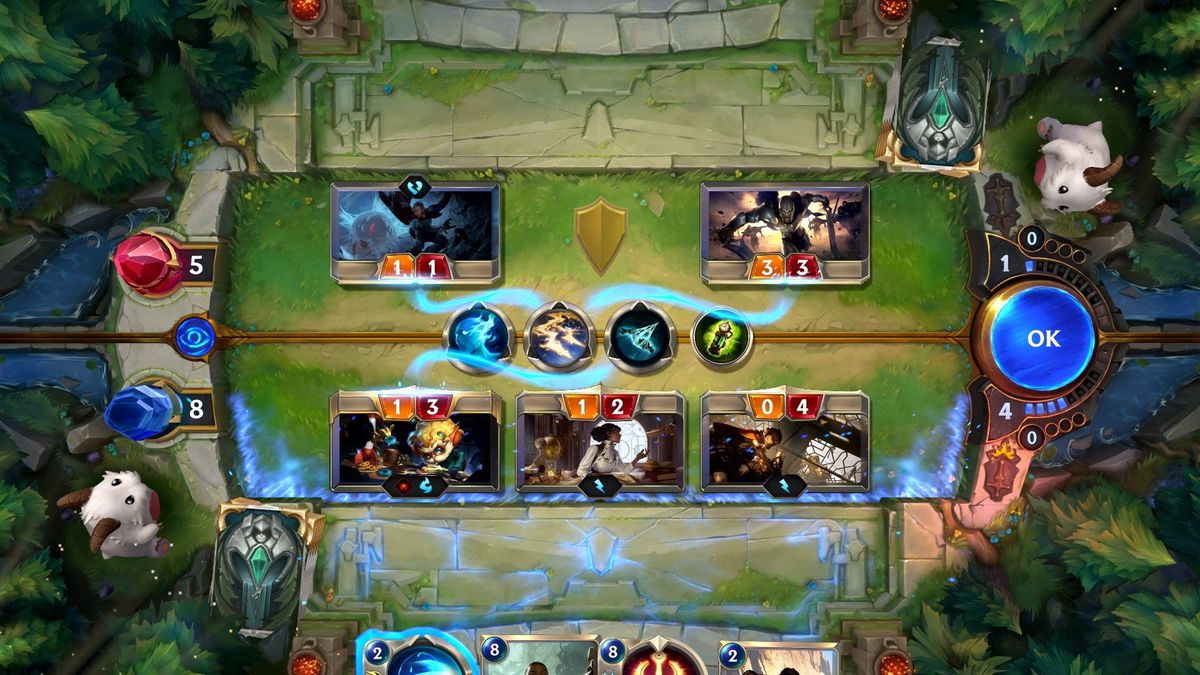
Legends of Runeterra is a one versus one duel where players aim to reduce their opponent's Nexus from 20 health to zero. Each match begins with a hand of four cards, which can be traded for a random replacement from the deck. Players draw one card per round and spend mana to play cards, starting with zero and gaining one mana crystal each round up to a maximum of ten. Unspent mana up to a limit of three is stored as spell mana for future rounds, usable only for casting spells.
A defining feature is the alternating combat pacing. Each round, an attack token passes between players, visually indicated by a sword icon for the attacker and a shield for the defender. The player with the token is the only one who can initiate combat that round, though some card effects can bypass this rule. This creates a predictable rhythm of aggression and defense that shapes strategic planning.
Card Types and Regions
Every card belongs to one of ten regions, each with a distinct playstyle and identity. A standard deck can include cards from up to two regions, and there are no neutral cards usable in every deck. The regions are drawn from the wider League of Legends expanded universe. Cards are primarily divided into champions, followers, and spells.
Champion cards represent characters from League of Legends and have the ability to level up during a match, transforming into a more powerful version. Both champions and follower cards are units, possessing attack and health statistics. Attack determines damage dealt, while health indicates how much damage a unit can withstand before being removed. Spell cards come with a speed mechanic, dictating when they can be played and if an opponent can respond. The speeds are Slow, Fast, Burst, and the later-added Focus. Landmarks, a card type added in an expansion, occupy a board space, cannot attack or block, and often feature countdown mechanics that trigger effects after a set number of rounds.
Development Philosophy
Development on Legends of Runeterra began in earnest in 2017, though Riot Games employees had considered making a card game much earlier. The team included fans of Magic: The Gathering, and they recruited professional Magic competitors as early playtesters. One of these, Steve Rubin, later joined the design team permanently. The developers prioritized accessibility, aiming to lower the barrier to entry common in the collectible card game genre.
A major challenge was designing the card acquisition system. The developers wanted to avoid the model of purchasable random booster packs. Their solution was a system that provides a scaling number of random cards each week based on play frequency, supplemented by Wild Cards that allow players to directly craft specific cards they want. Initially, there was also a weekly limit on how many cards could be bought with real money. Director Jeff Jew stated this frictionless collection model allowed for more responsive game balance, as players would not feel financially penalized by meta shifts.
Launch and Expansion History
The game was revealed in October 2019 during League of Legends' tenth anniversary celebration. It entered open beta in January 2020 and officially launched on April 29, 2020, simultaneously releasing on Windows, iOS, and Android. The launch introduced the Rising Tides set, adding 120 new cards and the Bilgewater region, bringing the total to seven regions.
Riot Games adopted a structured release schedule with sets divided into multiple expansions. The second set, Call of the Mountain, introduced Mount Targon. Subsequent sets added the regions of Shurima and, finally, Bandle City in August 2021, completing the ten-region roster. After Bandle City, the game shifted to releasing stand-alone expansions, such as Worldwalker in May 2022, which introduced Runeterran champions. In January 2024, following company-wide layoffs, Riot Games downsized the development team and shifted focus from PvP to the PvE Path of Champions mode, citing the game's underperformance.
Critical Reception and Accolades
Legends of Runeterra received positive reviews, with critics praising its balance of accessibility and depth. Review aggregator Metacritic reported a weighted average score of 87 out of 100. Reviewers noted that the game streamlined complex elements from other card games while maintaining strategic richness. Its free-to-play model was frequently highlighted as generous, with the absence of traditional booster packs and a rewarding weekly progression system earning particular acclaim.
The game earned several industry awards. It was nominated for Best Mobile Game at The Game Awards 2020. Apple named it the iPad Game of the Year for 2020, and it won Mobile Game of the Year at the 24th Annual D.I.C.E. Awards.
Business Model Evolution
The game's approach to monetization has centered on cosmetic purchases while providing cards through gameplay. A significant change came in 2023 with the introduction of the Emporium, a store where cards and cosmetics could be purchased with real currency. This update was met with criticism for its pricing and technical issues, which director Dave Guskin acknowledged. The Emporium included chests containing random cards, which players perceived as contradictory to the original stance against booster packs. Concurrent changes reduced the number of free Wild Cards players could earn, though this was later stated to be an unintended oversight.
These changes marked a shift from the original vision of a game where card collection was largely decoupled from direct spending. The 2024 downsizing of the development team and pivot toward PvE content further signaled a major evolution in the game's live service strategy.
FAQ
Is Legends of Runeterra free to play?
Yes, Legends of Runeterra is completely free to play. It is monetized through the purchase of cosmetic items, not through buying cards. The game provides cards to players through weekly rewards and a crafting system using Wild Cards.
What platforms is Legends of Runeterra available on?
The game is available on Microsoft Windows PCs and on mobile devices running iOS and Android operating systems. It launched simultaneously on all these platforms in April 2020.
How does the combat system work in Legends of Runeterra?
Combat is paced by an attack token that alternates between players each round. The player with the token can initiate attacks, while the other player defends. This creates a clear rhythm of alternating offensive and defensive turns, though some cards can allow attacks without the token.
How many regions are there in Legends of Runeterra?
There are ten regions in total. At launch, the game had six regions. Expansions added Bilgewater, Mount Targon, Shurima, and finally Bandle City in August 2021, completing the set. Decks can use cards from up to two regions.
What are champion cards?
Champion cards are powerful units representing characters from League of Legends. They can level up during a match, transforming into a stronger version. Leveling up applies to all copies of that champion in the player's deck and hand.
Source: English Wikipedia (CC BY-SA), rewritten by the Redington Cybersport desk.