Halo 2
Halo 2 is a landmark first-person shooter released for the Xbox in 2004. Its online multiplayer via Xbox Live defined console competitive play for a generation, establishing features like skill-based matchmaking as industry standards. The game's critical and commercial success made it the best-selling title on the original Xbox and a foundational part of modern esports.
| Developer | Bungie |
|---|---|
| Publisher | Microsoft Game Studios |
| Release | 2004 |
| Platform | Xbox |
| Genre | First-person shooter |
| Best-selling Xbox game | Over 8 million copies sold |
| Xbox Live support ended | April 2010 |
| PC port | Windows Vista (2007) |
| Remaster | Halo: The Master Chief Collection (2014) |
The Arena and Its Rules
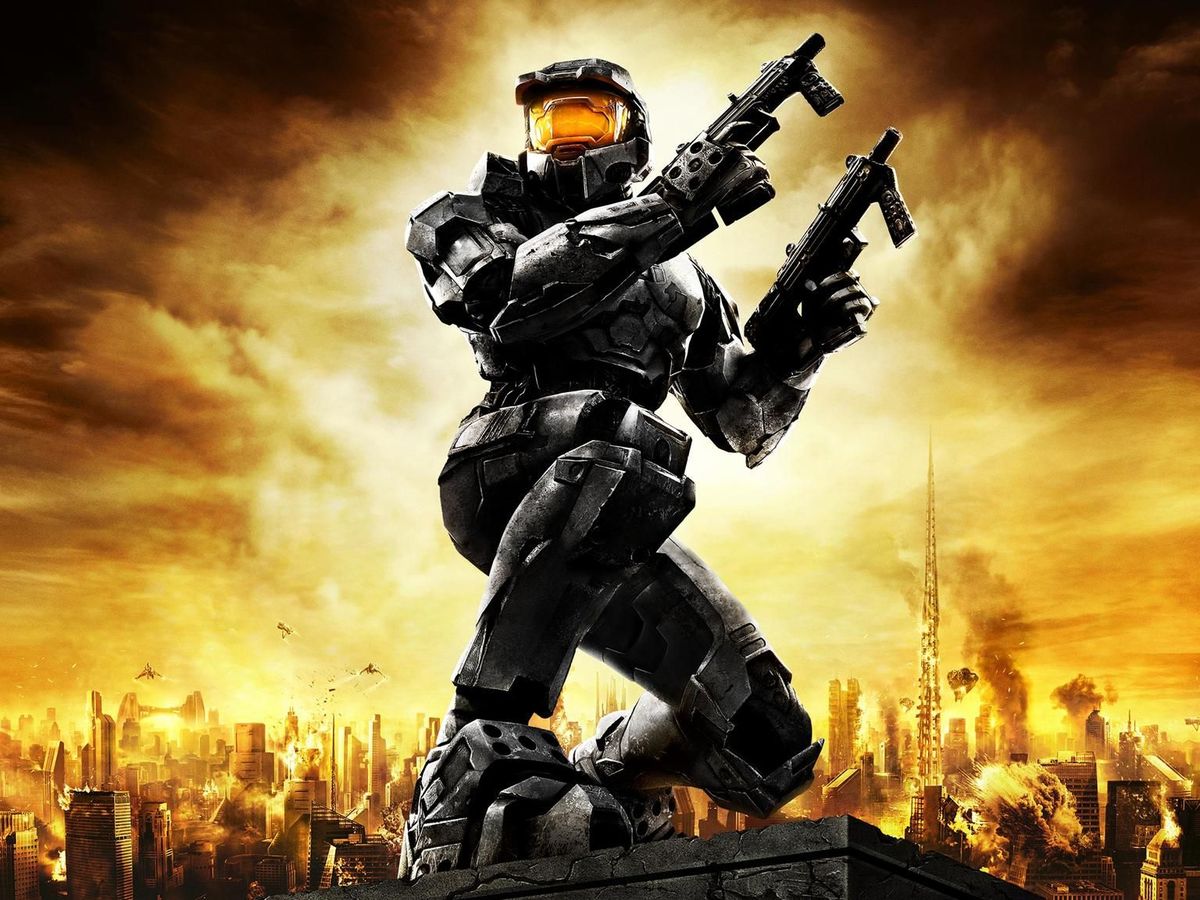
Halo 2's competitive multiplayer is an arena shooter built on tight, skill-based mechanics. Players view the action from a first-person perspective, switching to third-person when driving vehicles. A core innovation was dual wielding, allowing players to carry and fire two one-handed weapons simultaneously. This trade-off sacrificed accuracy, the ability to throw grenades, and melee attacks for increased firepower. The arsenal is split between human and Covenant technology, each with distinct characteristics. Human weapons use disposable magazines and require reloading but do not overheat, while most Covenant weapons have an internal battery that depletes with continuous fire and cannot be replaced.
Every player is protected by a regenerating energy shield that absorbs damage, with a hidden health bar underneath. This shield mechanic encourages aggressive, fluid engagements where players can recover from a fight if they find cover. The game also introduced the ability to hijack enemy vehicles, adding a dynamic, high-risk element to vehicle combat. Players could carry two standard weapons at a time, or three if dual wielding, with one weapon remaining holstered, forcing strategic choices about loadouts for different combat situations.
The Matchmaking Revolution
Halo 2 did not just offer online multiplayer, it reinvented how players accessed it. Before its release, joining competitive matches typically required manually searching for and joining player-hosted lobbies. Halo 2 replaced this with an automated matchmaking system. Players simply selected a general playlist, such as Team Slayer or Capture the Flag, and the game handled everything else. It found other players, selected the map and specific game type, and formed balanced teams.
This playlist system ensured a steady flow of available games at all times and was paired with a skill-ranking system. The automation lowered the barrier to entry, making competitive play accessible to millions. For nearly two years, Halo 2 was the most popular game on Xbox Live, a dominance only ended by Gears of War in 2006. The original Xbox Live service for Halo 2 was officially supported until its discontinuation in April 2010, with the final multiplayer session concluding in May of that year. The PC version used Games for Windows Live until its servers were taken offline in June 2013.
Campaign Structure and Co-op
Beyond competitive multiplayer, Halo 2 featured a substantial narrative campaign playable alone or cooperatively with another player. The story alternates between controlling the human supersoldier Master Chief and the Covenant Elite known as the Arbiter, offering two perspectives on a galactic war. Their gameplay is nearly identical, though the Arbiter's armor features a short-duration, rechargeable active camouflage ability that deactivates when he attacks or takes damage, instead of a flashlight.
The campaign offered four difficulty levels, from Easy to Legendary. Increasing the difficulty not only made enemies more numerous, tougher, and more accurate but also reduced the player's shield strength and health, and shortened the duration of the Arbiter's active camouflage. On higher difficulties, enemy artificial intelligence became more dynamic and even character dialogue could change, providing a fresh challenge on repeat playthroughs. The campaign's cliffhanger ending was divisive at launch but has since become a famous part of gaming lore, setting the stage for the sequel, Halo 3.
A Troubled and Ambitious Development
The development of Halo 2 was ambitious and fraught with challenges. Following the massive success of the first Halo, which sold over five million copies, the team at Bungie aimed to build on ideas cut from the original game. Designer Jaime Griesemer recalled that the team tripled everything, rebuilding the game engine, changing the physics, and prototyping new graphical features like stencil shadow volumes.
However, the project suffered from a lack of clear leadership and poor communication. Early discussions happened in small, unconnected teams. Project lead and Bungie cofounder Jason Jones, exhausted from shipping the first game, was similarly burned out and eventually left to work on another Bungie project called Phoenix. The departure of another cofounder, Alex Seropian, in 2002 created additional workplace friction. Artist Robert McLees noted that Bungie's creative managerial structure collapsed as the team grew from 12 to 60 people.
Writer Joseph Staten described the overambition as ordering a giant sandwich and not realizing its size until too late. This scope creep led to wasted effort, such as McLees spending two weeks on a weapon that was ultimately cut. Severe time constraints forced significant cuts, including a more ambitious multiplayer mode, and necessitated the campaign's abrupt cliffhanger ending.
The Internal Debate Over Multiplayer
A major internal debate centered on the direction of multiplayer. Inspired by the dedicated fans who connected multiple consoles for 16-player battles via System Link, some team members wanted to resurrect the original Halo's cut plans for large-scale battles and remove the smaller arena modes and split-screen play. Engineering lead Chris Butcher saw the potential to bring that large-scale experience to everyone via Xbox Live.
Designer Max Hoberman successfully argued against removing the successful small-scale combat from the first game. He was put in charge of a small team to develop the arena multiplayer that would define Halo 2, while the rest of the team worked on other aspects. This decision preserved the intimate, skill-based combat that formed the essential core of its competitive scene, rather than shifting entirely to larger, more chaotic battles.
Lasting Legacy and Influence
Halo 2's impact on competitive gaming and online services is significant. Its implementation of automated matchmaking, player lobbies, and integrated clan support became the blueprint for countless online games that followed. By creating a smooth, skill-ranked competitive environment, it fostered a dedicated community and proved the viability of console esports.
The game was a critical and commercial triumph, becoming the best-selling Xbox game with over 8 million copies sold. It received widespread acclaim for its multiplayer, audiovisual design, and soundtrack. Its marketing, including the pioneering alternate reality game I Love Bees, heralded video games as blockbuster media. After release, Bungie supported the game with additional multiplayer maps and updates to combat cheating and glitches, prolonging its competitive life.
The game's influence extended far beyond its own lifespan, establishing the core systems of modern online play. It was later ported to Windows Vista in 2007 and received a high-definition remaster as part of Halo: The Master Chief Collection in 2014. In 2024, the original Xbox version's online multiplayer was revived through the unofficial service Insignia, demonstrating its enduring appeal.
FAQ
When was Halo 2 released?
Halo 2 was released in 2004 for the Xbox console. It was later ported to Windows Vista in 2007 and remastered for the Xbox One in 2014 as part of Halo: The Master Chief Collection.
What is dual wielding in Halo 2?
Dual wielding is a gameplay mechanic that allows players to carry and fire two one-handed weapons at the same time. This provides greater firepower but comes with trade-offs, including reduced accuracy, the inability to throw grenades, and the loss of a melee attack while both weapons are drawn.
How did Halo 2 change online multiplayer?
Halo 2 changed online multiplayer by introducing an automated matchmaking system. Instead of manually searching for lobbies, players selected a playlist, and the game automatically found other players, chose the map, and formed matches. This system was paired with skill-based rankings and made competitive play much more accessible.
Can you play Halo 2 campaign cooperatively?
Yes, the campaign mode in Halo 2 supports cooperative play for two players. The story alternates between the Master Chief and the Arbiter, and the game can be played through on four different difficulty levels, from Easy to the hardest setting.
Why is Halo 2 considered influential?
Halo 2 is considered influential because its online multiplayer features, like matchmaking, lobbies, and clan support, became industry standards. It was the most popular game on Xbox Live for nearly two years and demonstrated the massive appeal of structured, competitive console gaming online, shaping the design of future titles.
Source: English Wikipedia (CC BY-SA), rewritten by the Redington Cybersport desk.