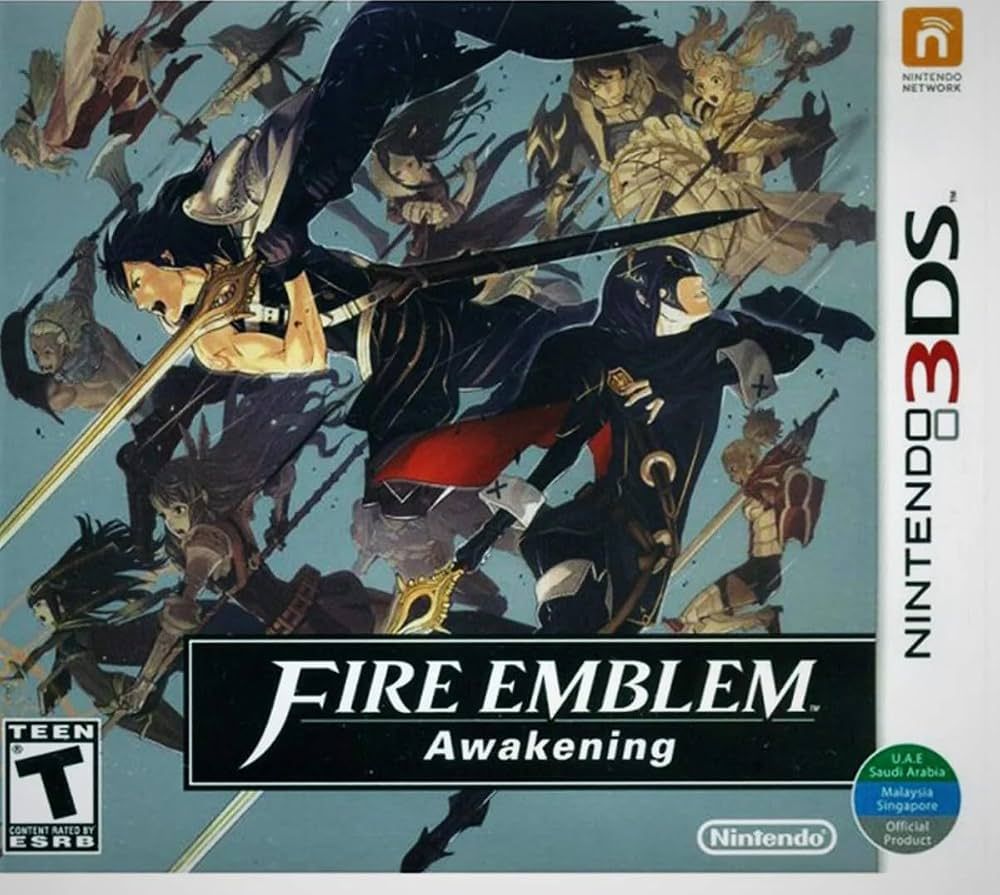
Fire Emblem Awakening
Fire Emblem Awakening is a tactical role-playing game for the Nintendo 3DS that revitalized its long-running series. Its critical and commercial success not only secured the franchise's future but also established a dedicated competitive scene centered on its deep strategic mechanics.
| Developer | Intelligent Systems |
|---|---|
| Publisher | Nintendo |
| Platform | Nintendo 3DS |
| Release (JP) | April 2012 |
| Release (NA/PAL) | Early 2013 |
| Game Genre | Tactical Role-Playing |
| Competitive Focus | Turn-based strategy, unit optimization, support building |
A Game Built as a Potential Finale
Development of Fire Emblem Awakening began in 2010, with the series facing declining sales. The team at Intelligent Systems, under Nintendo's supervision, approached it as a potential final entry. This led to a design philosophy of incorporating beloved elements from all previous Fire Emblem games into one package. The goal was to create a definitive and accessible experience that could appeal to both veterans and newcomers.
The hardware of the Nintendo 3DS, still being fine-tuned at the time, presented both a challenge and an opportunity. The developers made decisions on content and graphics based on what they believed was feasible on the portable system. This included utilizing the dual screens for an enhanced tactical interface and integrating features like StreetPass and SpotPass for player interaction. The result was a game that pushed the 3DS's capabilities while serving as a love letter to the series' history.
Core Strategic Gameplay and Systems
At its competitive heart, Fire Emblem Awakening is a turn-based tactical game played on grid-based battlefields. Players command a roster of characters, positioning them to attack enemy units controlled by artificial intelligence. The game introduced significant mechanical depth with its class and relationship systems. Each of the forty-nine recruitable characters starts in a specific class, such as knight or mage, which dictates their movement, attack range, and abilities.
Upon reaching level 10, characters can use Master Seals to promote to a more powerful advanced class or Second Seals to reclass into a different base or advanced class. Reclassing resets a unit to level 1 but allows them to retain previously learned skills and stats, enabling deep customization and the creation of optimized builds. The player-created Avatar character has the most flexibility, able to reclass into any class available to their chosen gender. This system forms the bedrock of competitive play, as players experiment with skill combinations across multiple class paths to create supremely powerful units.
The battle interface is split across the 3DS screens. The top screen displays the terrain and unit positions, while the bottom screen shows detailed unit information. Players can control units manually or use an auto-battle option. Combat initiates a 3D scene where optional camera angles, including a first-person view, can be activated with the stylus. Characters earn experience points through successful actions, leveling up to increase stats and learn new skills from a pool of forty-two available classes.
The Pair Up and Support Mechanics
Beyond individual unit strength, Awakening's Pair Up system is a fundamental part of its strategy. Two characters can combine into a single mobile unit on the battlefield. This pairing grants statistical bonuses and allows the supporting unit to occasionally block attacks or join in for a dual strike. The effectiveness of these bonuses is directly tied to the Support level between the two characters, which ranges from C to A for friendship and S for marriage.
Support levels are increased by having characters fight near each other and through optional conversations between chapters. A high Support level between paired units can dramatically increase their combat performance, making the careful cultivation of relationships a key strategic layer. Furthermore, opposite-gender couples who reach S rank can marry and have children. These children become recruitable characters in optional paralogue chapters, inheriting stats, skills, and even physical appearance from their parents, adding another complex dimension to team building. The Avatar can build a relationship with all characters and, depending on their chosen sex, marry any unit as long as they are not a direct descendant.
Defining the Competitive Challenge
The game offers distinct modes that shape the competitive experience. The choice between Casual and Classic Mode is fundamental. Classic Mode enforces permanent death, or permadeath, where units lost in battle are gone forever. This is a series staple that demands meticulous planning and risk assessment. Casual Mode disables this feature, allowing units to return after a battle, which lowers the stakes for players learning the game or experimenting with strategies. If the main character Chrom or the Avatar dies in any mode, the battle ends in a Game Over.
Difficulty settings further define the challenge. Normal, Hard, and Lunatic modes provide escalating tests of tactical skill, with enemy units gaining improved stats, equipment, and AI behavior. Completing the game on Lunatic unlocks the brutal Lunatic+ mode, which presents what many consider the ultimate test of mastery, featuring enemies with randomly assigned powerful skills. Competitive play often revolves around conquering these highest difficulty levels with optimized teams and flawless execution. The player's home base, the Barracks, allows for character interactions and activities between missions, contributing to support building.
Narrative Context and World
The story of Awakening is set approximately 2000 years after the events of the original Fire Emblem games, on continents now known as Ylisse and Valm. The player's Avatar, a customizable amnesiac tactician named Robin, is found by Chrom, prince of the Halidom of Ylisse, and joins his militia, the Shepherds. They fight against the hostile nation of Plegia and monstrous Risen, aided by a mysterious masked figure named Marth.
The plot deepens with the introduction of time travel. Marth is revealed to be Lucina, Chrom's daughter from a ruined future where the Fell Dragon Grima has been resurrected. She travels back in time to prevent this catastrophe. The central quest involves Chrom performing the Awakening ritual, using the Fire Emblem shield and five gemstones to gain the power to stop Grima. The story explores Robin's direct connection to Grima, creating a personal conflict that culminates in a final choice determining the game's ending, adding narrative weight to the player's strategic journey.
Legacy and Impact on the Series
Fire Emblem Awakening was met with critical acclaim and strong sales worldwide. Reviewers praised its presentation, story, characters, and the way it made deep tactical gameplay accessible. Its success is credited with boosting Nintendo 3DS sales and, most importantly, ensuring the continuation of the Fire Emblem franchise. The game is frequently cited as one of the best on the 3DS and among the greatest video games ever made.
The competitive community that formed around Awakening set the stage for the series' future. Its emphasis on unit building, support optimization, and high-difficulty play became defining traits for subsequent titles. The game proved that a deep, single-player tactical experience could foster a dedicated competitive scene focused on mastery, optimization, and sharing strategies for overcoming its toughest challenges. It transformed Fire Emblem from a niche series into a major franchise with a passionate strategic fanbase, directly leading to future games like Fire Emblem Fates.
FAQ
What is the Pair Up system in Fire Emblem Awakening?
The Pair Up system allows two characters to combine into a single unit on the battlefield. This grants statistical bonuses and enables the supporting unit to block attacks or perform dual strikes. The strength of these bonuses increases with the Support level between the paired characters.
What is the difference between Casual and Classic Mode?
Classic Mode is the traditional Fire Emblem experience where characters who fall in battle are permanently dead. Casual Mode disables permanent death, allowing defeated units to return after the battle is over. The mode is selected at the start of a new game.
How does the class and reclassing system work?
Characters start in a base class. At Level 10, a Master Seal promotes them to a stronger advanced class. A Second Seal allows a character to reclass into a different class, resetting to Level 1 but letting them keep stats and learned skills. This allows for deep customization of unit builds.
Can characters get married and have children?
Yes, opposite-gender characters who build their Support relationship to the highest S rank will marry. This marriage unlocks an optional paralogue chapter where their child can be recruited. The child's stats, skills, and appearance are influenced by their parents.
What is the hardest difficulty in Fire Emblem Awakening?
The standard hardest difficulty is Lunatic mode. After completing the game on Lunatic, an even more challenging Lunatic+ mode is unlocked. This mode features enemies with randomly assigned powerful skills, presenting the ultimate test of player strategy.
Source: English Wikipedia (CC BY-SA), rewritten by the Redington Cybersport desk.