FIFA 09
FIFA 09 is a football simulation video game released in 2008 that marked a major technical step forward for the series. Its enhanced physics, new online modes, and the introduction of Ultimate Team established a new standard for realism and competitive play.
| Developer | EA Canada |
|---|---|
| Publisher | Electronic Arts (EA Sports) |
| Release Date | October 2008 |
| Platforms | Microsoft Windows, Nintendo DS, PlayStation 2, PlayStation 3, PlayStation Portable, Wii, Xbox 360, Zeebo, N-Gage 2.0, mobile phones |
| Major New Modes | Ultimate Team, 10 vs. 10 Be a Pro online |
| Key Feature | Adidas Live Season (dynamic player updates) |
| Leagues Featured | Over 30 leagues |
| Teams Featured | Over 500 club teams, 41 national teams |
| Stadia | 48 total (17 fictional) |
Core Gameplay Evolution
FIFA 09 was built on a foundation of over 250 improvements aimed at creating a more authentic and responsive football simulation. A completely revamped collision system calculated the speed, weight, and power of players during challenges, with outcomes influenced by individual strength statistics. This was paired with a new jostle system for shoulder-to-shoulder duels that accounted for player strength.
Responsiveness saw significant upgrades, allowing for quicker ball release and greater urgency in off-the-ball running from AI teammates. Subtle new animations enabled more realistic first-time shots. Goalkeeper technology was improved for better positioning, sharper reactions to saves, and faster recovery after making a stop. The game also introduced user-controlled goal celebrations on seventh-generation consoles, a feature first tested in UEFA Euro 2008.
Environmental options expanded with the ability to play Kick-off matches in rain or snow, though weather effects were absent from Manager Mode. Matches could be set for day, dusk, or night depending on the chosen stadium. The English commentary team for primary console versions was Martin Tyler and Andy Gray, with Clive Tyldesley providing commentary on PC, DS, PS2, PSP, and Wii versions. Free downloadable commentators in 13 different languages were available on PlayStation 3 and Xbox 360.
The Ultimate Team Revolution
The most influential addition to FIFA 09 was the Ultimate Team mode, a downloadable expansion exclusively for PlayStation 3 and Xbox 360. This mode let users create custom teams by buying, selling, trading, and auctioning player cards with a global community. Players earned points by competing in matches online or offline, which could be used to purchase card packs categorized as Gold, Silver, or Bronze.
Each card pack contained random player items, introducing an element of chance and collectability. The mode was designed to offer full, customizable control over team building and facilitate global competition. While a similar concept appeared in UEFA Champions League 2006–2007, its integration into FIFA 09 laid the groundwork for what would become the franchise's most defining and enduring game mode.
Dynamic Updates and Post-Launch Support
FIFA 09 pioneered dynamic content updates with the Adidas Live Season feature. This premium service for PS3, Xbox 360, and PC updated player form and attributes in-game each week based on real-world performances, reflecting the ups and downs of the actual football season. It covered six leagues: the English Premier League, Spain's Liga BBVA, France's Ligue 1, the German Bundesliga, Italy's Serie A, and Mexico's Primera División.
Users received one league of their choice as a free trial lasting the entire 2008–09 season, with the option to purchase additional leagues. The game received substantial post-launch support, including a squad update in February 2009 to reflect the January transfer window. A major update in March 2009 added the Ultimate Team mode and introduced Trophies for the PlayStation 3 version. A further patch in June 2009 fixed various bugs introduced by the previous update.
Platform-Specific Features and Modes
The game offered distinct experiences across platforms. The Wii version, titled FIFA 09 All-Play, launched under a new casual-focused brand. It featured an exclusive 'Footii Match' mode, an 8 vs. 8 match where players used their Miis, with the goal of unlocking superstar team captains. It also introduced Manager Mode to the Wii and supported the GameCube and Classic controllers for the first time.
The PlayStation Portable and Nintendo DS versions included a 'Be a Pro' mode for the first time on those handhelds. The PlayStation 3 version featured a built-in FIFA Interactive World Cup hub, allowing players to track progress and compete within the game itself. It supported rumble with the DualShock 3 and seven-player local multiplayer. The Windows and PlayStation 2 versions focused on a deep Tournament Mode with 61 total tournaments, including 42 officially licensed ones, and the PC version offered mouse controls for executing trick moves.
The 'Be A Pro' mode was also expanded on PC, Xbox 360, and PS3, allowing users to play four seasons as a single player. On consoles, performance could lead to changing clubs or playing for a national team, a feature not present in the PC version.
Licensed Content and Global Presentation
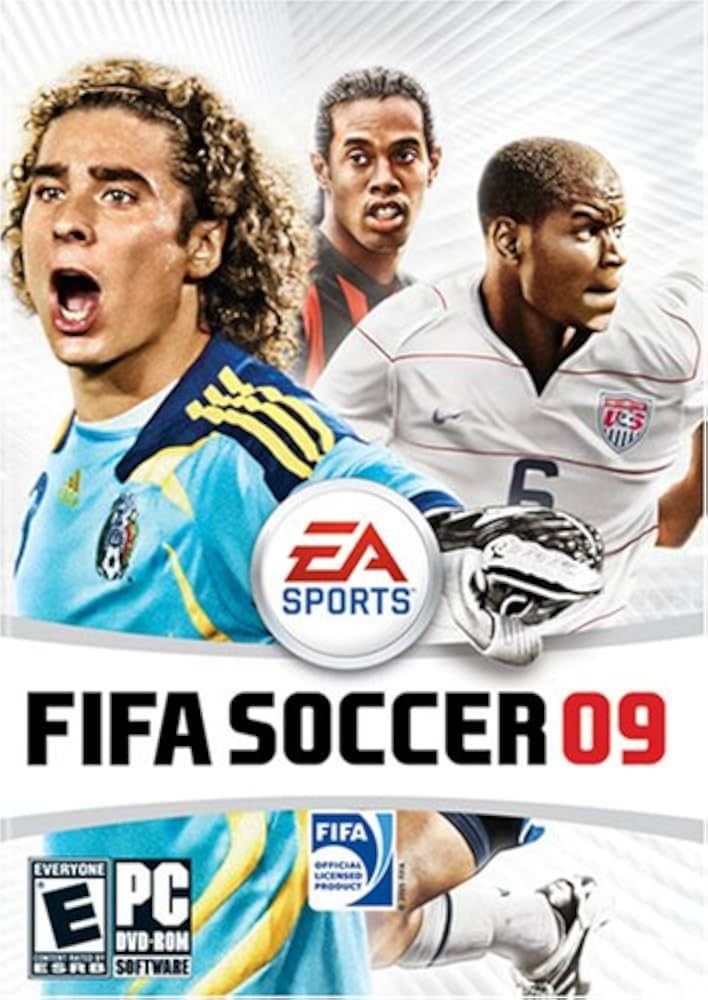
FIFA 09 provided extensive licensed content with over 500 club teams from more than 30 leagues. It included 41 national teams, though notable absences like Japan existed due to licensing, and some teams like the Netherlands and Russia were not fully licensed. Regional cover art featured Ronaldinho alongside a local star, such as Wayne Rooney in the UK, Franck Ribéry and Karim Benzema in France, or Guillermo Ochoa and Maurice Edu in North America. The Spanish cover featured only Gonzalo Higuaín.
The game included 48 stadiums, 17 of which were fictional, with a strong concentration in England and Germany. Stadia from France, Italy, Spain, Mexico, and Wales were also present, including each country's national stadium. The global atmosphere was reinforced by a soundtrack of 42 songs from 22 different countries, announced in August 2008.
Critical Reception and Commercial Success
FIFA 09 was met with strong critical acclaim. IGN awarded it a score of 8.6 out of 10 and an Editor's Choice Award, while GameSpot gave it an 8.5 out of 10. It was nominated for Best Sports Game for the Nintendo DS in IGN's 2008 awards and for Sports Game of the Year at the 12th Annual Interactive Achievement Awards.
Commercially, the game was a major success. In the United Kingdom, both the Xbox 360 and PlayStation 3 versions received a 'Double Platinum' sales award from ELSPA, certifying sales of at least 600,000 copies per version. This performance underscored the game's widespread popularity and the significant impact of its gameplay improvements and new modes on the franchise's trajectory.
FAQ
When was the FIFA 09 demo released?
The demo for FIFA 09 was released on September 10, 2008, for Windows and on September 11, 2008, for PlayStation 3 and Xbox 360. The PS3 demo featured the FIWC Stadium, while the Xbox 360 version used Wembley Stadium.
What was the 10 vs. 10 mode in FIFA 09?
FIFA 09 included a 10 vs. 10 'Be a Pro' online game mode. This allowed for large-scale online matches where each player controlled a single footballer, a feature that expanded the game's online competitive and cooperative possibilities.
Which consoles had user-controlled celebrations?
User-controlled goal celebrations were available only on seventh-generation consoles, specifically the PlayStation 3 and Xbox 360. This feature was excluded from the PC and Wii versions due to capacity limits.
How did the 'Be A Pro' mode work in FIFA 09?
The 'Be A Pro' mode allowed players to control a single footballer for four seasons. On PlayStation 3 and Xbox 360, performance could lead to transferring to new clubs or being selected for a national team. This club and country change feature was not available in the PC version of the mode.
What were the card pack prices in Ultimate Team?
In the Ultimate Team mode, card packs were purchased with points and categorized by price and quality. A Gold pack cost 5,000 points, a Silver pack cost 2,500 points, and a Bronze pack cost 500 points. Each pack contained a random assortment of player cards.
Source: English Wikipedia (CC BY-SA), rewritten by the Redington Cybersport desk.