Command & Conquer 3: Tiberium Wars
Command & Conquer 3: Tiberium Wars is a 2007 real-time strategy game that defined competitive play for the Command & Conquer series. Its launch was accompanied by a dedicated esports initiative, BattleCast, aimed at establishing RTS as a spectator sport. The game's three asymmetric factions and strategic depth fueled a dedicated competitive scene.
| Developer | Electronic Arts |
|---|---|
| Publisher | Electronic Arts |
| Release Date | March 2007 |
| Platforms | Windows, Mac OS X, Xbox 360, Xbox One, Xbox Series (via backward compatibility) |
| Genre | Real-time strategy |
| Multiplayer | LAN, online (originally via GameSpy) |
| Expansion | Command & Conquer 3: Kane's Wrath (March 24, 2008) |
| Playable Factions | Global Defense Initiative (GDI), Brotherhood of Nod, Scrin |
Gameplay and Core Mechanics
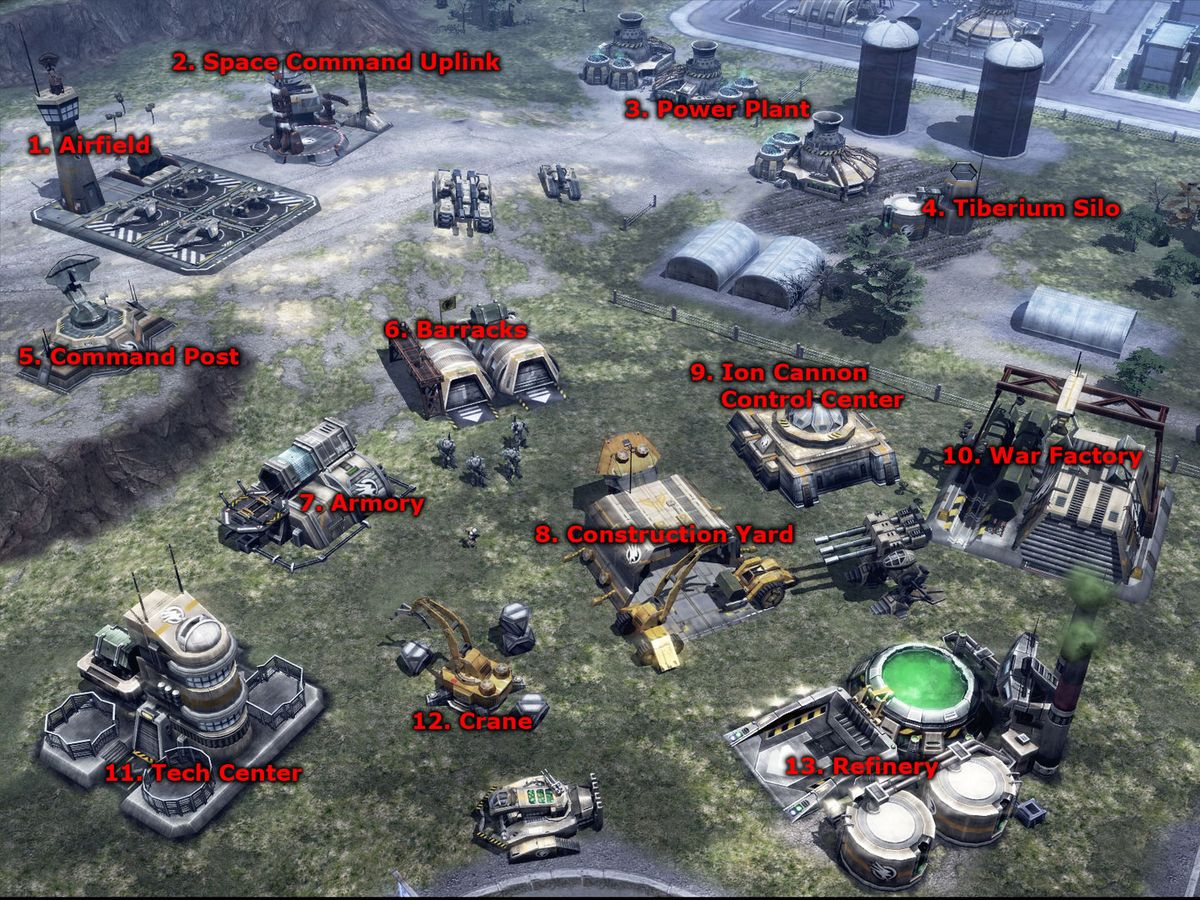
The competitive heart of Tiberium Wars is a classic real-time strategy framework built on resource management, base building, and tactical combat. Players start with a construction yard to build their base. The sole resource is Tiberium, harvested from crystal fields by specialized vehicles and converted into credits to fund production. A key strategic element is power management, as all structures require power plants to function, and losing power can cripple a player's economy and unit production.
Unit and structure production is streamlined. Players can build additional production structures like cranes and barracks to create multiple unit queues simultaneously, though at an increased cost. This system rewards efficient macro-management and careful spending. The game also features neutral structures on maps, such as Tiberium spikes that provide a steady income or EMP weapons, which can be captured by engineers to gain tactical advantages.
Combat follows a rock-paper-scissors model where unit types are strong and weak against others. Each of the three factions has access to infantry, vehicles, and aircraft with similar roles but distinct properties and special abilities. As players build more advanced structures, they unlock new units, upgrades, and faction-specific special powers. The ultimate goal in any match is to destroy the opponent's base while defending your own.
Base defense is handled by specialized defensive towers that must be placed within the territory controlled by a player's structures. Territory expands when new structures are placed, allowing for greater map control. Virtually every structure acts as part of a tech tree, with new options becoming available as the base expands. Production can be blocked if prerequisite structures are destroyed or if power plants are disabled.
The Three Factions
The competitive balance of Tiberium Wars revolves around three distinct factions, each with its own strengths and playstyles. The Global Defense Initiative represents conventional military power. GDI units are heavily armored and pack significant firepower, making them strong in direct, open confrontations, though they can be cumbersome. Their superweapon is the Ion Cannon, an orbital laser-guided energy strike.
The Brotherhood of Nod employs guerrilla warfare and deception. Nod forces are typically weaker in head-on fights but utilize stealth, hit-and-run tactics, and Tiberium-based weaponry. Like in the original Command & Conquer, their superweapon is a nuclear missile launched from the Temple of Nod. The alien Scrin faction is the most unconventional. Their technology is entirely Tiberium-based, and they can promote the growth of the substance and store it infinitely. Scrin units are immune to Tiberium's radiation but vulnerable to anti-Tiberium weapons. Their superweapon, the Rift Generator, creates a vortex that pulls nearby units into space.
Each faction has a highly destructive superweapon that becomes available after a timer expires. Once used, the timer must reset before it can be activated again, adding a strategic layer of timing and anticipation to matches. The factions' structures and units, while functionally similar, are adjusted to fit their themes, leading to varied strategic approaches and counter-play.
Multiplayer and the BattleCast Initiative
Tiberium Wars was designed with competitive multiplayer as a central focus. It supported LAN and online play, originally through GameSpy servers. After GameSpy shut down in 2014, community-based alternatives were developed to maintain online functionality. The game featured ranked ladders for 1v1 and 2v2 matches, both for individual players and clans, each using a separate Elo rating system. Players could also engage in unranked matches. The multiplayer suite included VoIP support for voice communication.
Electronic Arts made a significant push to market the game as an esport through the BattleCast project. This was a service on the game's official website that allowed players to schedule matches, spectate live games, and access a centralized replay archive. A key feature was the ability for spectators to act as live commentators, providing narration and even drawing on the screen with a digital brush to highlight tactics. Commentators could also talk to other observers through the BattleCast interface.
A free BattleCast Viewer was released, allowing people without the game to watch matches, broadening the potential audience for competitive play. Players could also download custom maps through the official channels, adding variety to the competitive map pool. This comprehensive suite of tools was a clear attempt to foster a spectator-friendly esports ecosystem around the game.
Single-Player and Skirmish Modes
While primarily a competitive title, Tiberium Wars offered extensive single-player content that served as training for multiplayer. The story-driven campaign consists of 38 missions across three factions, 17 for GDI, 17 for Nod, and 4 for the Scrin, which is unlocked after completing the first two. The narrative is advanced through full-motion video cutscenes. Players can choose to start with either the GDI or Nod campaign.
Each mission features main objectives, the completion of which ends the mission successfully. Several optional bonus objectives are also available, usually providing a tactical advantage, reinforcements, or supplies upon completion. All campaign missions can be set to a difficulty rating from Easy to Normal to Hard before starting. As players progress, they unlock entries in the Intelligence Database, providing background on the storyline, factions, units, and structures. Some entries require completing bonus objectives to access.
The skirmish mode acts as the game's sandbox and practice arena. Here, players can battle against AI opponents on any map. The AI can be customized with different behavioral profiles, such as rusher, turtler, or steamroller, and set to difficulty levels from Easy to Medium to Hard to Brutal. Handicap settings can also be applied to the AI, the player, or both. Winning a skirmish on a map places a star next to it in the menu, marking the player's achievement at that difficulty level.
Setting and Story Context
The competitive battles of Tiberium Wars are set against the backdrop of the Third Tiberium War in an alternate 2047. By this time, the alien substance Tiberium has severely contaminated Earth, dividing the world into zones. Red Zones are too toxic for human life, Yellow Zones are heavily contaminated and house most of the population, and Blue Zones have minimal contamination and are protected by GDI. Traditional nations have collapsed, leaving two superpowers, the GDI and the Brotherhood of Nod, in constant conflict.
The story begins when Nod's enigmatic leader, Kane, reappears after being presumed dead and launches a surprise attack, destroying GDI's orbital command station, the GDSS Philadelphia. This triggers the Third Tiberium War. The conflict escalates to a catastrophic event in Sarajevo, where the use of GDI's Ion Cannon on a Nod stronghold, Temple Prime, causes a massive liquid Tiberium explosion that kills millions.
This explosion reaches into space and attracts the Scrin, an extraterrestrial faction that invades Earth to harvest Tiberium, forcing all three factions into a three-way war. The game's campaigns show interwoven perspectives of this conflict from each side, with the events closely tied together in the same timeline. The GDI campaign ending differs from the endings of the Nod and Scrin campaigns.
Legacy and Expansion
Command & Conquer 3: Tiberium Wars proved to be a commercial success following its launch in March 2007. It received favorable reviews for its gameplay and presentation. The game's standalone expansion pack, Command & Conquer 3: Kane's Wrath, was released on March 24, 2008, adding new content and further extending the game's lifecycle.
The game's legacy in competitive play is marked by the ambitious BattleCast initiative, which represented one of the early formal efforts to present a real-time strategy game as a spectator sport. The structured ladder systems for 1v1 and 2v2 play provided a framework for competitive ranking that engaged the community. The three-faction design, with its clear asymmetrical strengths and the rock-paper-scissors unit balance, created a meta-game that required deep knowledge and adaptation, essential qualities for a strong competitive title.
Even after the original online services transitioned, the game's design ensured its longevity. The availability of the game on modern Xbox consoles through backward compatibility has also helped preserve access to its multiplayer and skirmish components for new and returning players.
FAQ
What are the playable factions in Command & Conquer 3?
There are three playable factions. The Global Defense Initiative uses conventional heavy weaponry. The Brotherhood of Nod specializes in stealth and guerrilla warfare. The alien Scrin faction utilizes Tiberium-based technology and is immune to its radiation.
What was the BattleCast feature?
BattleCast was Electronic Arts' initiative to promote Tiberium Wars as an esport. It was an online service that allowed players to schedule matches, spectate live games, function as commentators, and access a replay archive. A free viewer let people watch without owning the game.
What is the main resource in the game?
Tiberium is the sole resource. It is harvested from crystal fields by harvester vehicles and processed at refineries into credits, which are used automatically to build structures and train units.
Does the game have a single-player campaign?
Yes, it features a story-driven campaign with 38 missions across three factions. Players must complete the GDI and Nod campaigns to unlock the shorter Scrin campaign. Missions have main and bonus objectives with variable difficulty settings.
What platforms is Command & Conquer 3 available on?
The game was originally released for Windows, Mac OS X, and Xbox 360 in March 2007. It can also be purchased digitally and played on Xbox One and Xbox Series consoles through Microsoft's backward compatibility program.
Source: English Wikipedia (CC BY-SA), rewritten by the Redington Cybersport desk.