Overwatch Apex
Overwatch Apex was a premier South Korean esports tournament series for Overwatch, organized and broadcast by OnGameNet from 2016 to 2017. It served as the highest level of regional competition, blending top domestic teams with invited international squads across four seasons. The series is remembered for its high production value and for establishing the competitive foundation in Korea before the launch of Blizzard's global league system.
| First held | October 7, 2016 |
|---|---|
| Last held | 2017 |
| Number of seasons | 4 |
| Organizer | OnGameNet (OGN) |
| Game | Overwatch |
| Format | 16-team league with group stage and playoffs |
| Prize pool | Not specified |
| Venue | OGN Giga Arena |
| Final champion | Season 4: Not specified in notes |
| Status | Discontinued |
Origins and Structure
OnGameNet announced the creation of OGN Apex on September 16, 2016. The cable channel specialized in broadcasting video game content and esports. The goal was to host a 16-team Overwatch league. The initial response was substantial, with 1,531 players from 230 South Korean teams registering for the online qualifiers of the first season. From these qualifiers, 64 teams advanced to offline qualifiers. The top 12 from those offline qualifiers earned a spot in the main Apex league.
The tournament operated with a consistent format across its run. Each season, except the fourth, included a mix of qualified Korean teams and invited teams from North America and Europe. The competition began with a group stage, followed by playoffs. Every match in the regular season was a best-of-five series. The grand finals were always a best-of-seven series. OGN also ran a parallel competition called Overwatch Apex Challengers. This event acted as a promotion tournament, with the top teams earning a chance to qualify for the main Apex league in subsequent seasons.
The Inaugural Season and Its Champion
The first season of Overwatch Apex began on October 7, 2016. The twelve qualified Korean teams were Afreeca Freecs Blue, MVP Space, BK Stars, Luxury Watch Blue, Rhinos Gaming, Flash Lux, Mighty Storm, KongDoo Panthera, Kongdoo Uncia, RunAway, CONBOX T6, and Lunatic-Hai. They were joined by four invited Western teams. Team EnVyUs and NRG Esports represented North America, while Rogue and Reunited came from Europe. The English broadcast featured the casting duo of Christopher MonteCristo Mykles and Erik DoA Lonnquist.
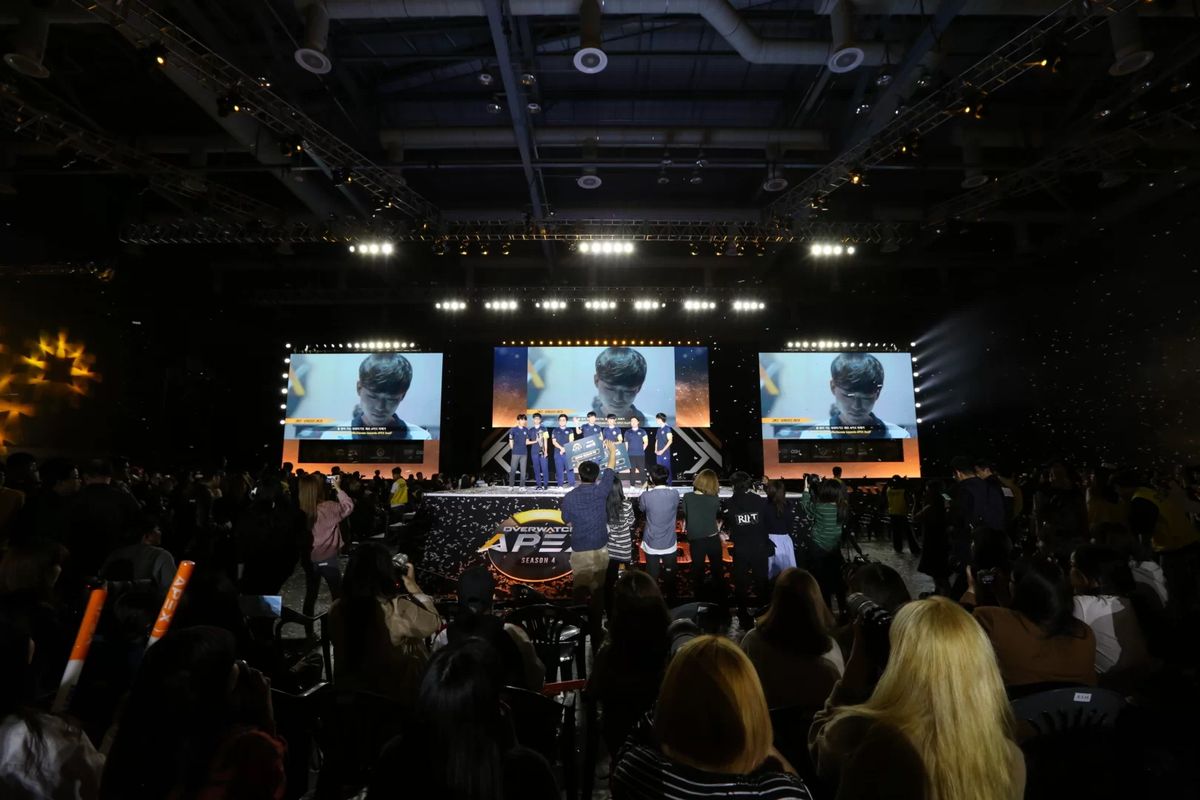
Following the group stage, an eight-team single elimination playoff bracket was held. The finals took place in Ilsan, South Korea on December 3, 2016. In that match, the North American team Team EnVyUs defeated the Korean team Afreeca Freecs Blue by a score of 4-1 to become the first Apex champion.
Format Refinements in Season Two
Several changes were implemented for the second season of Apex. The league added a double-elimination bracket that took place after the group stage and before the playoffs. The top four teams from this double-elimination bracket then advanced to the playoff stage. Another new rule allowed each team one timeout in the middle of a match.
The team lineup for season two included twelve South Korean teams, three from North America, and one from Europe. Compared to the first season, the Korean teams MVP Space, Rhinos Gaming, and Mighty Storm did not qualify. Their places were taken by MVP Infinity, Meta Athena, and Afreeca Freecs Red. The invited Western teams were Team EnVyUs, Fnatic, Cloud9, and Misfits. The season commenced with its first group stage matches on January 17, on January 17, 2017, in Seoul.
Roster Changes and a Casting Departure in Season Three
The third season followed the same format as the second, with a twelve-team group stage, an eight-team double-elimination bracket, and a four-team playoff. However, a major new rule was introduced. Teams were permitted to substitute players between maps. This rule change prompted many organizations to increase their roster size from the standard six players to seven or more.
This season also marked the end of an era for the English broadcast. The casting duo of Mykles and Lonnquist departed from Apex to prepare for Blizzard Entertainment's upcoming Overwatch League. Furthermore, the league reduced the number of invited non-Korean teams from four to two. The invited Western teams for season three were Rogue and Team EnVyUs. The Korean contingent included returning teams like Lunatic-Hai and KongDoo Panthera, as well as teams promoted from the Challengers league such as Mighty AOD and X6-Gaming. Season three began on April 28, 2017.
A Korean-Only Final Season
The fourth season of Apex represented a significant shift. In May 2017, Blizzard announced plans for Overwatch Contenders leagues in North America and Europe. Following this, OGN announced that no international teams would be invited to compete in Apex's fourth season. OGN also cancelled the promotion and relegation event for this season. Instead, the top five teams from the Challengers league received direct invitations to join the main league.
As a result, season four was contested exclusively by sixteen Korean teams. The participants included previous contenders like Lunatic-Hai, RunAway, KongDoo Panthera, and Meta Athena, alongside newer teams such as GC Busan, NC Foxes, and ROX Orcas. This season completed the tournament's run before its planned transition.
The Planned Rebrand and Sudden End
In late 2017, Blizzard Entertainment announced that Overwatch Contenders would operate in seven regions globally. As part of this plan, Overwatch Apex was to be re-branded as Contenders Korea. OGN had been preparing to run a fifth season under this new Contenders banner.
This plan was upended in December 2017. A Korean news outlet reported that Blizzard had sold the broadcasting rights for Contenders Korea to a different television channel, MBC. In January 2018, OGN confirmed the end of the Apex tournament series. In an interview, OGN stated they had agreed to most of Blizzard's conditions to continue the competition but were notified that Blizzard was preparing a competition with another broadcaster. OGN expressed regret, noting they had already been preparing for the next season.
Lasting Impact on Overwatch Esports
Overwatch Apex established a high competitive standard and production quality that influenced later Overwatch events. The OGN Giga Arena, the primary venue for Apex matches, later hosted the first Overwatch Contenders Gauntlet tournament. The league also functioned as the primary incubator for Korean talent, with many players and teams from Apex becoming stars in the global Overwatch League.
The series' production style left a particular mark. During the Overwatch League's 2021 season, the league produced a hype video for a match that was directly reminiscent of the videos OGN produced for Apex. This homage acknowledged the tournament's role in shaping the presentation and narrative style of professional Overwatch broadcasts.
FAQ
What was Overwatch Apex?
Overwatch Apex was a major South Korean esports tournament series for the game Overwatch, organized and broadcast by the cable channel OnGameNet. It ran for four seasons from 2016 to 2017 and was the top-level league in Korea before the introduction of Contenders.
Which teams won Overwatch Apex?
The notes specify that Team EnVyUs won the first season by defeating Afreeca Freecs Blue. The champions for seasons two, three, and four are not detailed in the provided notes.
Why did Overwatch Apex end?
The series ended after Blizzard Entertainment decided to launch its global Contenders system. OGN planned to rebrand Apex as Contenders Korea but Blizzard sold the broadcasting rights to another channel, MBC. OGN then chose to end the Apex series entirely.
What was the format of an Apex match?
Standard matches in all seasons were best-of-five series. The grand finals for each season were a longer best-of-seven series. Seasons two and three also featured a double-elimination bracket stage before the playoffs.
Were there non-Korean teams in Apex?
Yes, the first three seasons included invited teams from North America and Europe, such as Team EnVyUs, Rogue, Cloud9, and Misfits. Season four did not invite any international teams and was contested exclusively by Korean squads.
Source: English Wikipedia (CC BY-SA), rewritten by the Redington Cybersport desk.