Swordquest
Swordquest was a series of Atari 2600 action-adventure games and a high-stakes real-world treasure hunt launched in the early 1980s. It is remembered for its ambitious integration of physical comic books and valuable prizes, though the contest was never fully completed due to the video game crash of 1983.
| Developer | Atari, Inc. |
|---|---|
| Publisher | Atari, Inc. |
| Platform | Atari 2600 |
| First released | 1980s |
| Games released | Earthworld, Fireworld, Waterworld |
| Planned game | Airworld |
| Contest prize pool | $150,000 |
| Comic book publisher | DC Comics |
| Prize manufacturer | The Franklin Mint |
| Programmer | Tod Frye |
The Contest and Its Legendary Prizes
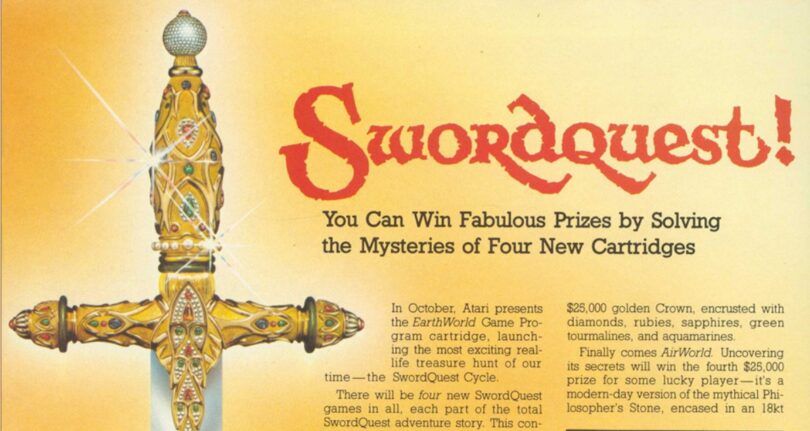
The Swordquest series was conceived not just as a set of games but as a massive promotional contest. Atari offered a total of $150,000 in prizes, with each of the four planned games corresponding to a physical treasure crafted by The Franklin Mint. The prizes were the Talisman of Penultimate Truth for Earthworld, the Chalice of Light for Fireworld, the Crown of Life for Waterworld, and the Philosopher's Stone for Airworld. The four winners were then meant to compete in a final contest for the grand prize, the Sword of Ultimate Sorcery, valued at $50,000.
Contestants had to solve puzzles within each game to find hidden words in the accompanying comic books. For Earthworld, about 5,000 entries were submitted, but only eight were correct. Stephen Bell won the Talisman in a final competition held in May 1983. The Fireworld contest drew more correct entries, 73, with Michael Rideout ultimately winning the Chalice in January 1984. The Waterworld contest was complicated by Atari's financial troubles and corporate sale, and was restricted to Atari Club members. The Crown was awarded to an anonymous winner in a secret final round.
The contest was cancelled before Airworld could be released or its prize awarded. As compensation, Earthworld and Fireworld winners Bell and Rideout each received an additional $15,000 and an Atari 7800. The ten Waterworld finalists were given $2,000 each. The fate of the unclaimed prizes, particularly the Sword and the Philosopher's Stone, became a subject of gaming urban legend, with rumors they were taken by Atari's new owner, Jack Tramiel. Historian Curt Vendel believes these items were likely returned to Warner Communications and melted down by The Franklin Mint after the project's cancellation.
Gameplay and Design Philosophy
Each Swordquest game was themed after a classical element: earth, fire, water, and air. The gameplay involved moving through a maze of rooms, collecting objects, and placing them in their correct locations. The room layouts were based on complex symbolic systems: Earthworld on the Western zodiac, Fireworld on the Kabbalah tree of life, Waterworld on the chakras, and the unreleased Airworld was planned to be modeled after the I Ching.
Progress often required completing action-oriented minigames, blending adventure game logic with twitch gameplay. This made the series one of the earliest attempts at the action-adventure genre on the Atari 2600. When a player correctly placed an item, the game would display numerical clues pointing to a specific page and panel in the packaged DC comic book. There, a hidden word was concealed. Submitting all correct words in order entered the player into the contest's next phase. The games sometimes contained more clues than necessary, requiring players to also decipher hints in the instruction manuals to know which ones to submit.
Narrative and Comic Book Integration
The story, told across the game comics, follows twins Tarra and Torr, who are prophesied to slay King Tyrannus. After their parents are killed, they are raised by thieves. Their quest leads them to seek the Sword of Ultimate Sorcery and the Talisman of Penultimate Truth, transporting them through Earthworld, Fireworld, and Waterworld. In each world, they face thematic challenges and a recurring rival thief named Herminus.
In Earthworld, they battle zodiac beasts. In Fireworld, they search for the Chalice of Light. In Waterworld, they lose their memories and become embroiled in a conflict over the Crown of Life before being transported to the unreleased Airworld for a final confrontation. The comic books, written by Roy Thomas and Gerry Conway and illustrated by George Pérez and Dick Giordano, were essential to the contest, hiding the puzzle solutions within their panels. The comic for Airworld was started but left unfinished when the series was cancelled.
Development and Corporate Upheaval
The concept for Swordquest grew from the success and Easter egg discovery in Atari's earlier game, Adventure. Atari, then owned by Warner Communications, leveraged its corporate connections, using DC Comics for the story and The Franklin Mint for the prizes. Programmer Tod Frye developed the games. The ambitious contest was designed to drive engagement and sales.
However, the project was derailed by the video game crash of 1983 and internal turmoil at Atari, including an insider trading scandal and the replacement of CEO Ray Kassar with James J. Morgan. Looking to cut losses, Atari cancelled the Swordquest project despite work on Airworld having begun. Legal obligations forced the company to complete the Waterworld contest, but the corporate chaos continued when Jack Tramiel purchased Atari in mid-1984. Tramiel's focus on home computers and the restructuring of the company further hindered any chance of reviving the contest or releasing Airworld.
Legacy and Modern Revivals
Despite its incomplete state, Swordquest is remembered as an ambitious crossover between video games and real-world treasure hunting. What it is remembered for includes the mystery surrounding the fate of its prizes. In 2022, the series was included in the Atari 50: The Anniversary Celebration collection. For this release, developer Digital Eclipse created a new, playable version of Airworld, finally offering a conclusion to the series over three decades later.
The story of the contest itself inspired new works. In 2017, Dynamite Entertainment published a six-issue comic book series titled Swordquest. This meta-narrative followed an adult fan of the original games who begins a quest to find the real Sword of Ultimate Sorcery, blending the history of the contest with a new adventure. The series was written by Chad Bowers and Chris Sims, with art by Scott Kowalchuk.
FAQ
What was the Swordquest contest?
Swordquest was a promotional contest where players solved puzzles in Atari 2600 games and accompanying comic books to find hidden words. Correct submissions entered them into competitions to win valuable physical treasures, like a gold talisman and a jeweled chalice, with a final grand prize of a $50,000 jeweled sword. The total prize pool was $150,000.
How many Swordquest games were released?
Three games were released: Earthworld, Fireworld, and Waterworld. A fourth game, Airworld, was planned but never officially released due to the cancellation of the contest and Atari's financial problems in 1983.
Who won the Swordquest prizes?
Stephen Bell won the Talisman for Earthworld in May 1983. Michael Rideout won the Chalice for Fireworld in January 1984. The Crown for Waterworld was awarded to an anonymous winner in a secret final round. The prizes for Airworld and the final Sword were never awarded.
What happened to the unclaimed Swordquest treasures?
The fate of the unclaimed Philosopher's Stone and Sword of Ultimate Sorcery is unknown and subject to urban legend. Historian Curt Vendel believes they were likely returned to Warner Communications and melted down by The Franklin Mint. Michael Rideout still possesses his Chalice, while Stephen Bell reportedly melted down the gold disc of his Talisman.
Is there a way to play Airworld today?
Yes. A new, completed version of Airworld was developed by Digital Eclipse and included in the 2022 compilation Atari 50: The Anniversary Celebration, finally providing an official conclusion to the game series.
Source: English Wikipedia (CC BY-SA), rewritten by the Redington Cybersport desk.