Nintendo Campus Challenge
The Nintendo Campus Challenge was a series of collegiate video game competitions sponsored by Nintendo in the early 1990s. It brought competitive gaming directly to university campuses across the United States and Canada, offering students a chance to win scholarships, cars, and the title of champion.
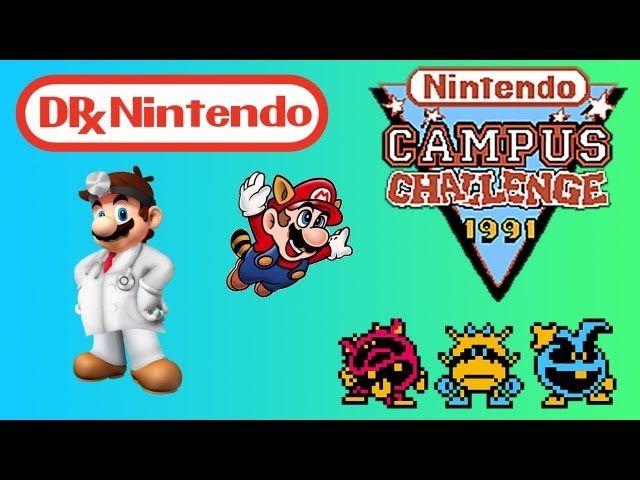
| First held | 1991 |
|---|---|
| Last held | 1992 |
| Organizer | Nintendo of America |
| Platform | NES (1991), SNES (1992) |
| Notable games | Super Mario Bros. 3, Pin Bot, Dr. Mario (1991); Super Mario World, F-Zero, Pilotwings (1992) |
| 1991 champion | Steve Lucas |
| 1992 US champion | Jeff Hanson |
| 1992 world champion | Jeff Hanson |
| Grand prize (1992) | $10,000 |
| Format | On-campus qualifiers, national finals |
The 1991 Challenge and Its Games
The inaugural Nintendo Campus Challenge in 1991 was a traveling competition that visited 58 college campuses and spring break locations over a year, starting in November 1990. At each stop, the event was structured across three stages. The main stage featured the competition itself on twelve different game stations. A second stage had standard Nintendo Entertainment Systems with various games for casual play, and a third stage was dedicated to Game Boy systems. This setup allowed attendees to play the challenge as many times as they wished, with the highest score at the end of the day announced as the local winner.
Contestants had six minutes and twenty one seconds to complete a special three game challenge on the Nintendo Entertainment System. The sequence began with Super Mario Bros. 3, where the goal was to collect 25 coins. Players then moved to a version of Pin Bot, aiming for 100,000 points. The final segment was Dr. Mario, played until the clock ran out. The total score was calculated using a specific formula: the Super Mario Bros. 3 coin count was multiplied by 10, the raw Pin Bot score was added, and then the Dr. Mario score was multiplied by 100 and added to the total.
Local winners earned round trip airfare to the national finals at Walt Disney World in Orlando, Florida, held over the New Year's weekend in January 1992. All competitors played in a first round, followed by a second round featuring only the six highest scoring players. The championship was decided by a head to head match between the top two finalists, Steve Lucas and Matt Sekelsky. Steve Lucas won with a final score of 2,394,130, becoming the college valedictorian of videogames as advertised.
The Rare 1991 Competition Cartridge
The software for the 1991 challenge was a special cartridge of its own. Only one original copy is known to exist. It was discovered by video game collector Rob Walters at a garage sale in New York in 2006. The cartridge sold to another collector, JJ Hendricks, for $14,000 in July 2009. After just three months, Hendricks resold the game on eBay for $20,100, highlighting its high value to collectors.
This cartridge was not used solely for the American Campus Challenge. It also powered the French Nintendo Super Tour in 1992 and a separate competition in Scandinavia the same year, indicating Nintendo's reuse of the specialized hardware for international promotions. The game's composition was finalized after changes from initial plans. Early advertisements listed Rad Racer as one of the three games, but it was replaced by Pin Bot in the final cartridge. This was likely because Rad Racer had been used in the earlier Nintendo World Championships cartridge, and the 1991 Campus Challenge cartridge used a different mapper chip from that event's cartridge.
The 1992 Challenge on the Super Nintendo
Nintendo returned with a new Campus Challenge in 1992, this time utilizing the newer 16 bit Super Nintendo Entertainment System. The tour was slightly smaller, visiting 35 college campuses throughout the US, including Central Michigan University, Arizona State University, and Texas A&M University. The competition format was updated for the new hardware but kept a similar three game structure.
The games were Super Mario World, where players had to collect 50 coins, F Zero, which required the completion of two laps on a track, and Pilotwings, where the goal was to land successfully on two targets. The scoring formula was revised for the new games. The final score was the sum of the Super Mario World score, the F Zero score multiplied by 100, and the Pilotwings score multiplied by 10,000.
Prizes for the 1992 campus events were clearly defined. The winner at each location received a Super NES console bundle that included Super Mario World, F Zero, and Pilotwings. Consolation prizes of $100, $75, and $50 were awarded to the second, third, and fourth place contestants, respectively. The overall United States champion won a grand prize of $10,000. Furthermore, all the campus winners were entered into a draw for additional prizes of $5,000 each.
Hardware and Promotion for the 1992 Tour
The 1992 competition cartridge was a technical marvel with an unusual physical design. The printed circuit board inside the cartridge shell was mounted parallel to the SNES console itself, unlike standard carts. It contained four ROM chips, presumably three for each game plus an additional one to link them together. Crucially, it also included the DSP 1 chip, a special chip used to handle advanced calculations in games like the retail version of Pilotwings. The cartridge also featured a set of eight switches, likely used by technicians to adjust game settings, and a phone jack, probably used to relay scores to a central Nintendo server to determine the grand prize winner.
Alongside the competition setup, Nintendo sent preview copies of upcoming games to the campus events. These previews included Contra III: The Alien Wars, Rival Turf, The Legend of Zelda: A Link to the Past, The Addams Family, and Super Scope 6. This served to promote the broader SNES library to the college audience while they attended the challenge events.
Only a handful of these 1992 cartridges were produced. Reports indicate three existed, but only two are known to collectors. One was found by the same Rob Walters at the same New York garage sale as the 1991 cart, and it is owned by collector Rick Bruns. The second known cartridge was discovered in the attic of a former employee of a company that did contract projects for Nintendo, to whom Nintendo had sent the cartridge along with systems and other games.
The 1992 World Championship
The 1992 Nintendo Campus Challenge was not confined to the United States. Similar competitions were held in Europe and Japan during the same year. The winner of the US competition was Jeff Hanson. His victory earned him the right to represent the United States in a world championship match.
This global finale pitted Hanson against the winner of the Japanese Campus Challenge, Yuichi Suyama. The match was held at the 1993 Consumer Electronics Show, a major industry trade event. Jeff Hanson defeated Yuichi Suyama in this contest, officially becoming the Nintendo Campus Challenge World Champion. This event marked an early, formalized instance of international esports competition organized by a major console manufacturer.
Legacy and Rarity
The Nintendo Campus Challenge holds a distinct place in gaming history as one of the first major corporate efforts to bring esports directly to a collegiate audience. It built upon the model of the Nintendo World Championships, adapting it for a university setting with prizes like scholarships and cars aimed directly at students, as highlighted in contemporary advertisements in gaming magazines.
Today, the events are perhaps best known for the extreme rarity and value of their competition cartridges. These special game cartridges, never sold commercially and used only for promotional tournaments, are among the most sought after and valuable collectibles in the video game hobby. Their discovery in garage sales and attics reads like treasure hunting lore, with prices at auction reaching well over $20,000.
The Challenge also represents an early blueprint for future gaming competitions. It featured a structured qualifying system across numerous venues, a national finals event at a major destination, and even an international championship. It served as a direct precursor to other Nintendo events like Nintendo PowerFest '94 and remains a fondly remembered piece of 1990s gaming culture that connected the company directly with its college aged fans.
FAQ
What was the Nintendo Campus Challenge?
It was a video game competition sponsored by Nintendo in 1991 and 1992, held at college campuses across the United States and Canada. Students competed in special multi game challenges on the NES and SNES for prizes like scholarships, cash, cars, and consoles.
Who won the 1991 Nintendo Campus Challenge?
Steve Lucas won the 1991 national finals at Walt Disney World in January 1992, defeating Matt Sekelsky in a head to head match with a final score of 2,394,130 to become the national champion.
What games were played in the 1992 challenge?
The 1992 challenge on the Super Nintendo featured three minigames: Super Mario World, where players collected 50 coins, F Zero for completing two laps, and Pilotwings for landing on two targets. The scoring formula multiplied the F Zero score by 100 and the Pilotwings score by 10,000.
How rare are the Campus Challenge cartridges?
They are extremely rare. Only one original 1991 cartridge is known, which sold for over $20,000. For the 1992 version, only three cartridges were reportedly made, with two known to exist today, one found in a garage sale and another in an ex contractor's attic.
Was there a world champion?
Yes. After winning the 1992 US competition, Jeff Hanson faced and defeated the 1992 Japanese champion, Yuichi Suyama, at the 1993 Consumer Electronics Show. This victory made Jeff Hanson the official Nintendo Campus Challenge World Champion.
Source: English Wikipedia (CC BY-SA), rewritten by the Redington Cybersport desk.