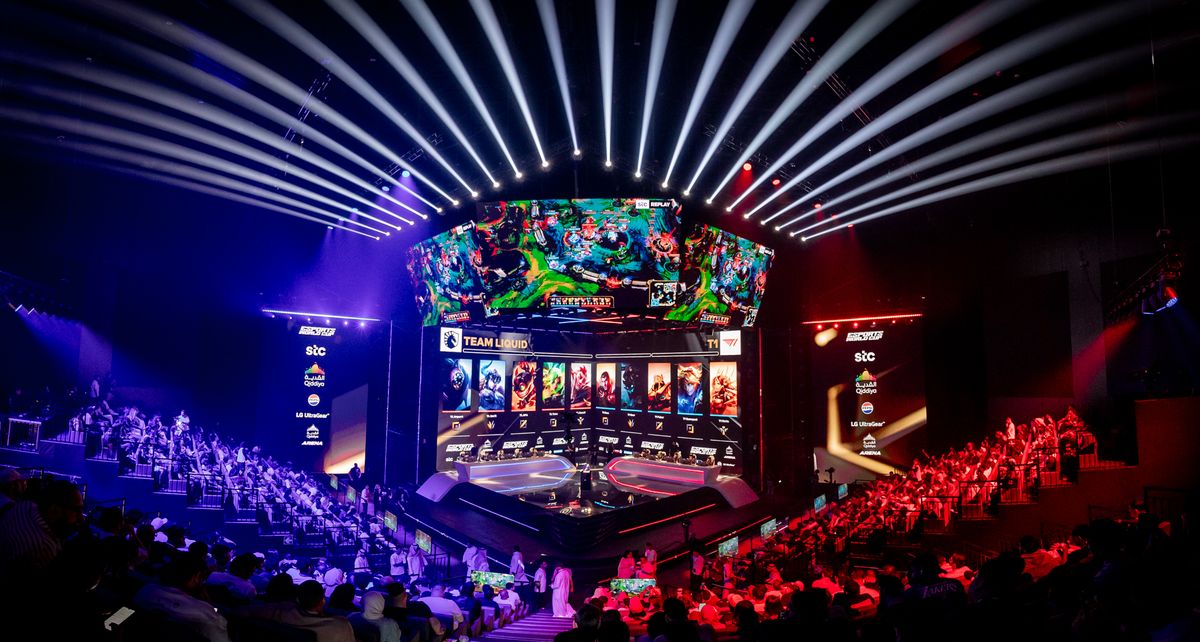
League of Legends Champions Korea
The League of Legends Champions Korea (LCK) is South Korea's premier professional league for the game League of Legends. It is the primary route for Korean teams to qualify for the annual World Championship and has produced a record ten world title winners.

| Founded | 2012 (as The Champions) |
|---|---|
| Current name | League of Legends Champions Korea (since 2014) |
| Administrators | Riot Games and KeSPA |
| Number of teams | 10 |
| Seasons per year | 2 (until 2024), 1 (since 2025) |
| World Championships won | 10 (by LCK teams) |
| Franchised | 2021 |
| Notable broadcaster | OGN (until 2016) |
Origins and Early Years
The LCK's history began shortly after the launch of the Korean League of Legends server in December 2011. In March 2012, the cable broadcaster OnGameNet launched the country's first major tournament, The Champions Spring 2012. This inaugural event featured 16 teams and was won by MiG Blaze, who defeated their sibling team MiG Frost in the final. Later that year, Azubu Frost, the rebranded MiG Frost, won The Champions Summer 2012. These early champions, Azubu Frost and NaJin Sword, represented South Korea at its first World Championship in October 2012.
The league settled into a yearly circuit of three tournaments: winter, spring, and summer. The 2013 season saw victories from NaJin Sword in Champions Winter, MVP Ozone in Champions Spring, and SK Telecom T1 K in Champions Summer. SK Telecom T1 K then made history by winning the Season 3 World Championship, the first world title for a Korean team. Their dominance continued into 2014 as they won Champions Winter, completing an undefeated run. Samsung Galaxy Blue and KT Rolster Arrows won the spring and summer titles that year, respectively.
The LCK Rebrand and New Era
In late 2014, the league underwent a major restructuring. It was rebranded from League of Legends Champions to League of Legends Champions Korea (LCK). The winter season was removed, leaving a yearly circuit of a Spring Split and a Summer Split. The format changed from a 16-team tournament to a 10-team league playing a round-robin, with the top five teams advancing to playoffs. A key rule change prohibited organizations from owning more than one team, which ended the common sibling team system and forced many rosters to merge or disband.
The new LCK era began in 2015. A merged SK Telecom T1 squad won both splits that year. They continued their dominance by winning three consecutive titles, a streak ended by the ROX Tigers in LCK Summer 2016. SK Telecom T1 remained a leading team, winning titles in 2017 Spring, and both splits in 2019. After rebranding to T1, the organization won Spring 2020, starting another three-split winning streak. Damwon Gaming, later known as DWG KIA, emerged as a new force, winning both splits in 2021. Gen.G then established its own era, winning four consecutive splits from Summer 2022 to Spring 2024 before Hanwha Life Esports won the Summer 2024 title.
Format Evolution
The LCK format has evolved significantly over time. From 2015 to 2024, the league operated with two splits per year, Spring and Summer. In October 2024, a new format was announced to align with global changes for the 2025 season. The two splits were merged into one single season. To accommodate a new international tournament in March called the First Stand, a preseason tournament called the LCK Cup was introduced. The winner of the LCK Cup qualifies for the First Stand.
The season is now split into two halves with a mid-season tournament in between. The first half features a double round-robin among all ten teams. The top six teams then compete in the Road to MSI tournament, a stepladder bracket that determines Korea's two representatives for the Mid-Season Invitational. Results from the first half also determine groups for the second half, where teams play additional round-robin matches within their group. The season concludes with playoffs to crown the LCK champion and qualify teams for the World Championship.
The LCK Cup and Playoff Structure
The LCK Cup is a preseason tournament that kicks off the competitive year. Teams are drafted into two groups, Baron and Elder. They play a group stage against teams from the opposite group. Since 2026, the final week of this stage uses best-of-five matches. Group stage results determine qualification for a play-in stage and a six-team double-elimination playoff bracket. The top two teams from this playoff qualify for the international First Stand tournament.
The regular season playoffs use a similar structure. At the end of the second half, teams qualify for either a play-in stage or directly to a six-team double-elimination playoff bracket. All playoff matches are best-of-five. The top three teams from these playoffs qualify for the World Championship, with a potential fourth spot available based on MSI performance.
Governance and Player Contracts
The LCK is administered through cooperation between Riot Games and the Korean e-Sports Association (KeSPA). A significant player protection issue arose in 2019. An investigation found that the team Griffin had placed a minor player, Seo 'Kanavi' Jin-hyeok, under a potentially exploitative contract. The team's head coach and director were suspended indefinitely, and Griffin was fined 100 million Korean won.
This controversy prompted South Korea's Ministry of Culture, Sports and Tourism to introduce standardized contracts for the esports industry. These new rules included the Esports Player Standard Contract and specific contracts for trainees and teenage players. The regulations limit player contracts to a maximum of three years and prohibit teams from trading players or extending contracts without the player's written consent.
Current Teams and Legacy
Since franchising in 2021, the LCK has featured ten permanent partner teams. The current competitors are BNK FearX, DN SOOPers, Dplus KIA, Gen.G, Hanjin Brion, Hanwha Life Esports, Kiwoom DRX, KT Rolster, Nongshim RedForce, and T1. These organizations represent the stable foundation of Korean professional League of Legends.
The legacy of the LCK and its predecessor league is defined by its international success. Teams from this competition have won the League of Legends World Championship a record ten times. This includes a historic run of five consecutive world titles from 2013 to 2017, achieved by SK Telecom T1 (2013, 2015, 2016), Samsung Galaxy (2014, 2017), and later by Damwon Gaming (2020) and DRX (2022). This sustained performance has confirmed the LCK's reputation as one of the most competitive and successful leagues in esports.
FAQ
What is the LCK?
The League of Legends Champions Korea (LCK) is the primary professional league for League of Legends in South Korea. It features ten teams and is the main qualification path for Korean squads to reach the League of Legends World Championship.
How many times have LCK teams won Worlds?
Teams from the LCK and its predecessor league have won the League of Legends World Championship a record ten times. This includes a streak of five consecutive world titles from 2013 through 2017.
When did the LCK start?
The league began in 2012 as The Champions, organized by OnGameNet. It was rebranded to League of Legends Champions Korea (LCK) in late 2014 after a major restructuring that changed its format and rules.
What is the LCK format?
Since 2025, the LCK operates a single season per year, starting with a preseason LCK Cup tournament. The regular season is split into two halves with a mid-season tournament for MSI qualification. The season concludes with playoffs to crown the champion and qualify teams for the World Championship.
Which team has won the most LCK titles?
The organization T1, formerly known as SK Telecom T1, has won the most LCK championships. They secured their tenth title in LCK Spring 2022, having won multiple titles across different eras of the league.
Source: English Wikipedia (CC BY-SA), rewritten by the Redington Cybersport desk.