2026 Overwatch World Cup
The 2026 Overwatch World Cup is the sixth edition of the premier international Overwatch 2 tournament, organized by Blizzard Entertainment. The event culminated in South Korea winning its fourth title, defeating defending champions Saudi Arabia in the final at BlizzCon 2026. This tournament marked a significant expansion with a new qualification system and celebrated a decade of Overwatch esports.
| Tournament | 2026 Overwatch World Cup |
|---|---|
| Game | Overwatch 2 |
| Organizer | Blizzard Entertainment |
| First held | 2026 |
| Dates | August 20 – September 13, 2026 |
| Champion | South Korea |
| Runner-up | Saudi Arabia |
| Prize pool | N/A |
| Format | Online qualifiers, Group stage, Single-elimination knockout |
| Venues | Busan Esports Arena (Group stage), Anaheim Convention Center (Knockout stage) |
Tournament Structure and Qualification
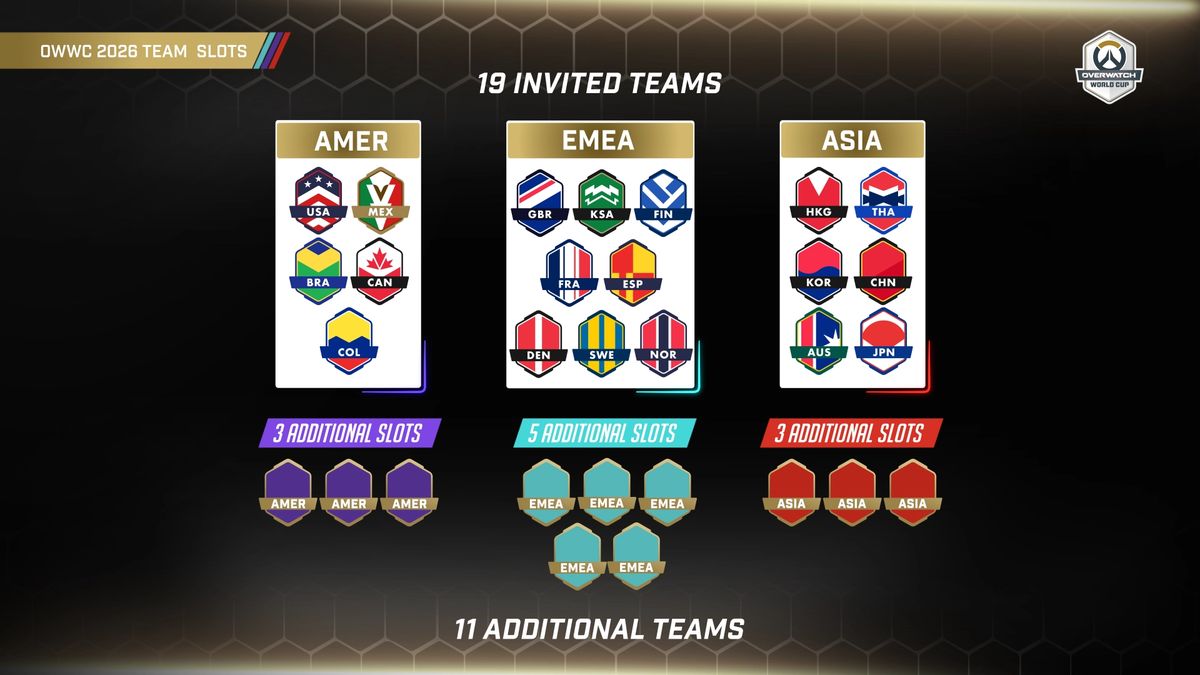
The 2026 Overwatch World Cup featured a greatly expanded field, with 52 national and regional teams vying for a place in the main event. A total of 30 teams ultimately qualified for the main tournament. This group consisted of 19 invited teams and 11 wildcard teams. The invited teams were selected based on past performance, specifically the top 16 teams from the 2023 World Cup and the three highest-performing teams from the EMEA region.
A new qualification pathway, the Conference Cups, was introduced for the 2026 event to determine the 11 wildcard spots. These online tournaments were held in March and April 2026, with three teams from the Americas, five from EMEA, and three from Asia advancing. These 11 teams joined the 19 invited teams in the Online Qualifiers.
The Online Qualifiers featured 28 teams divided into seven regional groups of four. The top two teams from each of these groups earned a spot in the Group Stage. The defending champions, Saudi Arabia, and the 2023 runners-up, China, received direct berths to the Group Stage, bringing the total number of teams at that stage to 16.
The regional groupings for the Online Qualifiers were optimized for location and connectivity. There were two groups for the Americas (AMER A and B), three groups for Europe and the Middle East (EMEA A, B, and C), and two groups for Asia-Pacific (ASIA A and B). EMEA earned an additional group and two extra qualification spots due to being the top-performing region in the 2023 tournament.
Team Selection and Committees
Each participating country was represented by a three-person competition committee, consisting of a general manager, a head coach, and a social lead. These committees were responsible for managing their national teams and all operational aspects. They were also eligible to receive an equal share of any prize money earned by their team.
Applications for committee positions opened in November 2025, with the deadline originally set for January 16, 2026, before being extended to February 6, 2026. The team selection process began in the spring of 2026, with committees assembling their national rosters ahead of the Conference Cups in March. Wildcard teams competing in the Conference Cups were required to lock in a roster for that specific tournament, with the option to update it if they advanced to the Online Qualifiers. Invited teams were required to finalize their rosters by May 2026.
The Conference Cup tournaments for wildcard teams were held on specific dates. The Americas Conference Cup ran from March 13 to 15, the EMEA Conference Cup from April 17 to 19, and the Asia Conference Cup from March 14 to 15. These tournaments were conducted online via the FACEIT platform.
Group Stage in Busan
The Group Stage was held as a LAN event at the Busan Esports Arena in Busan, South Korea, from August 20 to 23, 2026. The 16 qualified teams were seeded into four groups of four through an online show prior to the event, with draw pools based on performance in the Online Qualifiers. Each group competed in a single round-robin format, with every match played as a first-to-three series. The top two teams from each group advanced to the eight-team knockout stage at BlizzCon.
The event in Busan was complemented by Overwatch Day, a large-scale fan event organized by Nexon at BEXCO on August 22 and 23. This event was held to commemorate the launch of the PC version of Overwatch on Nexon's platform in South Korea, which began on August 12. It featured developer talks, creator matches, a cosplay contest, live art demonstrations, and interactive areas themed around the game's Busan map and MEKA unit. Members of the South Korean national team also participated in a fan meeting and cheering event during the second day of the festival.
Knockout Stage and Finals at BlizzCon
The knockout stage was an eight-team, single-elimination tournament held live at the Anaheim Convention Center in Anaheim, California, as part of BlizzCon 2026 from September 12 to 13. The finals were a centerpiece of the event, celebrating ten years of Overwatch esports with the return of the World Cup to the Anaheim Convention Center Arena.
On September 13, South Korea defeated Saudi Arabia by a score of 4-1 to win the tournament. This victory marked South Korea's fourth Overwatch World Cup title, having previously won the first three tournaments and now reclaiming the crown in 2026. Saudi Arabia, the defending champions from 2023, finished as runners-up. This result continued a pattern of dominance by a few nations, with the United States and Saudi Arabia having won the 2019 and 2023 tournaments respectively between South Korea's reigns.
The finals at BlizzCon featured several entertainment appearances, integrating the esports competition with the broader convention experience. Rapper T-Pain was announced as a special guest for the Overwatch World Cup game. Japanese musical duo Yoasobi was scheduled to perform during BlizzCon's first esports halftime show at the Overwatch World Cup Arena on September 13.
Broadcast and Coverage
The 2026 Overwatch World Cup was broadcast on Blizzard's official channels with live coverage available in multiple languages. English-language coverage was streamed on Twitch and YouTube. Japanese coverage was available on Twitch, YouTube, and the SOOP platform. Korean coverage was streamed on Naver's CHZZK and SOOP platforms, providing extensive access for fans in one of the game's most passionate regions. This multi-platform approach ensured global accessibility for the tournament's key stages.
The Game and Competitive Context
Overwatch is a 5v5, role-based hero shooter where teams composed of Tank, Damage, and Support heroes compete across various objective-based maps. With a roster of 45 heroes, success depends on teamwork, strategic adaptation, and mastery of distinct roles. The game features several competitive modes including Control, Escort, Flashpoint, Hybrid, Push, and Clash, played across 30 maps.
The Overwatch World Cup represents the peak of the game's international competitive scene, drawing from one of the most passionate and enduring esports communities. The 2026 tournament was also part of the broader Esports World Cup 2026, a multi-game festival that spanned seven weeks and featured over 2,000 players across 24 different titles. While the Overwatch World Cup operated as its own distinct championship, its scheduling within this period placed it at the heart of a summer of global esports competition.
Significance and Legacy
The 2026 tournament represented a major evolution for the Overwatch World Cup. The expansion to 52 participating teams and the introduction of the Conference Cup system opened the competition to more nations and regions than ever before, creating a more structured and accessible path to the main event. The victory by South Korea reasserted its historical dominance in the competition, while Saudi Arabia's strong performance confirmed its status as a top-tier contender following its 2023 win.
Held to commemorate a decade of Overwatch esports, the event successfully blended high-level competition with significant fan engagement, from the festivities in Busan to the spectacle at BlizzCon. The return of the World Cup finals to the Anaheim Convention Center, a historic venue for Blizzard events, provided a fitting stage for crowning a new, yet familiar, world champion. The integration of entertainment acts like T-Pain and Yoasobi highlighted the event's growth into a major presentation within the broader esports and gaming culture.
FAQ
Who won the 2026 Overwatch World Cup?
South Korea won the 2026 Overwatch World Cup, defeating Saudi Arabia 4-1 in the final on September 13. This was South Korea's fourth World Cup title, having also won the first three tournaments before reclaiming the crown in 2026.
Where was the 2026 Overwatch World Cup held?
The tournament was held in two locations. The Group Stage took place at the Busan Esports Arena in Busan, South Korea, from August 20-23. The knockout stage and finals were held at the Anaheim Convention Center in Anaheim, California, during BlizzCon from September 12-13.
How many teams competed in the 2026 Overwatch World Cup?
A total of 52 national and regional teams participated in the overall program, including the new Conference Cup qualifiers. Of these, 30 teams qualified for the main tournament: 19 invited teams and 11 wildcard teams that advanced through the Conference Cups.
What was the new Conference Cup system?
The Conference Cups were a new online qualification pathway introduced for 2026. They were open to wildcard teams and determined 11 spots in the main tournament. Three teams from the Americas, five from EMEA, and three from Asia advanced from these cups, which were held on FACEIT in March and April 2026.
What entertainment was featured at the event?
The Group Stage in Busan coincided with Overwatch Day, a fan event with developer talks and cosplay. At the BlizzCon finals, rapper T-Pain was a special guest, and Japanese duo Yoasobi performed during the first esports halftime show at the Overwatch World Cup Arena.
Source: English Wikipedia (CC BY-SA), rewritten by the Redington Cybersport desk.